

Corrigés desproblèmes
189
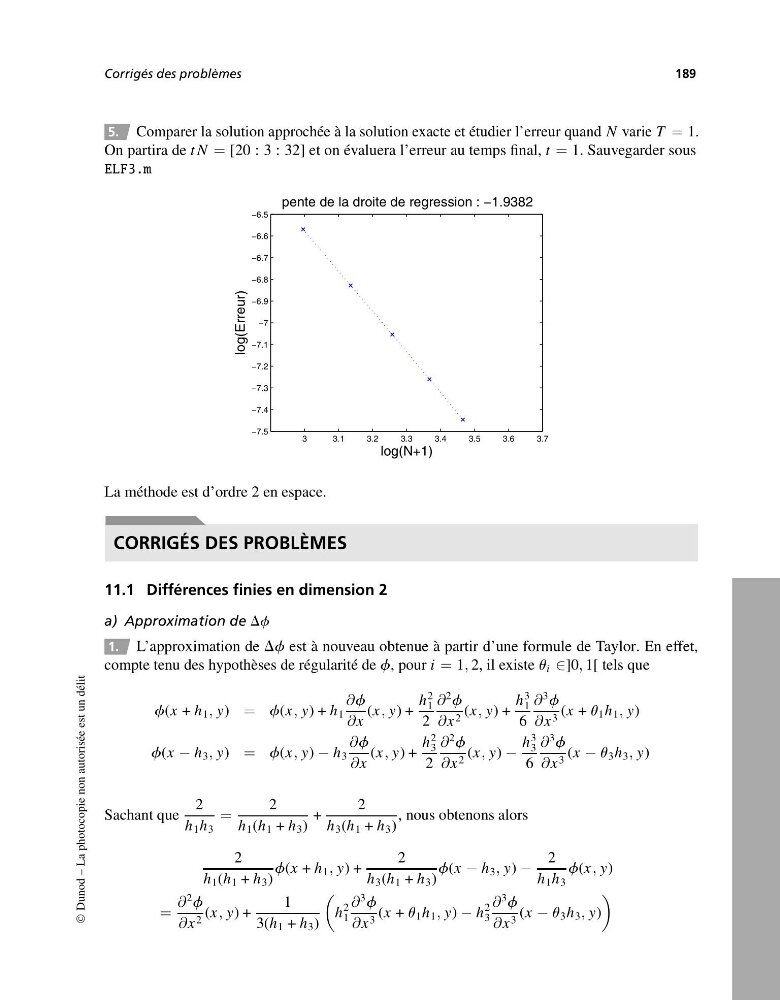
5. Comparer la solution approchée àlasolution exacte et étudier l’erreur quand N varie T = 1.
On partira de tN = [20 :3:32] et on évaluera l’erreur au temps final, t = 1. Sauvegarder sous
ELF3.m
3
3.1
3.2
3.3
3.4
3.5
3.6
3.7
−7.5
−7.4
−7.3
−7.2
−7.1
−7
−6.9
−6.8
−6.7
−6.6
−6.5
pente de la droite de regression : −1.9382
log(N+1)
log(Erreur)
La méthodeest d’ordre 2enespace.
CORRIGÉS DES PROBLÈMES
11.1D ifférences finies en dimension 2
a) Approximation de D f
1. L’approximation de D f est ànouveau obtenue àpartir d’une formule de Taylor. En effet,
compte tenu des hypothèses de régularité de f ,pour i = 1 , 2, il existe u i ∈ ]0, 1[ tels que
f ( x + h 1 , y ) = f ( x , y )+h 1
∂ f
∂ x
( x , y )+
h
2
1
2
∂
2
f
∂ x 2 ( x , y )+
h
3
1
6
∂
3
f
∂ x 3 ( x + u 1 h 1 , y )
f ( x − h 3 , y ) = f ( x , y ) − h 3
∂ f
∂ x
( x , y )+
h
2
3
2
∂
2
f
∂ x 2 ( x , y ) −
h
3
3
6
∂
3
f
∂ x 3 ( x − u 3 h 3 , y )
Sachant que
2
h 1 h 3
=
2
h 1 ( h 1 + h 3 )
+
2
h 3 ( h 1 + h 3 )
,nous obtenons alors
2
h 1 ( h 1 + h 3 )
f ( x + h 1 , y )+
2
h 3 ( h 1 + h 3 )
f ( x − h 3 , y ) −
2
h 1 h 3
f ( x , y )
=
∂
2
f
∂ x 2 ( x , y )+
1
3(h 1 + h 3 )
h
2
1
∂
3
f
∂ x 3 ( x + u 1 h 1 , y ) − h
2
3
∂
3
f
∂ x 3 ( x − u 3 h 3 , y )
Dunod –Laphotocopie non autorisée est un délit
189
5. Comparer la solution approchée àlasolution exacte et étudier l’erreur quand N varie T = 1.
On partira de tN = [20 :3:32] et on évaluera l’erreur au temps final, t = 1. Sauvegarder sous
ELF3.m
3
3.1
3.2
3.3
3.4
3.5
3.6
3.7
−7.5
−7.4
−7.3
−7.2
−7.1
−7
−6.9
−6.8
−6.7
−6.6
−6.5
pente de la droite de regression : −1.9382
log(N+1)
log(Erreur)
La méthodeest d’ordre 2enespace.
CORRIGÉS DES PROBLÈMES
11.1D ifférences finies en dimension 2
a) Approximation de D f
1. L’approximation de D f est ànouveau obtenue àpartir d’une formule de Taylor. En effet,
compte tenu des hypothèses de régularité de f ,pour i = 1 , 2, il existe u i ∈ ]0, 1[ tels que
f ( x + h 1 , y ) = f ( x , y )+h 1
∂ f
∂ x
( x , y )+
h
2
1
2
∂
2
f
∂ x 2 ( x , y )+
h
3
1
6
∂
3
f
∂ x 3 ( x + u 1 h 1 , y )
f ( x − h 3 , y ) = f ( x , y ) − h 3
∂ f
∂ x
( x , y )+
h
2
3
2
∂
2
f
∂ x 2 ( x , y ) −
h
3
3
6
∂
3
f
∂ x 3 ( x − u 3 h 3 , y )
Sachant que
2
h 1 h 3
=
2
h 1 ( h 1 + h 3 )
+
2
h 3 ( h 1 + h 3 )
,nous obtenons alors
2
h 1 ( h 1 + h 3 )
f ( x + h 1 , y )+
2
h 3 ( h 1 + h 3 )
f ( x − h 3 , y ) −
2
h 1 h 3
f ( x , y )
=
∂
2
f
∂ x 2 ( x , y )+
1
3(h 1 + h 3 )
h
2
1
∂
3
f
∂ x 3 ( x + u 1 h 1 , y ) − h
2
3
∂
3
f
∂ x 3 ( x − u 3 h 3 , y )
Dunod –Laphotocopie non autorisée est un délit