

204
Appendix C
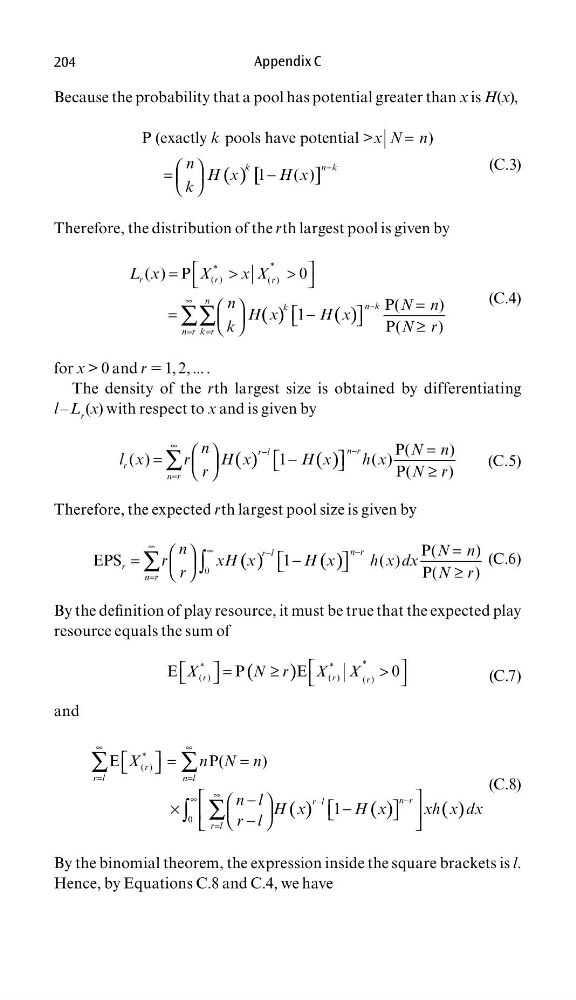
Because the probability that a pool has potential greater than x is H(x),
( ) [
]
P (exactly pools have potential >
)
1
( )
n k
k
k
x N n
n H x
H x
k
−
=
=
−
(C.3)
Therefore, the distribution of the rth largest pool is given by
( )
( )
∞
−
=
=
=
>
>
=
=
−
≥
∑∑
*
*
( )
( )
( ) P
0
P(
)
1
P(
)
r
r
r
n
n k
k
n r k r
L x
X
x X
n
N n
H x
H x
k
N r
(C.4)
for x > 0 and r 5 1, 2, ... .
The density of the rth largest size is obtained by differentiating
l – L r (x) with respect to x and is given by
( )
( )
∞
−
−
=
=
=
−
≥
∑
P(
)
( )
1
( )
P(
)
n r
r l
r
n r
n
N n
l x
r
H x
H x
h x
r
N r
(C.5)
Therefore, the expected rth largest pool size is given by
( )
( )
∞
∞
−
−
=
=
=
−
≥
∑
∫ 0
P(
)
EPS
1
( )
P(
)
n r
r l
r
n r
n
N n
r
xH x
H x
h x dx
r
N r
(C.6)
By the defi nition of play resource, it must be true that the expected play
resource equals the sum of
(
)
*
*
*
( )
( )
( )
E
P
E
0
r
r
r
X
N r
X X
=
≥
>
(C.7)
and
( )
( )
( )
∞
∞
=
=
∞
∞
−
−
=
=
=
−
×
−
−
∑
∑
∑
∫
*
( )
0
E
P (
)
1
r
r l
n l
n r
r l
r l
X
n N n
n l H x
H x
xh x dx
r l
(C.8)
By the binomial theorem, the expression inside the square brackets is l.
Hence, by Equations C.8 and C.4, we have
Appendix C
Because the probability that a pool has potential greater than x is H(x),
( ) [
]
P (exactly pools have potential >
)
1
( )
n k
k
k
x N n
n H x
H x
k
−
=
=
−
(C.3)
Therefore, the distribution of the rth largest pool is given by
( )
( )
∞
−
=
=
=
>
>
=
=
−
≥
∑∑
*
*
( )
( )
( ) P
0
P(
)
1
P(
)
r
r
r
n
n k
k
n r k r
L x
X
x X
n
N n
H x
H x
k
N r
(C.4)
for x > 0 and r 5 1, 2, ... .
The density of the rth largest size is obtained by differentiating
l – L r (x) with respect to x and is given by
( )
( )
∞
−
−
=
=
=
−
≥
∑
P(
)
( )
1
( )
P(
)
n r
r l
r
n r
n
N n
l x
r
H x
H x
h x
r
N r
(C.5)
Therefore, the expected rth largest pool size is given by
( )
( )
∞
∞
−
−
=
=
=
−
≥
∑
∫ 0
P(
)
EPS
1
( )
P(
)
n r
r l
r
n r
n
N n
r
xH x
H x
h x dx
r
N r
(C.6)
By the defi nition of play resource, it must be true that the expected play
resource equals the sum of
(
)
*
*
*
( )
( )
( )
E
P
E
0
r
r
r
X
N r
X X
=
≥
>
(C.7)
and
( )
( )
( )
∞
∞
=
=
∞
∞
−
−
=
=
=
−
×
−
−
∑
∑
∑
∫
*
( )
0
E
P (
)
1
r
r l
n l
n r
r l
r l
X
n N n
n l H x
H x
xh x dx
r l
(C.8)
By the binomial theorem, the expression inside the square brackets is l.
Hence, by Equations C.8 and C.4, we have