

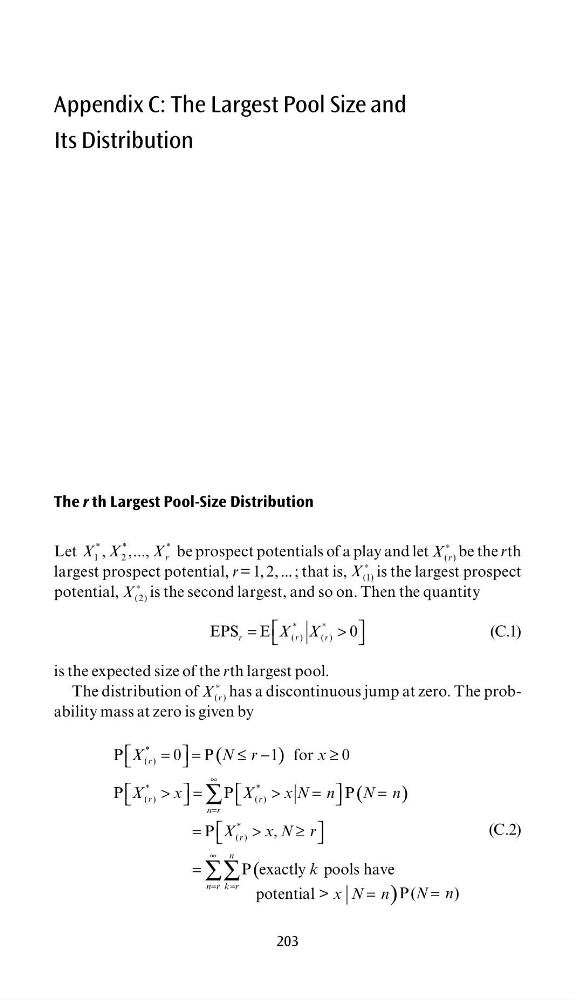
203
Appendix C: The Largest Pool Size and
Its Distribution
The r th Largest Pool-Size Distribution
Let
*
*
*
1
2
, ,..., r
X X
X be prospect potentials of a play and let ( )
r
X
∗ be the rth
largest prospect potential, r = 1, 2, ... ; that is, (1)
X
∗ is the largest prospect
potential, (2)
X
∗ is the second largest, and so on. Then the quantity
=
>
*
*
( )
( )
EPS E
0
r
r
r
X X
(C.1)
is the expected size of the rth largest pool.
The distribution of ( )
r
X
∗ has a discontinuous jump at zero. The probability mass at zero is given by
(
)
(
)
(
)
∞
=
∞
=
=
= =
≤ −
≥
> =
>
=
=
=
>
≥
=
=
=
∑
∑∑
*
( )
*
*
( )
( )
*
( )
P
0 P
1 f o r
0
P
P
P
P
,
P exactly pools have
P(
)
potential >
r
r
r
n r
r
n
n r k r
X
N r
x
X
x
X
xN n
N n
X
x N r
k
N n
x N n
(C.2)
Appendix C: The Largest Pool Size and
Its Distribution
The r th Largest Pool-Size Distribution
Let
*
*
*
1
2
, ,..., r
X X
X be prospect potentials of a play and let ( )
r
X
∗ be the rth
largest prospect potential, r = 1, 2, ... ; that is, (1)
X
∗ is the largest prospect
potential, (2)
X
∗ is the second largest, and so on. Then the quantity
=
>
*
*
( )
( )
EPS E
0
r
r
r
X X
(C.1)
is the expected size of the rth largest pool.
The distribution of ( )
r
X
∗ has a discontinuous jump at zero. The probability mass at zero is given by
(
)
(
)
(
)
∞
=
∞
=
=
= =
≤ −
≥
> =
>
=
=
=
>
≥
=
=
=
∑
∑∑
*
( )
*
*
( )
( )
*
( )
P
0 P
1 f o r
0
P
P
P
P
,
P exactly pools have
P(
)
potential >
r
r
r
n r
r
n
n r k r
X
N r
x
X
x
X
xN n
N n
X
x N r
k
N n
x N n
(C.2)