

Other Assessment Methods—An Overview
169
The Creaming Method
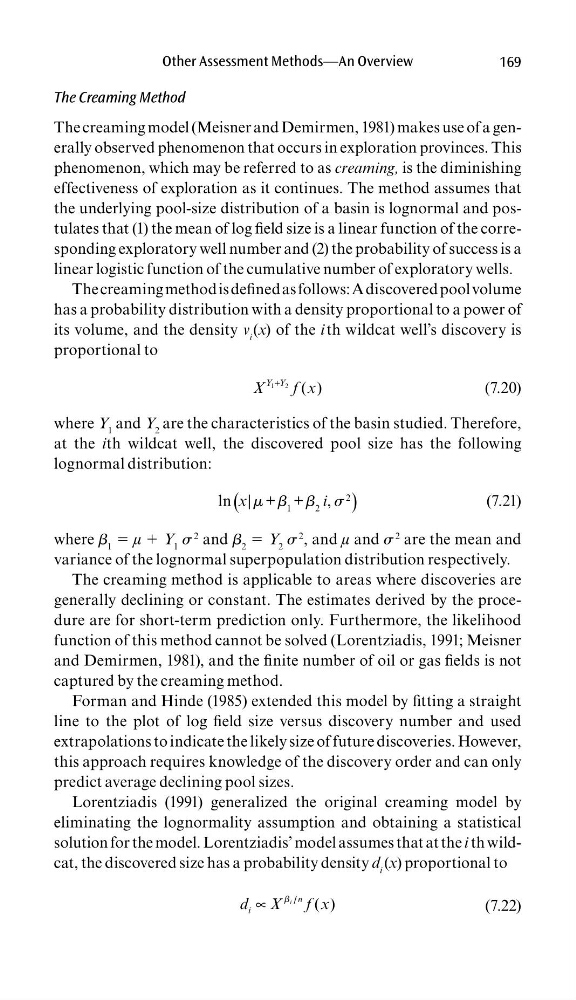
The creaming model (Meisner and Demirmen, 1981) makes use of a generally observed phenomenon that occurs in exploration provinces. This
phenomenon, which may be referred to as creaming, is the diminishing
effectiveness of exploration as it continues. The method assumes that
the underlying pool-size distribution of a basin is lognormal and postulates that (1) the mean of log fi eld size is a linear function of the corresponding exploratory well number and (2) the probability of success is a
linear logistic function of the cumulative number of exploratory wells.
The creaming method is defi ned as follows: A discovered pool volume
has a probability distribution with a density proportional to a power of
its volume, and the density v i (x) of the i th wildcat well’s discovery is
proportional to
1
2
( )
Y Y
X
f x
+
(7.20)
where Y 1 and Y 2 are the characteristics of the basin studied. Therefore,
at the ith wildcat well, the discovered pool size has the following
lognormal distribution:
ln ( x| m + b 1 + b 2 i, s
2
)
(7.21)
where b 1 = µ + Y 1 s
2 and b 2 = Y 2 s
2 , and µ and s
2 are the mean and
variance of the lognormal superpopulation distribution respectively.
The creaming method is applicable to areas where discoveries are
generally declining or constant. The estimates derived by the procedure are for short-term prediction only. Furthermore, the likelihood
function of this method cannot be solved (Lorentziadis, 1991; Meisner
and Demirmen, 1981), and the fi nite number of oil or gas fi elds is not
captured by the creaming method.
Forman and Hinde (1985) extended this model by fi tting a straight
line to the plot of log fi eld size versus discovery number and used
extrapolations to indicate the likely size of future discoveries. However,
this approach requires knowledge of the discovery order and can only
predict average declining pool sizes.
Lorentziadis (1991) generalized the original creaming model by
eliminating the lognormality assumption and obtaining a statistical
solution for the model. Lorentziadis’ model assumes that at the i th wildcat, the discovered size has a probability density d i (x) proportional to
/
( )
i n
i
d X
f x
∝
b
(7.22)
169
The Creaming Method
The creaming model (Meisner and Demirmen, 1981) makes use of a generally observed phenomenon that occurs in exploration provinces. This
phenomenon, which may be referred to as creaming, is the diminishing
effectiveness of exploration as it continues. The method assumes that
the underlying pool-size distribution of a basin is lognormal and postulates that (1) the mean of log fi eld size is a linear function of the corresponding exploratory well number and (2) the probability of success is a
linear logistic function of the cumulative number of exploratory wells.
The creaming method is defi ned as follows: A discovered pool volume
has a probability distribution with a density proportional to a power of
its volume, and the density v i (x) of the i th wildcat well’s discovery is
proportional to
1
2
( )
Y Y
X
f x
+
(7.20)
where Y 1 and Y 2 are the characteristics of the basin studied. Therefore,
at the ith wildcat well, the discovered pool size has the following
lognormal distribution:
ln ( x| m + b 1 + b 2 i, s
2
)
(7.21)
where b 1 = µ + Y 1 s
2 and b 2 = Y 2 s
2 , and µ and s
2 are the mean and
variance of the lognormal superpopulation distribution respectively.
The creaming method is applicable to areas where discoveries are
generally declining or constant. The estimates derived by the procedure are for short-term prediction only. Furthermore, the likelihood
function of this method cannot be solved (Lorentziadis, 1991; Meisner
and Demirmen, 1981), and the fi nite number of oil or gas fi elds is not
captured by the creaming method.
Forman and Hinde (1985) extended this model by fi tting a straight
line to the plot of log fi eld size versus discovery number and used
extrapolations to indicate the likely size of future discoveries. However,
this approach requires knowledge of the discovery order and can only
predict average declining pool sizes.
Lorentziadis (1991) generalized the original creaming model by
eliminating the lognormality assumption and obtaining a statistical
solution for the model. Lorentziadis’ model assumes that at the i th wildcat, the discovered size has a probability density d i (x) proportional to
/
( )
i n
i
d X
f x
∝
b
(7.22)