

170
Statistical Methods for Estimating Petroleum Resources
where f (x) is the superpopulation pool-size distribution of the population. Unlike the creaming method, the generalized model is solvable
because the method does not require the parameter b 1 , without which
there is no loss of information. It is semiparametric in the sense that the
superpopulation pool-size distribution consists of a parametric component and a nonparametric component.
Take, as an example, the Swan Hills–Kaybob South play of the
Western Canada Sedimentary Basin (Reinson et al., 1993). Lorentziadis
(1991) eliminated the fi rst 41 failed wildcats and used the next 306 wildcats with 12 discoveries to predict the discoveries for the following 40
wildcats. The results of the lognormal and semiparametric approaches
ranged from 117 × 10
6 m
3 (median) to 4608 × 10
6 m
3 (upper quartile) and
116 × 10
6 m
3 (median) to 1741 × 10
6 m
3 (upper quartile) respectively. The
actual discovery is 473 × 10
6 m
3 of in-place gas volume.
The Long Method
Long (1988) considered Kaufman’s discovery process model as well as
the effects of economic truncation and incomplete reporting of small
pools. Assigning an economic truncation value to any given play is a
diffi cult task, because whether a pool size is economic also depends on
its size as well as its location.
Long claims that his method can account for size-biased data.
Unfortunately, the Long method cannot estimate exploration effi -
ciency. However, he suggests that the empirical relationship obtained by
Forman and Hinde (1985) can be adopted here to estimate the value.
Before one can establish a fully satisfactory model that accounts for
the truncation problem, one should incorporate all possible “pools”
into the discovery sequence. The Long method was applied to the
Bashaw data set and estimated that the Bashaw play contained 46 pools
(Long, 1988, p. 119) instead of the 80 predicted by Lee and Wang (1985).
By 1994, the Bashaw play discoveries numbered 75.
The Regression Method
If a basin or play has a long history of exploration and has a long time
range and aggregated reserve data, then a regression method can be
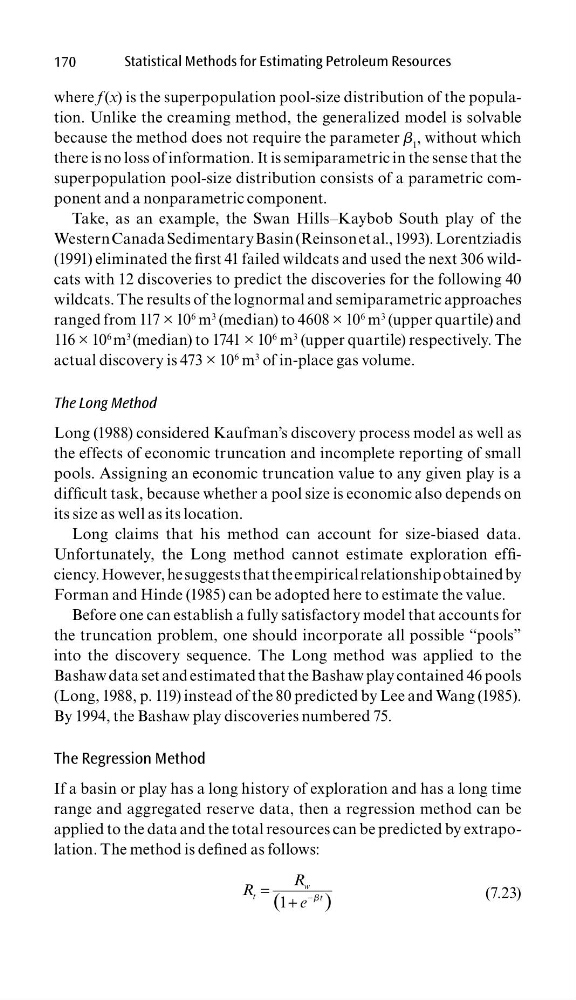
applied to the data and the total resources can be predicted by extrapolation. The method is defi ned as follows:
1
(
)
w
t
t
R
R
e
−
= +
b
(7.23)
Statistical Methods for Estimating Petroleum Resources
where f (x) is the superpopulation pool-size distribution of the population. Unlike the creaming method, the generalized model is solvable
because the method does not require the parameter b 1 , without which
there is no loss of information. It is semiparametric in the sense that the
superpopulation pool-size distribution consists of a parametric component and a nonparametric component.
Take, as an example, the Swan Hills–Kaybob South play of the
Western Canada Sedimentary Basin (Reinson et al., 1993). Lorentziadis
(1991) eliminated the fi rst 41 failed wildcats and used the next 306 wildcats with 12 discoveries to predict the discoveries for the following 40
wildcats. The results of the lognormal and semiparametric approaches
ranged from 117 × 10
6 m
3 (median) to 4608 × 10
6 m
3 (upper quartile) and
116 × 10
6 m
3 (median) to 1741 × 10
6 m
3 (upper quartile) respectively. The
actual discovery is 473 × 10
6 m
3 of in-place gas volume.
The Long Method
Long (1988) considered Kaufman’s discovery process model as well as
the effects of economic truncation and incomplete reporting of small
pools. Assigning an economic truncation value to any given play is a
diffi cult task, because whether a pool size is economic also depends on
its size as well as its location.
Long claims that his method can account for size-biased data.
Unfortunately, the Long method cannot estimate exploration effi -
ciency. However, he suggests that the empirical relationship obtained by
Forman and Hinde (1985) can be adopted here to estimate the value.
Before one can establish a fully satisfactory model that accounts for
the truncation problem, one should incorporate all possible “pools”
into the discovery sequence. The Long method was applied to the
Bashaw data set and estimated that the Bashaw play contained 46 pools
(Long, 1988, p. 119) instead of the 80 predicted by Lee and Wang (1985).
By 1994, the Bashaw play discoveries numbered 75.
The Regression Method
If a basin or play has a long history of exploration and has a long time
range and aggregated reserve data, then a regression method can be
applied to the data and the total resources can be predicted by extrapolation. The method is defi ned as follows:
1
(
)
w
t
t
R
R
e
−
= +
b
(7.23)