

Other Assessment Methods—An Overview
165
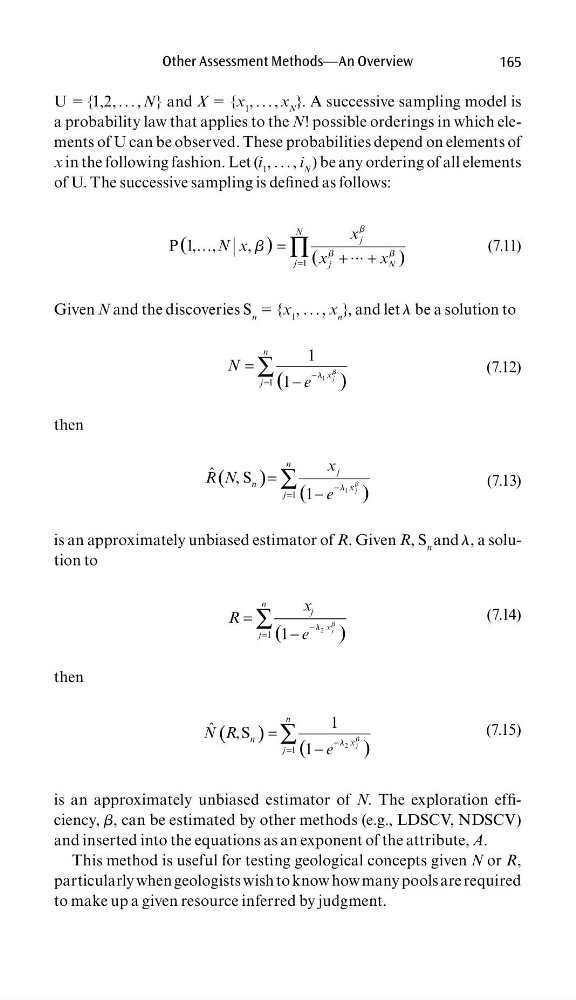
U = {1,2, . . . , N} and X = {x 1 , . . . , x N }. A successive sampling model is
a probability law that applies to the N! possible orderings in which elements of U can be observed. These probabilities depend on elements of
x in the following fashion. Let (i 1 , . . . , i N ) be any ordering of all elements
of U. The successive sampling is defi ned as follows:
1
P 1, ,
,
···
(
)
(
)
N
j
j
j
N
x
N x
x
x
=
…
=
+ +
∏
b
b
b
b
(7.11)
Given N and the discoveries S n = {x 1 , . . . , x n }, and let l be a solution to
1
1
1
1
)
(
j
n
x
j
N
e
−
=
=
−
∑
b
l
(7.12)
then
(
)
−
=
=
−
∑
1
1
ˆ , S
1
(
)
j
n
j
n
x
j
x
R N
e
b
l
(7.13)
is an approximately unbiased estimator of R. Given R, S n and l, a solution to
2
1 1
(
)
j
n
j
x
j
x
R
e
−
=
=
−
∑
b
l
(7.14)
then
(
)
2
1
1
ˆ ,S
1
(
)
j
n
n
x
j
N R
e
−
=
=
−
∑
b
l
(7.15)
is an approximately unbiased estimator of N. The exploration effi -
ciency, b, can be estimated by other methods (e.g., LDSCV, NDSCV)
and inserted into the equations as an exponent of the attribute, A.
This method is useful for testing geological concepts given N or R,
particularly when geologists wish to know how many pools are required
to make up a given resource inferred by judgment.
165
U = {1,2, . . . , N} and X = {x 1 , . . . , x N }. A successive sampling model is
a probability law that applies to the N! possible orderings in which elements of U can be observed. These probabilities depend on elements of
x in the following fashion. Let (i 1 , . . . , i N ) be any ordering of all elements
of U. The successive sampling is defi ned as follows:
1
P 1, ,
,
···
(
)
(
)
N
j
j
j
N
x
N x
x
x
=
…
=
+ +
∏
b
b
b
b
(7.11)
Given N and the discoveries S n = {x 1 , . . . , x n }, and let l be a solution to
1
1
1
1
)
(
j
n
x
j
N
e
−
=
=
−
∑
b
l
(7.12)
then
(
)
−
=
=
−
∑
1
1
ˆ , S
1
(
)
j
n
j
n
x
j
x
R N
e
b
l
(7.13)
is an approximately unbiased estimator of R. Given R, S n and l, a solution to
2
1 1
(
)
j
n
j
x
j
x
R
e
−
=
=
−
∑
b
l
(7.14)
then
(
)
2
1
1
ˆ ,S
1
(
)
j
n
n
x
j
N R
e
−
=
=
−
∑
b
l
(7.15)
is an approximately unbiased estimator of N. The exploration effi -
ciency, b, can be estimated by other methods (e.g., LDSCV, NDSCV)
and inserted into the equations as an exponent of the attribute, A.
This method is useful for testing geological concepts given N or R,
particularly when geologists wish to know how many pools are required
to make up a given resource inferred by judgment.