

166
Statistical Methods for Estimating Petroleum Resources
Chen and Sinding–Larsen’s Geo-Anchored Method
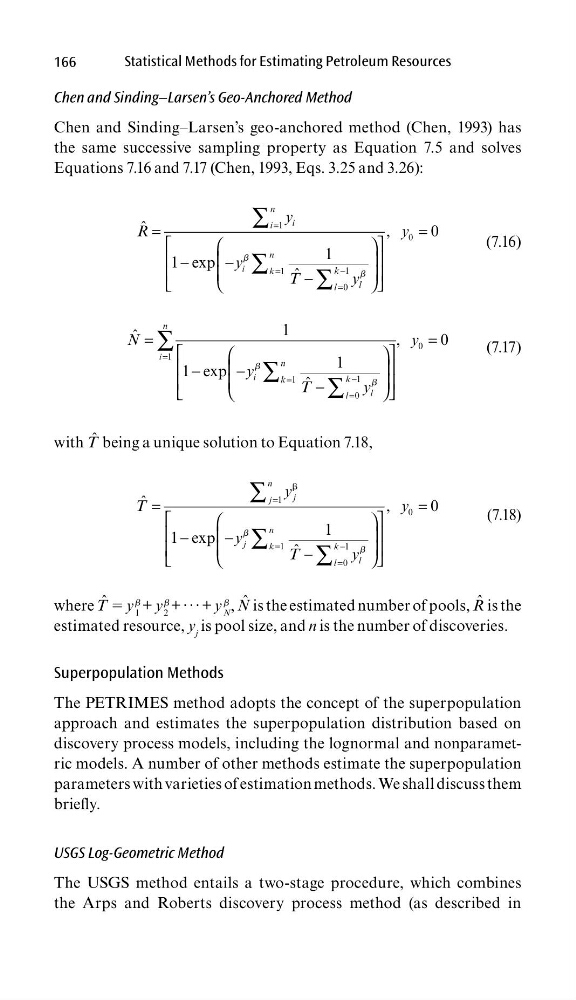
Chen and Sinding–Larsen’s geo-anchored method (Chen, 1993) has
the same successive sampling property as Equation 7.5 and solves
Equations 7.16 and 7.17 (Chen, 1993, Eqs. 3.25 and 3.26):
1
0
1
1
0
ˆ
,
0
1
1 exp
ˆ
n
i
i
n
i
k
k
l
l
y
R
y
y
T
y
=
−
=
=
=
=
−
−
−
∑
∑
∑
b
b
(7.16)
0
1
1
1
0
1
ˆ
,
0
1
1 exp
ˆ
n
i
n
i
k
k
l
l
N
y
y
T
y
=
−
=
=
=
=
−
−
−
∑
∑
∑
b
b
(7.17)
with T ˆ being a unique solution to Equation 7.18,
1
0
1
1
0
ˆ
,
0
1
1 exp
ˆ
n
j
j
n
j
k
k
l
l
y
T
y
y
T
y
b
=
=
−
=
=
=
−
−
−
∑
∑
∑
b
b
(7.18)
where T ˆ = y
b
1
+ y
b
2
+ · · · + y
b
N
, N ˆ is the estimated number of pools, R ˆ is the
estimated resource, y j is pool size, and n is the number of discoveries.
Superpopulation Methods
The PETRIMES method adopts the concept of the superpopulation
approach and estimates the superpopulation distribution based on
discovery process models, including the lognormal and nonparametric models. A number of other methods estimate the superpopulation
parameters with varieties of estimation methods. We shall discuss them
briefl y.
USGS Log-Geometric Method
The USGS method entails a two-stage procedure, which combines
the Arps and Roberts discovery process method (as described in
Statistical Methods for Estimating Petroleum Resources
Chen and Sinding–Larsen’s Geo-Anchored Method
Chen and Sinding–Larsen’s geo-anchored method (Chen, 1993) has
the same successive sampling property as Equation 7.5 and solves
Equations 7.16 and 7.17 (Chen, 1993, Eqs. 3.25 and 3.26):
1
0
1
1
0
ˆ
,
0
1
1 exp
ˆ
n
i
i
n
i
k
k
l
l
y
R
y
y
T
y
=
−
=
=
=
=
−
−
−
∑
∑
∑
b
b
(7.16)
0
1
1
1
0
1
ˆ
,
0
1
1 exp
ˆ
n
i
n
i
k
k
l
l
N
y
y
T
y
=
−
=
=
=
=
−
−
−
∑
∑
∑
b
b
(7.17)
with T ˆ being a unique solution to Equation 7.18,
1
0
1
1
0
ˆ
,
0
1
1 exp
ˆ
n
j
j
n
j
k
k
l
l
y
T
y
y
T
y
b
=
=
−
=
=
=
−
−
−
∑
∑
∑
b
b
(7.18)
where T ˆ = y
b
1
+ y
b
2
+ · · · + y
b
N
, N ˆ is the estimated number of pools, R ˆ is the
estimated resource, y j is pool size, and n is the number of discoveries.
Superpopulation Methods
The PETRIMES method adopts the concept of the superpopulation
approach and estimates the superpopulation distribution based on
discovery process models, including the lognormal and nonparametric models. A number of other methods estimate the superpopulation
parameters with varieties of estimation methods. We shall discuss them
briefl y.
USGS Log-Geometric Method
The USGS method entails a two-stage procedure, which combines
the Arps and Roberts discovery process method (as described in