

164
Statistical Methods for Estimating Petroleum Resources
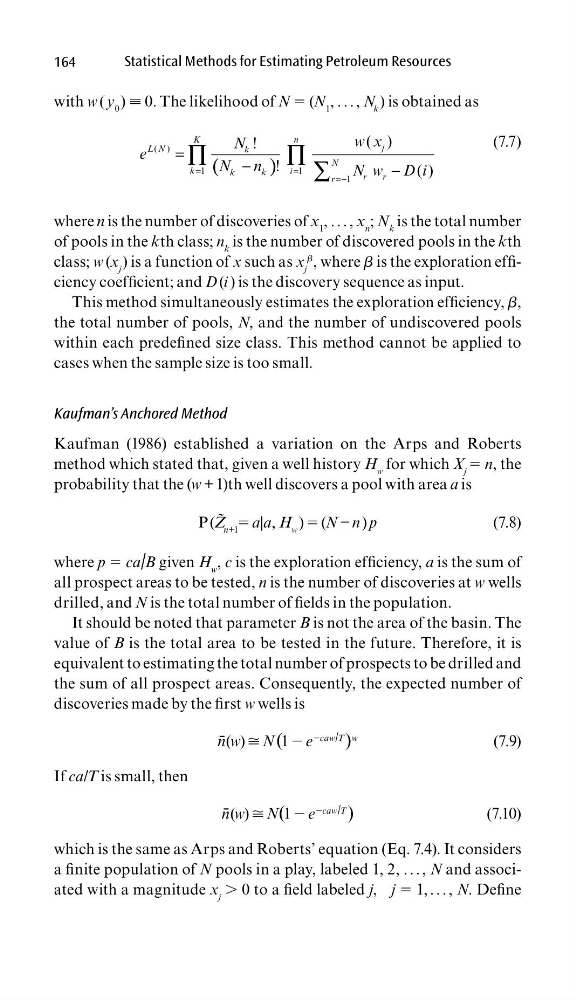
with w ( y 0 ) ≡ 0. The likelihood of N = (N 1 , . . . , N k ) is obtained as
(
)
=
=
=−
=
−
−
∏
∏ ∑
( )
1
1
1
( )
!
!
( )
K
n
j
L N
k
N
k
i
k
k
r
r
r
w x
N
e
N n
N w D i
(7.7)
where n is the number of discoveries of x 1 , . . . , x n ; N k is the total number
of pools in the kth class; n k is the number of discovered pools in the kth
class; w (x j ) is a function of x such as x j
b , where b is the exploration effi -
ciency coeffi cient; and D (i ) is the discovery sequence as input.
This method simultaneously estimates the exploration effi ciency, b,
the total number of pools, N, and the number of undiscovered pools
within each predefi ned size class. This method cannot be applied to
cases when the sample size is too small.
Kaufman’s Anchored Method
Kaufman (1986) established a variation on the Arps and Roberts
method which stated that, given a well history H w for which X j = n, the
probability that the (w + 1)th well discovers a pool with area a is
P (Z ˜
n+1
= a|a, H w ) = (N − n ) p
(7.8)
where p = ca / B given H w , c is the exploration effi ciency, a is the sum of
all prospect areas to be tested, n is the number of discoveries at w wells
drilled, and N is the total number of fi elds in the population.
It should be noted that parameter B is not the area of the basin. The
value of B is the total area to be tested in the future. Therefore, it is
equivalent to estimating the total number of prospects to be drilled and
the sum of all prospect areas. Consequently, the expected number of
discoveries made by the fi rst w wells is
n ˉ(w) ≅ N (1 − e
−caw/T
)
w
(7.9)
If ca/T is small, then
n ˉ(w) ≅ N(1 − e
−caw/T
)
(7.10)
which is the same as Arps and Roberts’ equation (Eq. 7.4). It considers
a fi nite population of N pools in a play, labeled 1, 2, . . . , N and associated with a magnitude x j > 0 to a fi eld labeled j, j = 1, . . . , N. Defi ne
Statistical Methods for Estimating Petroleum Resources
with w ( y 0 ) ≡ 0. The likelihood of N = (N 1 , . . . , N k ) is obtained as
(
)
=
=
=−
=
−
−
∏
∏ ∑
( )
1
1
1
( )
!
!
( )
K
n
j
L N
k
N
k
i
k
k
r
r
r
w x
N
e
N n
N w D i
(7.7)
where n is the number of discoveries of x 1 , . . . , x n ; N k is the total number
of pools in the kth class; n k is the number of discovered pools in the kth
class; w (x j ) is a function of x such as x j
b , where b is the exploration effi -
ciency coeffi cient; and D (i ) is the discovery sequence as input.
This method simultaneously estimates the exploration effi ciency, b,
the total number of pools, N, and the number of undiscovered pools
within each predefi ned size class. This method cannot be applied to
cases when the sample size is too small.
Kaufman’s Anchored Method
Kaufman (1986) established a variation on the Arps and Roberts
method which stated that, given a well history H w for which X j = n, the
probability that the (w + 1)th well discovers a pool with area a is
P (Z ˜
n+1
= a|a, H w ) = (N − n ) p
(7.8)
where p = ca / B given H w , c is the exploration effi ciency, a is the sum of
all prospect areas to be tested, n is the number of discoveries at w wells
drilled, and N is the total number of fi elds in the population.
It should be noted that parameter B is not the area of the basin. The
value of B is the total area to be tested in the future. Therefore, it is
equivalent to estimating the total number of prospects to be drilled and
the sum of all prospect areas. Consequently, the expected number of
discoveries made by the fi rst w wells is
n ˉ(w) ≅ N (1 − e
−caw/T
)
w
(7.9)
If ca/T is small, then
n ˉ(w) ≅ N(1 − e
−caw/T
)
(7.10)
which is the same as Arps and Roberts’ equation (Eq. 7.4). It considers
a fi nite population of N pools in a play, labeled 1, 2, . . . , N and associated with a magnitude x j > 0 to a fi eld labeled j, j = 1, . . . , N. Defi ne