

132
Statistical Methods for Estimating Petroleum Resources
where F n (t) = P[X 1 + X 2 + · · · + X n > t ].
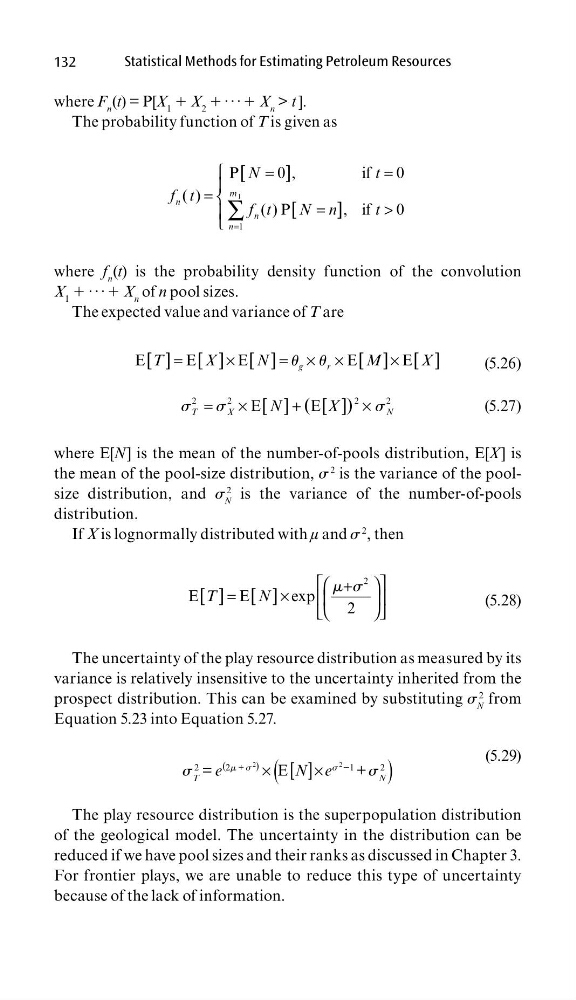
The probability function of T is given as
=
=
=
=
=
>
∑
1
1
P
0 ,
if
0
( )
( ) P
, if
0
[
]
[
]
m
n
n
n
N
t
f t
f t
N n
t
where f n (t) is the probability density function of the convolution
X 1 + · · · + X n of n pool sizes.
The expected value and variance of T are
E
E
E
E
E
[ ] [ ] [ ]
[ ] [ ]
g
r
T
X
N
M
X
=
×
= × ×
×
u u
(5.26)
=
×
+
×
2
2
2
2
E
E
[ ] ( [ ])
T
X
N
N
X
s
s
s
(5.27)
where E[N] is the mean of the number-of-pools distribution, E[X] is
the mean of the pool-size distribution, s
2 is the variance of the poolsize distribution, and s
2
N
is the variance of the number-of-pools
distribution.
If X is lognormally distributed with μ and s
2 , then
2
E
E
exp
2
[ ] [ ]
T
N
+
=
×
m s
(5.28)
The uncertainty of the play resource distribution as measured by its
variance is relatively insensitive to the uncertainty inherited from the
prospect distribution. This can be examined by substituting s
2
N
from
Equation 5.23 into Equation 5.27.
s
2
T
= e
(2m + s
2 )
× ( E [N] × e
s
2 21 + s
2
N )
(5.29)
The play resource distribution is the superpopulation distribution
of the geological model. The uncertainty in the distribution can be
reduced if we have pool sizes and their ranks as discussed in Chapter 3.
For frontier plays, we are unable to reduce this type of uncertainty
because of the lack of information.
Statistical Methods for Estimating Petroleum Resources
where F n (t) = P[X 1 + X 2 + · · · + X n > t ].
The probability function of T is given as
=
=
=
=
=
>
∑
1
1
P
0 ,
if
0
( )
( ) P
, if
0
[
]
[
]
m
n
n
n
N
t
f t
f t
N n
t
where f n (t) is the probability density function of the convolution
X 1 + · · · + X n of n pool sizes.
The expected value and variance of T are
E
E
E
E
E
[ ] [ ] [ ]
[ ] [ ]
g
r
T
X
N
M
X
=
×
= × ×
×
u u
(5.26)
=
×
+
×
2
2
2
2
E
E
[ ] ( [ ])
T
X
N
N
X
s
s
s
(5.27)
where E[N] is the mean of the number-of-pools distribution, E[X] is
the mean of the pool-size distribution, s
2 is the variance of the poolsize distribution, and s
2
N
is the variance of the number-of-pools
distribution.
If X is lognormally distributed with μ and s
2 , then
2
E
E
exp
2
[ ] [ ]
T
N
+
=
×
m s
(5.28)
The uncertainty of the play resource distribution as measured by its
variance is relatively insensitive to the uncertainty inherited from the
prospect distribution. This can be examined by substituting s
2
N
from
Equation 5.23 into Equation 5.27.
s
2
T
= e
(2m + s
2 )
× ( E [N] × e
s
2 21 + s
2
N )
(5.29)
The play resource distribution is the superpopulation distribution
of the geological model. The uncertainty in the distribution can be
reduced if we have pool sizes and their ranks as discussed in Chapter 3.
For frontier plays, we are unable to reduce this type of uncertainty
because of the lack of information.