

Evaluating Conceptual Plays
127
Estimating Resources
Number-of-Prospects Distribution
If an identifi able type of trap, such as an anticline, can be mapped on
the surface of a play or detected seismically at depth, then the number
of prospects can be counted. Some of the prospects cannot be mapped
on the surface because of the presence of vegetation. They also might
not be detected at depth because seismic coverage might be too sparse
to detect small prospects. Three questions might arise at this point:
What is the maximum number of prospects that the play could
1.
have?
Given a 50% chance, what is the least number of prospects that
2.
the play could have?
What is the observed number of prospects?
3.
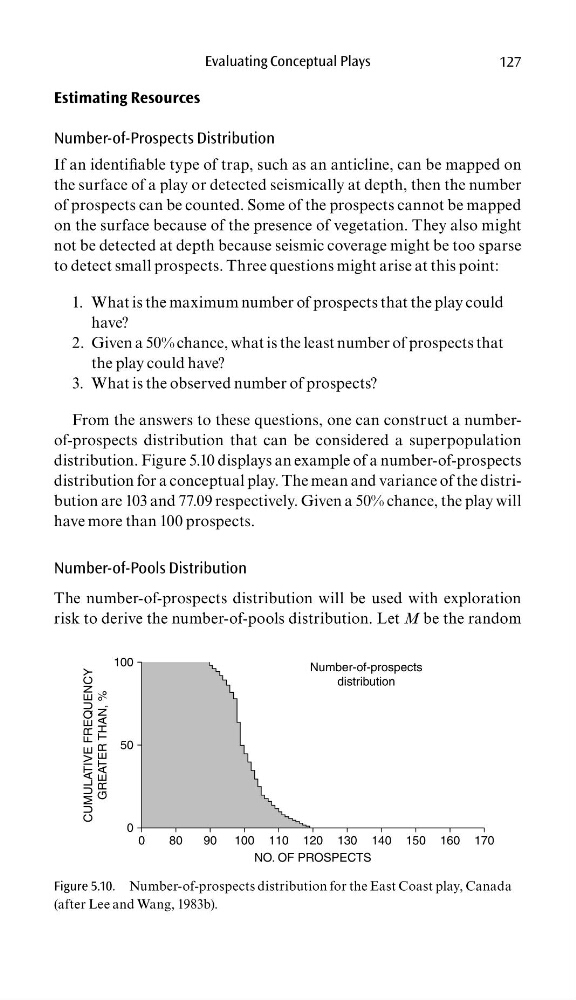
From the answers to these questions, one can construct a numberof-prospects distribution that can be considered a superpopulation
distribution. Figure 5.10 displays an example of a number-of-prospects
distribution for a conceptual play. The mean and variance of the distribution are 103 and 77.09 respectively. Given a 50% chance, the play will
have more than 100 prospects.
Number-of-Pools Distribution
The number-of-prospects distribution will be used with exploration
risk to derive the number-of-pools distribution. Let M be the random
0
0
50
100
80
90 100 110 120 130
NO. OF PROSPECTS
Number-of-prospects
distribution
CUMULATIVE FREQUENCY
GREATER THAN, %
140 150 160 170
Figure 5.10. Number-of-prospects distribution for the East Coast play, Canada
(after Lee and Wang, 1983b).
127
Estimating Resources
Number-of-Prospects Distribution
If an identifi able type of trap, such as an anticline, can be mapped on
the surface of a play or detected seismically at depth, then the number
of prospects can be counted. Some of the prospects cannot be mapped
on the surface because of the presence of vegetation. They also might
not be detected at depth because seismic coverage might be too sparse
to detect small prospects. Three questions might arise at this point:
What is the maximum number of prospects that the play could
1.
have?
Given a 50% chance, what is the least number of prospects that
2.
the play could have?
What is the observed number of prospects?
3.
From the answers to these questions, one can construct a numberof-prospects distribution that can be considered a superpopulation
distribution. Figure 5.10 displays an example of a number-of-prospects
distribution for a conceptual play. The mean and variance of the distribution are 103 and 77.09 respectively. Given a 50% chance, the play will
have more than 100 prospects.
Number-of-Pools Distribution
The number-of-prospects distribution will be used with exploration
risk to derive the number-of-pools distribution. Let M be the random
0
0
50
100
80
90 100 110 120 130
NO. OF PROSPECTS
Number-of-prospects
distribution
CUMULATIVE FREQUENCY
GREATER THAN, %
140 150 160 170
Figure 5.10. Number-of-prospects distribution for the East Coast play, Canada
(after Lee and Wang, 1983b).