

128
Statistical Methods for Estimating Petroleum Resources
variable denoting the total number of prospects in a play and m be a
value of M. Let its probability function be
P [m] = P [M = m], m = m 0 , . . . , m i
This distribution could be obtained from seismic detection and expert
knowledge of the play. Associated with the ith prospect, we defi ne
=
1, if the th prospect satisfies the condition
0, otherwise
i
R
I
Given that event G has occurred (i.e., the play has all the conditions
necessary for hydrocarbon occurrence), the total number of pools in
the play is given as
N = I 1 + I 2 + · · · + I m
N is a sum of random variables; therefore, its conditional probability
distribution, given G, is
P [N = n |G ]
= S m
P [N = n, M = m |G ]
= S m
P [N = n |M = m, G ] × P [M = m ]
(5.17)
= S m
P [I 1 + I 2 + · · · + I m = n |M = m, G ] × P [ m ]
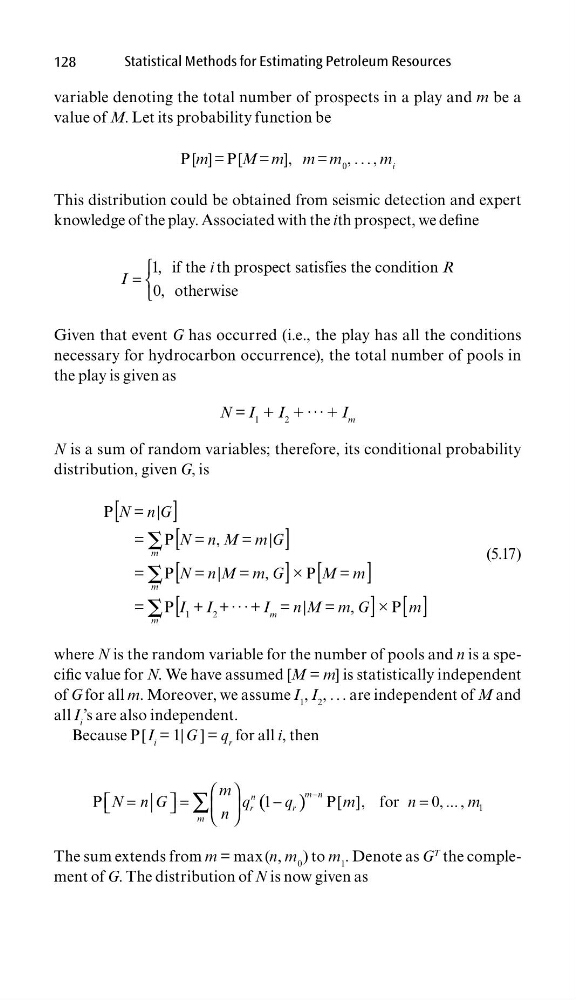
where N is the random variable for the number of pools and n is a specifi c value for N. We have assumed [M = m] is statistically independent
of G for all m. Moreover, we assume I 1 , I 2 , . . . are independent of M and
all I i ’s are also independent.
Because P [ I i = 1 | G ] = q r for all i, then
(
)
1
P
1
P [ ], for
0, ... ,
m n
n
r
r
m
m
N n G
q
q
m
n
m
n
−
=
=
−
=
∑
The sum extends from m = max (n, m 0 ) to m 1 . Denote as G
T the complement of G. The distribution of N is now given as
Statistical Methods for Estimating Petroleum Resources
variable denoting the total number of prospects in a play and m be a
value of M. Let its probability function be
P [m] = P [M = m], m = m 0 , . . . , m i
This distribution could be obtained from seismic detection and expert
knowledge of the play. Associated with the ith prospect, we defi ne
=
1, if the th prospect satisfies the condition
0, otherwise
i
R
I
Given that event G has occurred (i.e., the play has all the conditions
necessary for hydrocarbon occurrence), the total number of pools in
the play is given as
N = I 1 + I 2 + · · · + I m
N is a sum of random variables; therefore, its conditional probability
distribution, given G, is
P [N = n |G ]
= S m
P [N = n, M = m |G ]
= S m
P [N = n |M = m, G ] × P [M = m ]
(5.17)
= S m
P [I 1 + I 2 + · · · + I m = n |M = m, G ] × P [ m ]
where N is the random variable for the number of pools and n is a specifi c value for N. We have assumed [M = m] is statistically independent
of G for all m. Moreover, we assume I 1 , I 2 , . . . are independent of M and
all I i ’s are also independent.
Because P [ I i = 1 | G ] = q r for all i, then
(
)
1
P
1
P [ ], for
0, ... ,
m n
n
r
r
m
m
N n G
q
q
m
n
m
n
−
=
=
−
=
∑
The sum extends from m = max (n, m 0 ) to m 1 . Denote as G
T the complement of G. The distribution of N is now given as