

COVID-19 Impacts on Climate Change—Sustainable Technologies …
25
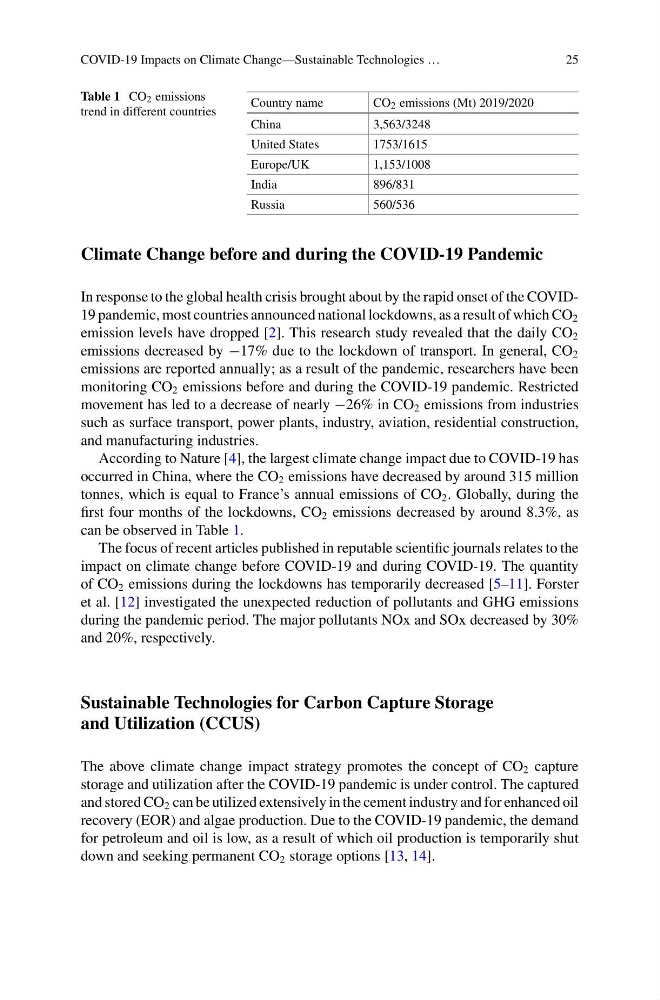
Table 1 CO 2 emissions
trend in different countries
Country name
CO 2 emissions (Mt) 2019/2020
China
3,563/3248
United States
1753/1615
Europe/UK
1,153/1008
India
896/831
Russia
560/536
Climate Change before and during the COVID-19 Pandemic
In response to the global health crisis brought about by the rapid onset of the COVID19 pandemic, most countries announced national lockdowns, as a result of which CO 2
emission levels have dropped [2]. This research study revealed that the daily CO 2
emissions decreased by −17% due to the lockdown of transport. In general, CO 2
emissions are reported annually; as a result of the pandemic, researchers have been
monitoring CO 2 emissions before and during the COVID-19 pandemic. Restricted
movement has led to a decrease of nearly −26% in CO 2 emissions from industries
such as surface transport, power plants, industry, aviation, residential construction,
and manufacturing industries.
According to Nature [4], the largest climate change impact due to COVID-19 has
occurred in China, where the CO 2 emissions have decreased by around 315 million
tonnes, which is equal to France’s annual emissions of CO 2 . Globally, during the
first four months of the lockdowns, CO 2 emissions decreased by around 8.3%, as
can be observed in Table 1.
The focus of recent articles published in reputable scientific journals relates to the
impact on climate change before COVID-19 and during COVID-19. The quantity
of CO 2 emissions during the lockdowns has temporarily decreased [5–11]. Forster
et al. [12] investigated the unexpected reduction of pollutants and GHG emissions
during the pandemic period. The major pollutants NOx and SOx decreased by 30%
and 20%, respectively.
Sustainable Technologies for Carbon Capture Storage
and Utilization (CCUS)
The above climate change impact strategy promotes the concept of CO 2 capture
storage and utilization after the COVID-19 pandemic is under control. The captured
and stored CO 2 can be utilized extensively in the cement industry and for enhanced oil
recovery (EOR) and algae production. Due to the COVID-19 pandemic, the demand
for petroleum and oil is low, as a result of which oil production is temporarily shut
down and seeking permanent CO 2 storage options [13, 14].
25
Table 1 CO 2 emissions
trend in different countries
Country name
CO 2 emissions (Mt) 2019/2020
China
3,563/3248
United States
1753/1615
Europe/UK
1,153/1008
India
896/831
Russia
560/536
Climate Change before and during the COVID-19 Pandemic
In response to the global health crisis brought about by the rapid onset of the COVID19 pandemic, most countries announced national lockdowns, as a result of which CO 2
emission levels have dropped [2]. This research study revealed that the daily CO 2
emissions decreased by −17% due to the lockdown of transport. In general, CO 2
emissions are reported annually; as a result of the pandemic, researchers have been
monitoring CO 2 emissions before and during the COVID-19 pandemic. Restricted
movement has led to a decrease of nearly −26% in CO 2 emissions from industries
such as surface transport, power plants, industry, aviation, residential construction,
and manufacturing industries.
According to Nature [4], the largest climate change impact due to COVID-19 has
occurred in China, where the CO 2 emissions have decreased by around 315 million
tonnes, which is equal to France’s annual emissions of CO 2 . Globally, during the
first four months of the lockdowns, CO 2 emissions decreased by around 8.3%, as
can be observed in Table 1.
The focus of recent articles published in reputable scientific journals relates to the
impact on climate change before COVID-19 and during COVID-19. The quantity
of CO 2 emissions during the lockdowns has temporarily decreased [5–11]. Forster
et al. [12] investigated the unexpected reduction of pollutants and GHG emissions
during the pandemic period. The major pollutants NOx and SOx decreased by 30%
and 20%, respectively.
Sustainable Technologies for Carbon Capture Storage
and Utilization (CCUS)
The above climate change impact strategy promotes the concept of CO 2 capture
storage and utilization after the COVID-19 pandemic is under control. The captured
and stored CO 2 can be utilized extensively in the cement industry and for enhanced oil
recovery (EOR) and algae production. Due to the COVID-19 pandemic, the demand
for petroleum and oil is low, as a result of which oil production is temporarily shut
down and seeking permanent CO 2 storage options [13, 14].