

24
Q. T. Lai et al.
Introduction
Currently, global warming is the biggest environmental challenge and is caused by the
large quantity of greenhouse gas (GHG) emitted by anthropogenic activities. There
are a variety of industries emitting CO 2 at peak levels, such as iron and steel, cement,
chemicals, paper and pulp, nonferrous, food processing, textiles, leather, transport,
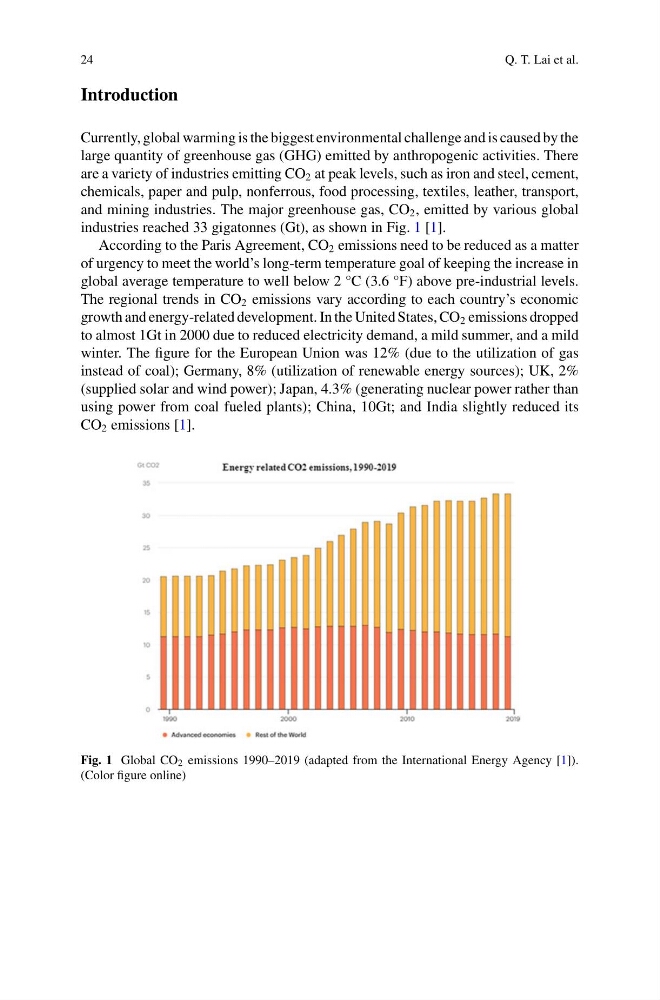
and mining industries. The major greenhouse gas, CO 2 , emitted by various global
industries reached 33 gigatonnes (Gt), as shown in Fig. 1 [1].
According to the Paris Agreement, CO 2 emissions need to be reduced as a matter
of urgency to meet the world’s long-term temperature goal of keeping the increase in
global average temperature to well below 2 °C (3.6 °F) above pre-industrial levels.
The regional trends in CO 2 emissions vary according to each country’s economic
growth and energy-related development. In the United States, CO 2 emissions dropped
to almost 1Gt in 2000 due to reduced electricity demand, a mild summer, and a mild
winter. The figure for the European Union was 12% (due to the utilization of gas
instead of coal); Germany, 8% (utilization of renewable energy sources); UK, 2%
(supplied solar and wind power); Japan, 4.3% (generating nuclear power rather than
using power from coal fueled plants); China, 10Gt; and India slightly reduced its
CO 2 emissions [1].
Fig. 1 Global CO 2 emissions 1990–2019 (adapted from the International Energy Agency [1]).
(Color figure online)
Q. T. Lai et al.
Introduction
Currently, global warming is the biggest environmental challenge and is caused by the
large quantity of greenhouse gas (GHG) emitted by anthropogenic activities. There
are a variety of industries emitting CO 2 at peak levels, such as iron and steel, cement,
chemicals, paper and pulp, nonferrous, food processing, textiles, leather, transport,
and mining industries. The major greenhouse gas, CO 2 , emitted by various global
industries reached 33 gigatonnes (Gt), as shown in Fig. 1 [1].
According to the Paris Agreement, CO 2 emissions need to be reduced as a matter
of urgency to meet the world’s long-term temperature goal of keeping the increase in
global average temperature to well below 2 °C (3.6 °F) above pre-industrial levels.
The regional trends in CO 2 emissions vary according to each country’s economic
growth and energy-related development. In the United States, CO 2 emissions dropped
to almost 1Gt in 2000 due to reduced electricity demand, a mild summer, and a mild
winter. The figure for the European Union was 12% (due to the utilization of gas
instead of coal); Germany, 8% (utilization of renewable energy sources); UK, 2%
(supplied solar and wind power); Japan, 4.3% (generating nuclear power rather than
using power from coal fueled plants); China, 10Gt; and India slightly reduced its
CO 2 emissions [1].
Fig. 1 Global CO 2 emissions 1990–2019 (adapted from the International Energy Agency [1]).
(Color figure online)