

16
Q. T. Lai et al.
However, the public desire for REE and the considerable content of noteworthy
elements such as scandium and yttrium. In this sample, the concentration of scandium
and yttrium was 17.5 ppm and 29.9 ppm, respectively. This can emerge this FA
sample to be a noticeable source for REE. Therefore, the present study investigated
the extraction efficiency of scandium and yttrium concerning the varied experimental
condition.
Leaching Experiments
The notable amount of Ca-based compounds such as anhydrite, lime, and calcite was
due to the addition of limestone in the desulfurization stage at the CFBC power plants.
However, the significant amount of calcium and iron in the FA sample favored more
REE concentrated in Ca–Fe aluminosilicate minerals [18]. Therefore, acid leaching is
expected to yield the desired REE extraction efficiency. The previous studies reported
that the pulp density (w/v) of FA leaching tests targeted REE extraction at 100 g/L
was the optimum condition providing desired leaching efficiency [15]. Thereafter,
the pulp density (w/v) in the subsequent experiments was remained unaltered at
100 g/L. The mixing speed was unchanged at 200 rpm. The leaching performance
of reagents including HCl, H 2 SO 4 , HNO 3 was investigated in the preliminary tests.
The better acid was selected for subsequent experiments.
Subsequently, the effects of leaching time, acid strength, and temperature on REE
leaching were investigated. The leaching time, acid strength, and temperature were
varied between 5–120 min, 1.5–4 mol/L, and 25–80 °C, respectively.
When the reaction time finished, the leaching solution was separated from the
residue by vacuum filtration equipped with Advantec filter paper (ø110 mm). The
concentration of targeted REE in the diluted leachate was identified by inductively
coupled plasma-optical emission spectrometry (ICP-OES). Eventually, the leaching
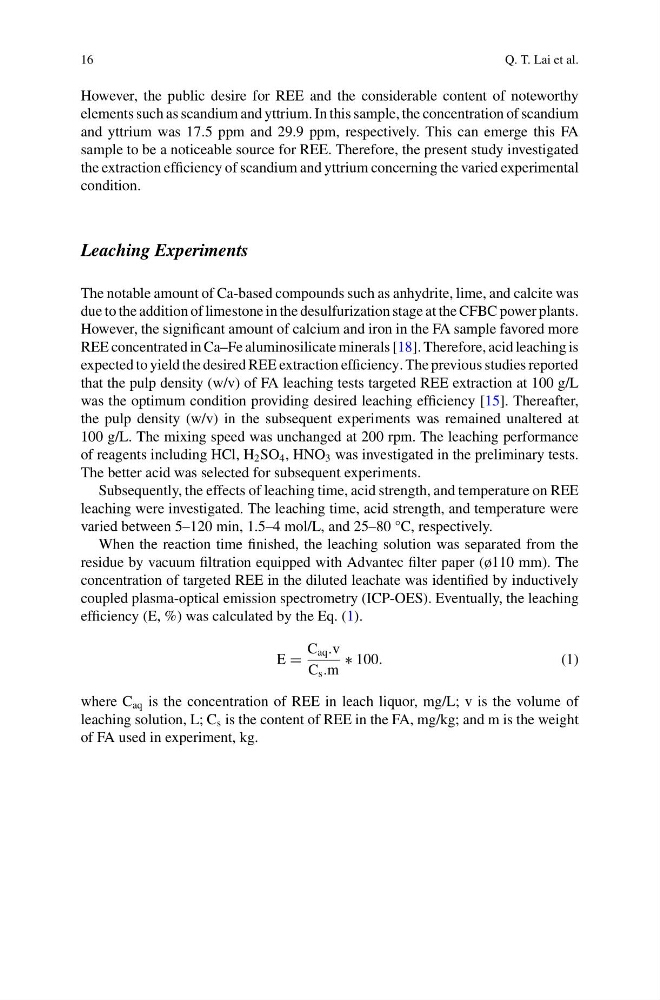
efficiency (E, %) was calculated by the Eq. (1).
E =
C aq .v
C s .m
∗ 100.
(1)
where C aq is the concentration of REE in leach liquor, mg/L; v is the volume of
leaching solution, L; C s is the content of REE in the FA, mg/kg; and m is the weight
of FA used in experiment, kg.
Q. T. Lai et al.
However, the public desire for REE and the considerable content of noteworthy
elements such as scandium and yttrium. In this sample, the concentration of scandium
and yttrium was 17.5 ppm and 29.9 ppm, respectively. This can emerge this FA
sample to be a noticeable source for REE. Therefore, the present study investigated
the extraction efficiency of scandium and yttrium concerning the varied experimental
condition.
Leaching Experiments
The notable amount of Ca-based compounds such as anhydrite, lime, and calcite was
due to the addition of limestone in the desulfurization stage at the CFBC power plants.
However, the significant amount of calcium and iron in the FA sample favored more
REE concentrated in Ca–Fe aluminosilicate minerals [18]. Therefore, acid leaching is
expected to yield the desired REE extraction efficiency. The previous studies reported
that the pulp density (w/v) of FA leaching tests targeted REE extraction at 100 g/L
was the optimum condition providing desired leaching efficiency [15]. Thereafter,
the pulp density (w/v) in the subsequent experiments was remained unaltered at
100 g/L. The mixing speed was unchanged at 200 rpm. The leaching performance
of reagents including HCl, H 2 SO 4 , HNO 3 was investigated in the preliminary tests.
The better acid was selected for subsequent experiments.
Subsequently, the effects of leaching time, acid strength, and temperature on REE
leaching were investigated. The leaching time, acid strength, and temperature were
varied between 5–120 min, 1.5–4 mol/L, and 25–80 °C, respectively.
When the reaction time finished, the leaching solution was separated from the
residue by vacuum filtration equipped with Advantec filter paper (ø110 mm). The
concentration of targeted REE in the diluted leachate was identified by inductively
coupled plasma-optical emission spectrometry (ICP-OES). Eventually, the leaching
efficiency (E, %) was calculated by the Eq. (1).
E =
C aq .v
C s .m
∗ 100.
(1)
where C aq is the concentration of REE in leach liquor, mg/L; v is the volume of
leaching solution, L; C s is the content of REE in the FA, mg/kg; and m is the weight
of FA used in experiment, kg.