

Characteristic Studies of Critical Rare Earths Scandium …
15
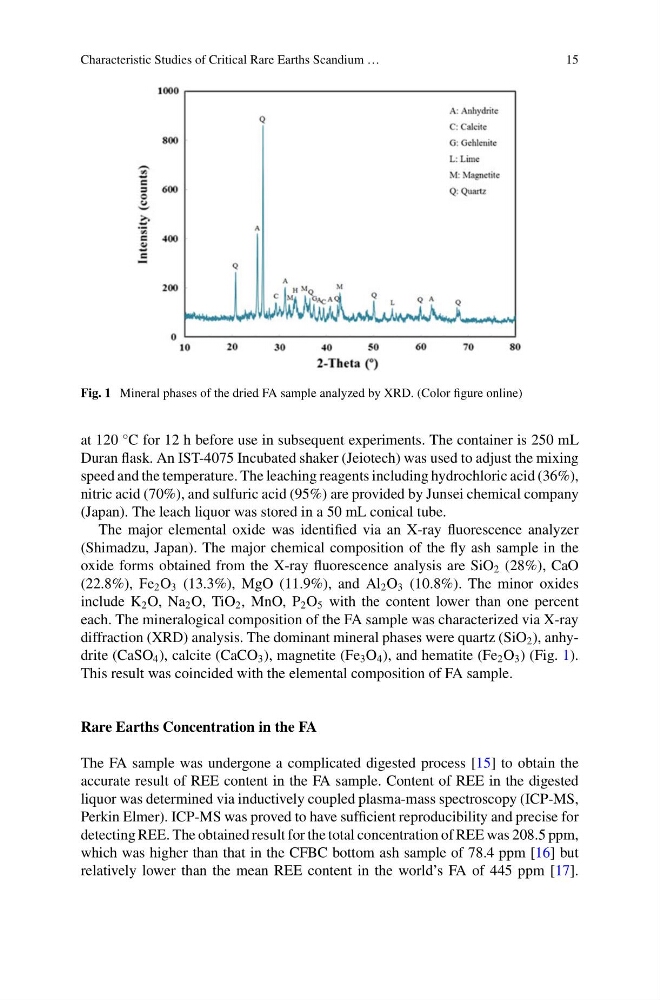
Fig. 1 Mineral phases of the dried FA sample analyzed by XRD. (Color figure online)
at 120 °C for 12 h before use in subsequent experiments. The container is 250 mL
Duran flask. An IST-4075 Incubated shaker (Jeiotech) was used to adjust the mixing
speed and the temperature. The leaching reagents including hydrochloric acid (36%),
nitric acid (70%), and sulfuric acid (95%) are provided by Junsei chemical company
(Japan). The leach liquor was stored in a 50 mL conical tube.
The major elemental oxide was identified via an X-ray fluorescence analyzer
(Shimadzu, Japan). The major chemical composition of the fly ash sample in the
oxide forms obtained from the X-ray fluorescence analysis are SiO 2 (28%), CaO
(22.8%), Fe 2 O 3 (13.3%), MgO (11.9%), and Al 2 O 3 (10.8%). The minor oxides
include K 2 O, Na 2 O, TiO 2 , MnO, P 2 O 5 with the content lower than one percent
each. The mineralogical composition of the FA sample was characterized via X-ray
diffraction (XRD) analysis. The dominant mineral phases were quartz (SiO 2 ), anhydrite (CaSO 4 ), calcite (CaCO 3 ), magnetite (Fe 3 O 4 ), and hematite (Fe 2 O 3 ) (Fig. 1).
This result was coincided with the elemental composition of FA sample.
Rare Earths Concentration in the FA
The FA sample was undergone a complicated digested process [15] to obtain the
accurate result of REE content in the FA sample. Content of REE in the digested
liquor was determined via inductively coupled plasma-mass spectroscopy (ICP-MS,
Perkin Elmer). ICP-MS was proved to have sufficient reproducibility and precise for
detecting REE. The obtained result for the total concentration of REE was 208.5 ppm,
which was higher than that in the CFBC bottom ash sample of 78.4 ppm [16] but
relatively lower than the mean REE content in the world’s FA of 445 ppm [17].
15
Fig. 1 Mineral phases of the dried FA sample analyzed by XRD. (Color figure online)
at 120 °C for 12 h before use in subsequent experiments. The container is 250 mL
Duran flask. An IST-4075 Incubated shaker (Jeiotech) was used to adjust the mixing
speed and the temperature. The leaching reagents including hydrochloric acid (36%),
nitric acid (70%), and sulfuric acid (95%) are provided by Junsei chemical company
(Japan). The leach liquor was stored in a 50 mL conical tube.
The major elemental oxide was identified via an X-ray fluorescence analyzer
(Shimadzu, Japan). The major chemical composition of the fly ash sample in the
oxide forms obtained from the X-ray fluorescence analysis are SiO 2 (28%), CaO
(22.8%), Fe 2 O 3 (13.3%), MgO (11.9%), and Al 2 O 3 (10.8%). The minor oxides
include K 2 O, Na 2 O, TiO 2 , MnO, P 2 O 5 with the content lower than one percent
each. The mineralogical composition of the FA sample was characterized via X-ray
diffraction (XRD) analysis. The dominant mineral phases were quartz (SiO 2 ), anhydrite (CaSO 4 ), calcite (CaCO 3 ), magnetite (Fe 3 O 4 ), and hematite (Fe 2 O 3 ) (Fig. 1).
This result was coincided with the elemental composition of FA sample.
Rare Earths Concentration in the FA
The FA sample was undergone a complicated digested process [15] to obtain the
accurate result of REE content in the FA sample. Content of REE in the digested
liquor was determined via inductively coupled plasma-mass spectroscopy (ICP-MS,
Perkin Elmer). ICP-MS was proved to have sufficient reproducibility and precise for
detecting REE. The obtained result for the total concentration of REE was 208.5 ppm,
which was higher than that in the CFBC bottom ash sample of 78.4 ppm [16] but
relatively lower than the mean REE content in the world’s FA of 445 ppm [17].