

Characteristic Studies of Critical Rare Earths Scandium …
17
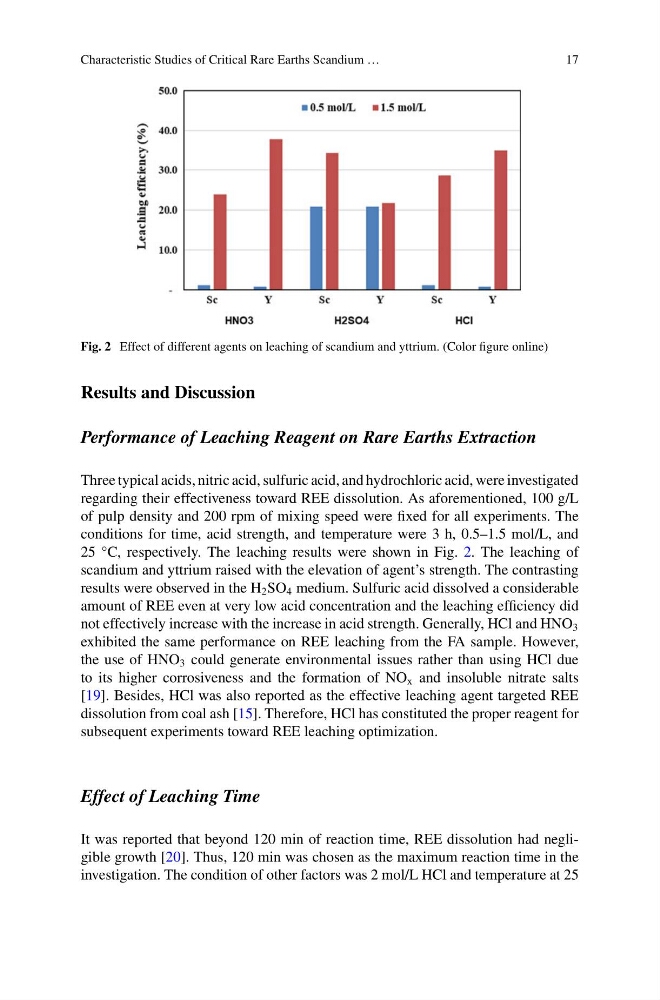
Fig. 2 Effect of different agents on leaching of scandium and yttrium. (Color figure online)
Results and Discussion
Performance of Leaching Reagent on Rare Earths Extraction
Three typical acids, nitric acid, sulfuric acid, and hydrochloric acid, were investigated
regarding their effectiveness toward REE dissolution. As aforementioned, 100 g/L
of pulp density and 200 rpm of mixing speed were fixed for all experiments. The
conditions for time, acid strength, and temperature were 3 h, 0.5–1.5 mol/L, and
25 °C, respectively. The leaching results were shown in Fig. 2. The leaching of
scandium and yttrium raised with the elevation of agent’s strength. The contrasting
results were observed in the H 2 SO 4 medium. Sulfuric acid dissolved a considerable
amount of REE even at very low acid concentration and the leaching efficiency did
not effectively increase with the increase in acid strength. Generally, HCl and HNO 3
exhibited the same performance on REE leaching from the FA sample. However,
the use of HNO 3 could generate environmental issues rather than using HCl due
to its higher corrosiveness and the formation of NO x and insoluble nitrate salts
[19]. Besides, HCl was also reported as the effective leaching agent targeted REE
dissolution from coal ash [15]. Therefore, HCl has constituted the proper reagent for
subsequent experiments toward REE leaching optimization.
Effect of Leaching Time
It was reported that beyond 120 min of reaction time, REE dissolution had negligible growth [20]. Thus, 120 min was chosen as the maximum reaction time in the
investigation. The condition of other factors was 2 mol/L HCl and temperature at 25
17
Fig. 2 Effect of different agents on leaching of scandium and yttrium. (Color figure online)
Results and Discussion
Performance of Leaching Reagent on Rare Earths Extraction
Three typical acids, nitric acid, sulfuric acid, and hydrochloric acid, were investigated
regarding their effectiveness toward REE dissolution. As aforementioned, 100 g/L
of pulp density and 200 rpm of mixing speed were fixed for all experiments. The
conditions for time, acid strength, and temperature were 3 h, 0.5–1.5 mol/L, and
25 °C, respectively. The leaching results were shown in Fig. 2. The leaching of
scandium and yttrium raised with the elevation of agent’s strength. The contrasting
results were observed in the H 2 SO 4 medium. Sulfuric acid dissolved a considerable
amount of REE even at very low acid concentration and the leaching efficiency did
not effectively increase with the increase in acid strength. Generally, HCl and HNO 3
exhibited the same performance on REE leaching from the FA sample. However,
the use of HNO 3 could generate environmental issues rather than using HCl due
to its higher corrosiveness and the formation of NO x and insoluble nitrate salts
[19]. Besides, HCl was also reported as the effective leaching agent targeted REE
dissolution from coal ash [15]. Therefore, HCl has constituted the proper reagent for
subsequent experiments toward REE leaching optimization.
Effect of Leaching Time
It was reported that beyond 120 min of reaction time, REE dissolution had negligible growth [20]. Thus, 120 min was chosen as the maximum reaction time in the
investigation. The condition of other factors was 2 mol/L HCl and temperature at 25