

The Influence of Hydrogen Injection on the Reduction …
157
the CO partial pressure gradually decreases, and the CO 2 partial pressure is just the
opposite, which shows that adding a little hydrogen is beneficial to the improvement
of the gas utilization ratio. However, the partial pressure of H 2 O always remains at
zero. From the perspective of the equilibrium results, the added hydrogen does not
participate in the reduction of FeO which is completely completed by carbon. What
needs to be emphasized is that it is not ruled out the possibility that hydrogen reduces
FeO to produce H 2 O, and H 2 O reacts with carbon to produce H 2 . H 2 only acts as
a transmission medium due to the presence of carbon [6, 23]. The hydrogen will
then enter the upper part of the blast furnace through the cohesive zone along with
the gas flow, and participates in the stepwise reduction reaction of high-valent iron
oxides [8], the generated water and the remaining unreacted hydrogen pass through
the layer of iron ore and coke to the top of the blast furnace and are discharged with
the blast furnace gas [5, 22]. Figure 5 shows that the remaining carbon percentage is
less than the situation without hydrogenation, indicating that adding a little hydrogen
can promote the production of CO and CO 2 in the system, and CO further converted
to CO 2 so that the gas utilization ratio is improved.
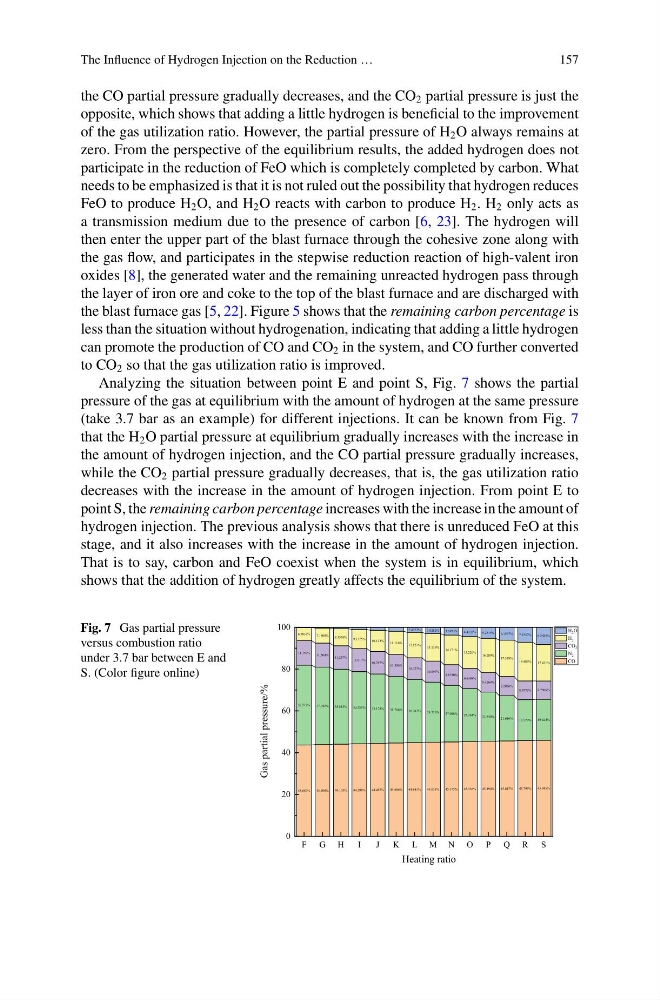
Analyzing the situation between point E and point S, Fig. 7 shows the partial
pressure of the gas at equilibrium with the amount of hydrogen at the same pressure
(take 3.7 bar as an example) for different injections. It can be known from Fig. 7
that the H 2 O partial pressure at equilibrium gradually increases with the increase in
the amount of hydrogen injection, and the CO partial pressure gradually increases,
while the CO 2 partial pressure gradually decreases, that is, the gas utilization ratio
decreases with the increase in the amount of hydrogen injection. From point E to
point S, the remaining carbon percentage increases with the increase in the amount of
hydrogen injection. The previous analysis shows that there is unreduced FeO at this
stage, and it also increases with the increase in the amount of hydrogen injection.
That is to say, carbon and FeO coexist when the system is in equilibrium, which
shows that the addition of hydrogen greatly affects the equilibrium of the system.
Fig. 7 Gas partial pressure
versus combustion ratio
under 3.7 bar between E and
S. (Color figure online)
43.687%
43.900%
44.103%
44.298%
44.485%
44.666%
44.841%
45.011%
45.175%
45.336%
45.494%
45.647%
45.799%
45.945%
38.219%
37.042%
35.813%
34.525%
33.178%
31.766%
30.283%
28.726%
27.088%
25.361%
23.540%
21.616%
19.579%
19.624%
11.759%
11.504%
11.257%
11.017%
10.782%
10.550%
10.323%
10.097%
9.8730%
9.6498%
9.4264%
9.2026%
8.9773%
8.7506%
6.2032%
7.1808%
8.1576%
9.1375%
10.123%
11.116%
12.121%
13.139%
14.171%
15.220%
16.289%
17.378%
18.489%
17.421%
2.4323%
3.0282%
3.6933%
4.4326%
5.2515%
6.1567%
7.1557%
8.2585%
F G H
I
J
K L M N O P Q R S
0
20
40
60
80
100
Gas partial pressure/%
Heating ratio
H2O
H2
CO2
N2
CO
157
the CO partial pressure gradually decreases, and the CO 2 partial pressure is just the
opposite, which shows that adding a little hydrogen is beneficial to the improvement
of the gas utilization ratio. However, the partial pressure of H 2 O always remains at
zero. From the perspective of the equilibrium results, the added hydrogen does not
participate in the reduction of FeO which is completely completed by carbon. What
needs to be emphasized is that it is not ruled out the possibility that hydrogen reduces
FeO to produce H 2 O, and H 2 O reacts with carbon to produce H 2 . H 2 only acts as
a transmission medium due to the presence of carbon [6, 23]. The hydrogen will
then enter the upper part of the blast furnace through the cohesive zone along with
the gas flow, and participates in the stepwise reduction reaction of high-valent iron
oxides [8], the generated water and the remaining unreacted hydrogen pass through
the layer of iron ore and coke to the top of the blast furnace and are discharged with
the blast furnace gas [5, 22]. Figure 5 shows that the remaining carbon percentage is
less than the situation without hydrogenation, indicating that adding a little hydrogen
can promote the production of CO and CO 2 in the system, and CO further converted
to CO 2 so that the gas utilization ratio is improved.
Analyzing the situation between point E and point S, Fig. 7 shows the partial
pressure of the gas at equilibrium with the amount of hydrogen at the same pressure
(take 3.7 bar as an example) for different injections. It can be known from Fig. 7
that the H 2 O partial pressure at equilibrium gradually increases with the increase in
the amount of hydrogen injection, and the CO partial pressure gradually increases,
while the CO 2 partial pressure gradually decreases, that is, the gas utilization ratio
decreases with the increase in the amount of hydrogen injection. From point E to
point S, the remaining carbon percentage increases with the increase in the amount of
hydrogen injection. The previous analysis shows that there is unreduced FeO at this
stage, and it also increases with the increase in the amount of hydrogen injection.
That is to say, carbon and FeO coexist when the system is in equilibrium, which
shows that the addition of hydrogen greatly affects the equilibrium of the system.
Fig. 7 Gas partial pressure
versus combustion ratio
under 3.7 bar between E and
S. (Color figure online)
43.687%
43.900%
44.103%
44.298%
44.485%
44.666%
44.841%
45.011%
45.175%
45.336%
45.494%
45.647%
45.799%
45.945%
38.219%
37.042%
35.813%
34.525%
33.178%
31.766%
30.283%
28.726%
27.088%
25.361%
23.540%
21.616%
19.579%
19.624%
11.759%
11.504%
11.257%
11.017%
10.782%
10.550%
10.323%
10.097%
9.8730%
9.6498%
9.4264%
9.2026%
8.9773%
8.7506%
6.2032%
7.1808%
8.1576%
9.1375%
10.123%
11.116%
12.121%
13.139%
14.171%
15.220%
16.289%
17.378%
18.489%
17.421%
2.4323%
3.0282%
3.6933%
4.4326%
5.2515%
6.1567%
7.1557%
8.2585%
F G H
I
J
K L M N O P Q R S
0
20
40
60
80
100
Gas partial pressure/%
Heating ratio
H2O
H2
CO2
N2
CO