

156
Z. Tang et al.
of hydrogen injection, indicating that FeO is not completely reduced, the injected
hydrogen affects the reduction process of FeO by carbon, and the more hydrogen
sprayed, the more significant the effect is. When the amount of heat supplied by
hydrogen injection is 95%, even more than 20% of FeO is not reduced.
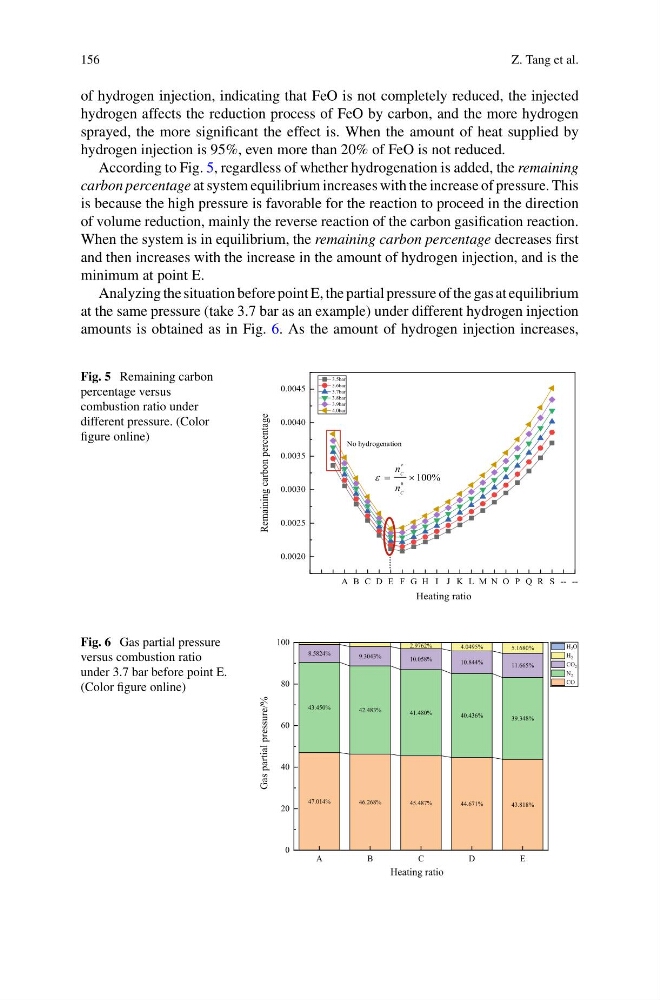
According to Fig. 5, regardless of whether hydrogenation is added, the remaining
carbon percentage at system equilibrium increases with the increase of pressure. This
is because the high pressure is favorable for the reaction to proceed in the direction
of volume reduction, mainly the reverse reaction of the carbon gasification reaction.
When the system is in equilibrium, the remaining carbon percentage decreases first
and then increases with the increase in the amount of hydrogen injection, and is the
minimum at point E.
Analyzing the situation before point E, the partial pressure of the gas at equilibrium
at the same pressure (take 3.7 bar as an example) under different hydrogen injection
amounts is obtained as in Fig. 6. As the amount of hydrogen injection increases,
Fig. 5 Remaining carbon
percentage versus
combustion ratio under
different pressure. (Color
figure online)
A B C D E F G H I J K L M N O P Q R S -- -0.0020
0.0025
0.0030
0.0035
0.0040
0.0045
Remaining
carbon percentage
Heating ratio
3.5bar
3.6bar
3.7bar
3.8bar
3.9bar
4.0bar
No hydrogenation
0
100%
e
C
C
n
n
Fig. 6 Gas partial pressure
versus combustion ratio
under 3.7 bar before point E.
(Color figure online)
47.014%
46.268%
45.487%
44.671%
43.818%
43.450%
42.483%
41.480%
40.436%
39.348%
8.5824%
9.3043%
10.058%
10.844%
11.665%
2.9762%
4.0495%
5.1680%
A
B
C
D
E
0
20
40
60
80
100
Gas partial pressure/%
Heating ratio
H 2 O
H 2
CO 2
N 2
CO
Z. Tang et al.
of hydrogen injection, indicating that FeO is not completely reduced, the injected
hydrogen affects the reduction process of FeO by carbon, and the more hydrogen
sprayed, the more significant the effect is. When the amount of heat supplied by
hydrogen injection is 95%, even more than 20% of FeO is not reduced.
According to Fig. 5, regardless of whether hydrogenation is added, the remaining
carbon percentage at system equilibrium increases with the increase of pressure. This
is because the high pressure is favorable for the reaction to proceed in the direction
of volume reduction, mainly the reverse reaction of the carbon gasification reaction.
When the system is in equilibrium, the remaining carbon percentage decreases first
and then increases with the increase in the amount of hydrogen injection, and is the
minimum at point E.
Analyzing the situation before point E, the partial pressure of the gas at equilibrium
at the same pressure (take 3.7 bar as an example) under different hydrogen injection
amounts is obtained as in Fig. 6. As the amount of hydrogen injection increases,
Fig. 5 Remaining carbon
percentage versus
combustion ratio under
different pressure. (Color
figure online)
A B C D E F G H I J K L M N O P Q R S -- -0.0020
0.0025
0.0030
0.0035
0.0040
0.0045
Remaining
carbon percentage
Heating ratio
3.5bar
3.6bar
3.7bar
3.8bar
3.9bar
4.0bar
No hydrogenation
0
100%
e
C
C
n
n
Fig. 6 Gas partial pressure
versus combustion ratio
under 3.7 bar before point E.
(Color figure online)
47.014%
46.268%
45.487%
44.671%
43.818%
43.450%
42.483%
41.480%
40.436%
39.348%
8.5824%
9.3043%
10.058%
10.844%
11.665%
2.9762%
4.0495%
5.1680%
A
B
C
D
E
0
20
40
60
80
100
Gas partial pressure/%
Heating ratio
H 2 O
H 2
CO 2
N 2
CO