

5.6 Prototypical Implementation
149
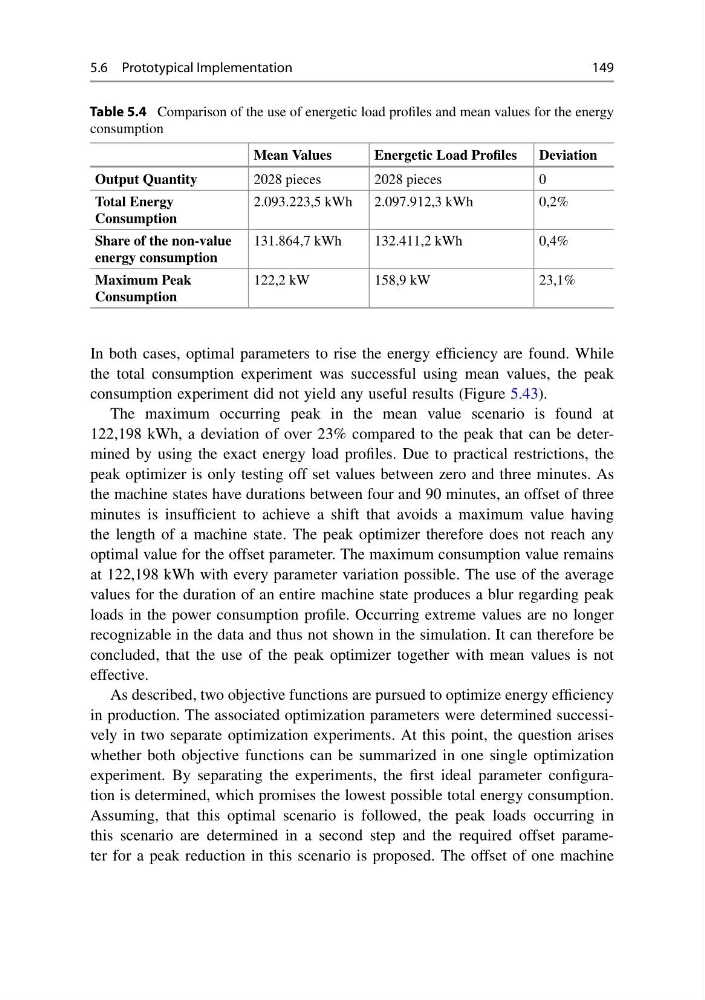
Table 5.4 Comparison of the use of energetic load profiles and mean values for the energy
consumption
Mean Values
Energetic Load Profiles
Deviation
Output Quantity
2028 pieces
2028 pieces
0
Total Energy
Consumption
2.093.223,5 kWh
2.097.912,3 kWh
0,2%
Share of the non-value
energy consumption
131.864,7 kWh
132.411,2 kWh
0,4%
Maximum Peak
Consumption
122,2 kW
158,9 kW
23,1%
In both cases, optimal parameters to rise the energy efficiency are found. While
the total consumption experiment was successful using mean values, the peak
consumption experiment did not yield any useful results (Figure 5.43).
The maximum occurring peak in the mean value scenario is found at
122,198 kWh, a deviation of over 23% compared to the peak that can be determined by using the exact energy load profiles. Due to practical restrictions, the
peak optimizer is only testing off set values between zero and three minutes. As
the machine states have durations between four and 90 minutes, an offset of three
minutes is insufficient to achieve a shift that avoids a maximum value having
the length of a machine state. The peak optimizer therefore does not reach any
optimal value for the offset parameter. The maximum consumption value remains
at 122,198 kWh with every parameter variation possible. The use of the average
values for the duration of an entire machine state produces a blur regarding peak
loads in the power consumption profile. Occurring extreme values are no longer
recognizable in the data and thus not shown in the simulation. It can therefore be
concluded, that the use of the peak optimizer together with mean values is not
effective.
As described, two objective functions are pursued to optimize energy efficiency
in production. The associated optimization parameters were determined successively in two separate optimization experiments. At this point, the question arises
whether both objective functions can be summarized in one single optimization
experiment. By separating the experiments, the first ideal parameter configuration is determined, which promises the lowest possible total energy consumption.
Assuming, that this optimal scenario is followed, the peak loads occurring in
this scenario are determined in a second step and the required offset parameter for a peak reduction in this scenario is proposed. The offset of one machine
149
Table 5.4 Comparison of the use of energetic load profiles and mean values for the energy
consumption
Mean Values
Energetic Load Profiles
Deviation
Output Quantity
2028 pieces
2028 pieces
0
Total Energy
Consumption
2.093.223,5 kWh
2.097.912,3 kWh
0,2%
Share of the non-value
energy consumption
131.864,7 kWh
132.411,2 kWh
0,4%
Maximum Peak
Consumption
122,2 kW
158,9 kW
23,1%
In both cases, optimal parameters to rise the energy efficiency are found. While
the total consumption experiment was successful using mean values, the peak
consumption experiment did not yield any useful results (Figure 5.43).
The maximum occurring peak in the mean value scenario is found at
122,198 kWh, a deviation of over 23% compared to the peak that can be determined by using the exact energy load profiles. Due to practical restrictions, the
peak optimizer is only testing off set values between zero and three minutes. As
the machine states have durations between four and 90 minutes, an offset of three
minutes is insufficient to achieve a shift that avoids a maximum value having
the length of a machine state. The peak optimizer therefore does not reach any
optimal value for the offset parameter. The maximum consumption value remains
at 122,198 kWh with every parameter variation possible. The use of the average
values for the duration of an entire machine state produces a blur regarding peak
loads in the power consumption profile. Occurring extreme values are no longer
recognizable in the data and thus not shown in the simulation. It can therefore be
concluded, that the use of the peak optimizer together with mean values is not
effective.
As described, two objective functions are pursued to optimize energy efficiency
in production. The associated optimization parameters were determined successively in two separate optimization experiments. At this point, the question arises
whether both objective functions can be summarized in one single optimization
experiment. By separating the experiments, the first ideal parameter configuration is determined, which promises the lowest possible total energy consumption.
Assuming, that this optimal scenario is followed, the peak loads occurring in
this scenario are determined in a second step and the required offset parameter for a peak reduction in this scenario is proposed. The offset of one machine