

13.
INTÉGRATION DES ÉQUATIONS DIFFÉRENTIELLES DANS LE CHAMP RÉEL
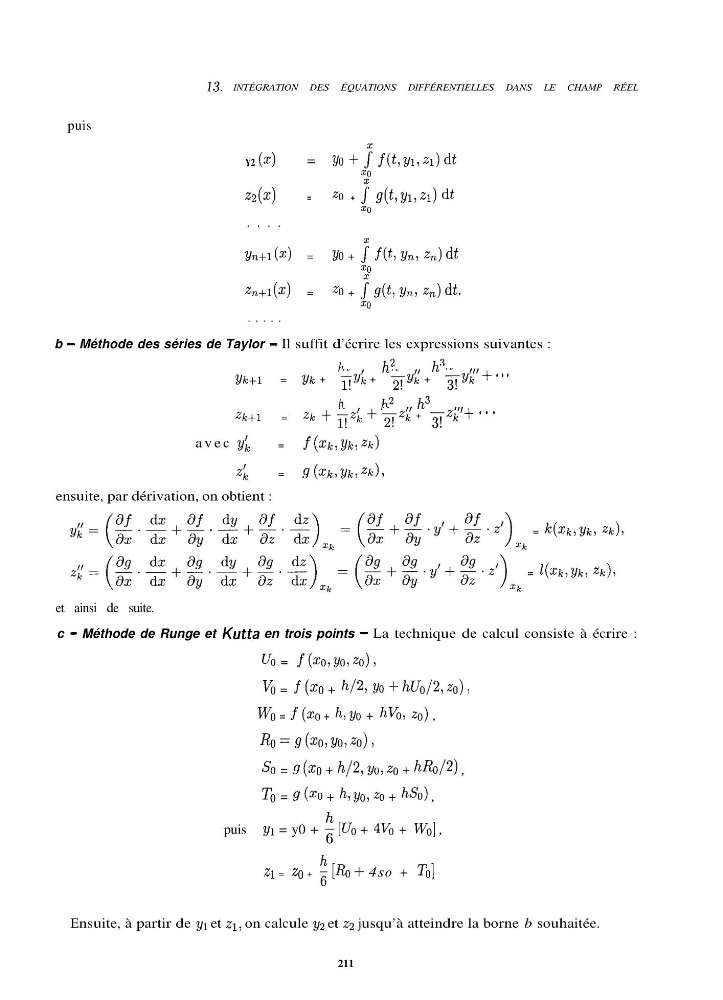
puis
Y2 (XI
= YO + 7 f(t,vl,-4 dt
x0
4x1
=
zo + 7 g(t,yl,a)
dt
x0
. . . .
Yn+l (XI
=
YO + 7 f(t, ~n, 2,) dt
20
Zn+l (xl
=
zo + 7 g(t, yn, z,) dt.
x0
. . . . .
b - Méthode des séries de Taylor - Il suffit d’écrire les expressions suivantes :
h
h2
h3
Ykfl
=yk + ,Y; + !Yk + -&tt + ’ ’ ’
h
zk+l
=
h2
h3
,,,
zk + 3”; + 32; + Tz” + ” ’
avec y;
=
f (xk, Yk> zk)
4
=
9 (~k,Yk, zk) >
ensuite, par dérivation, on obtient :
= k(Zk,Yk, zk),
= ~(xk,Yk, zk)>
et ainsi de suite.
c - Méthode de Runge et Kutta en trois points - La technique de calcul consiste à écrire :
uo = f(Xo,Yo,Zo),
Vo = f (xo + W, YO + hUoP,zo) >
wo = f (xo + h, YO + hVo, ~0) ,
&l =g(xo,Yo,~o),
SO = g (20 + h/2, YO, 20 + hRo/2) ,
TO = g (20 + h, yo, zo + hSo) ,
puis y1 = y0 + t [VO + ~VO + WO] ,
21 = zo + ; [Ro + 4so + TO]
Ensuite, à partir de y1 et zl, on calcule y2 et 22 jusqu’à atteindre la borne b souhaitée.
211
INTÉGRATION DES ÉQUATIONS DIFFÉRENTIELLES DANS LE CHAMP RÉEL
puis
Y2 (XI
= YO + 7 f(t,vl,-4 dt
x0
4x1
=
zo + 7 g(t,yl,a)
dt
x0
. . . .
Yn+l (XI
=
YO + 7 f(t, ~n, 2,) dt
20
Zn+l (xl
=
zo + 7 g(t, yn, z,) dt.
x0
. . . . .
b - Méthode des séries de Taylor - Il suffit d’écrire les expressions suivantes :
h
h2
h3
Ykfl
=yk + ,Y; + !Yk + -&tt + ’ ’ ’
h
zk+l
=
h2
h3
,,,
zk + 3”; + 32; + Tz” + ” ’
avec y;
=
f (xk, Yk> zk)
4
=
9 (~k,Yk, zk) >
ensuite, par dérivation, on obtient :
= k(Zk,Yk, zk),
= ~(xk,Yk, zk)>
et ainsi de suite.
c - Méthode de Runge et Kutta en trois points - La technique de calcul consiste à écrire :
uo = f(Xo,Yo,Zo),
Vo = f (xo + W, YO + hUoP,zo) >
wo = f (xo + h, YO + hVo, ~0) ,
&l =g(xo,Yo,~o),
SO = g (20 + h/2, YO, 20 + hRo/2) ,
TO = g (20 + h, yo, zo + hSo) ,
puis y1 = y0 + t [VO + ~VO + WO] ,
21 = zo + ; [Ro + 4so + TO]
Ensuite, à partir de y1 et zl, on calcule y2 et 22 jusqu’à atteindre la borne b souhaitée.
211