

4.5 Diffraction: Gratings and Zone Plates
Diffraction normally refers to scattering of waves into well-defined directions by an
ordered array of scatterers. Macroscopic arrays of lines or circles are used to make
gratings and Fresnel lenses, while microscopic arrays of planes of atoms are used in
X-ray diffraction from crystals and multilayers. The physics and mathematical
derivations for diffraction are well documented in the texts listed at the end of this
chapter. In this section, we mostly state those results and how diffraction is used for
X-ray optics.
4.5.1 Gratings
A diffraction grating is a periodic arrangement of holes (transmission grating) or
reflecting surfaces (reflection grating), as shown in Fig. 4.11. In synchrotron X-ray
spectroscopy, gratings are typically used for the energy range from 50 to 2000 eV,
where the wavelengths are too large for practical crystal monochromators. For
describing diffraction from a grating, the convention is to, respectively, define angles
α and β for the incident and diffracted beams with respect to the surface normal (note
that β is considered negative if it is to the right of the normal). By requiring that the
optical path length difference λ for rays from different grating lines spaced d apart is
an integral number m of wavelengths λ, one arrives at the grating equation:
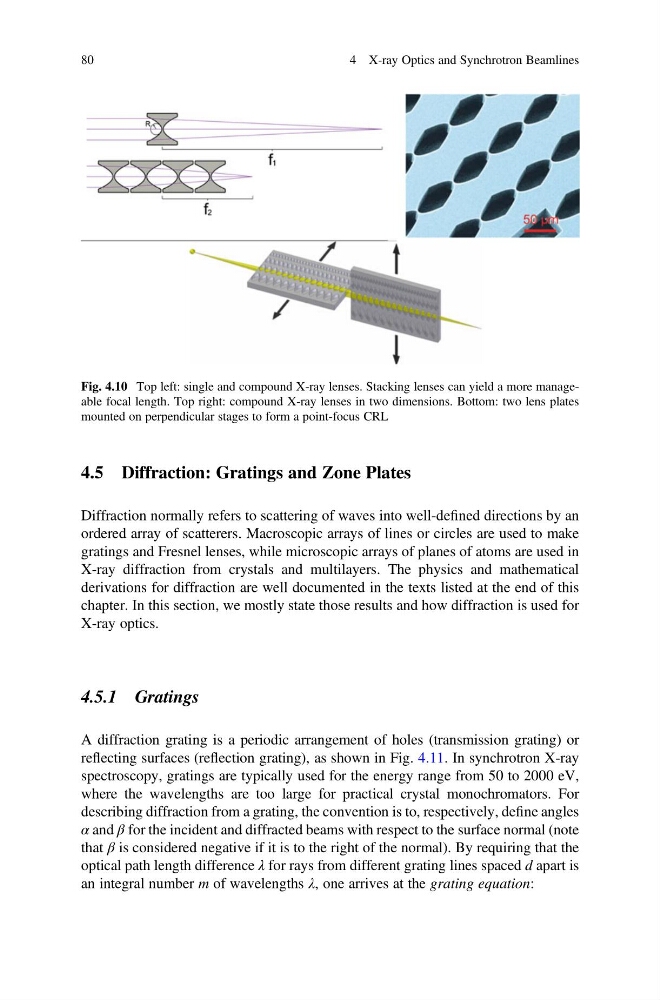
Fig. 4.10 Top left: single and compound X-ray lenses. Stacking lenses can yield a more manageable focal length. Top right: compound X-ray lenses in two dimensions. Bottom: two lens plates
mounted on perpendicular stages to form a point-focus CRL
80
4 X-ray Optics and Synchrotron Beamlines
Diffraction normally refers to scattering of waves into well-defined directions by an
ordered array of scatterers. Macroscopic arrays of lines or circles are used to make
gratings and Fresnel lenses, while microscopic arrays of planes of atoms are used in
X-ray diffraction from crystals and multilayers. The physics and mathematical
derivations for diffraction are well documented in the texts listed at the end of this
chapter. In this section, we mostly state those results and how diffraction is used for
X-ray optics.
4.5.1 Gratings
A diffraction grating is a periodic arrangement of holes (transmission grating) or
reflecting surfaces (reflection grating), as shown in Fig. 4.11. In synchrotron X-ray
spectroscopy, gratings are typically used for the energy range from 50 to 2000 eV,
where the wavelengths are too large for practical crystal monochromators. For
describing diffraction from a grating, the convention is to, respectively, define angles
α and β for the incident and diffracted beams with respect to the surface normal (note
that β is considered negative if it is to the right of the normal). By requiring that the
optical path length difference λ for rays from different grating lines spaced d apart is
an integral number m of wavelengths λ, one arrives at the grating equation:
Fig. 4.10 Top left: single and compound X-ray lenses. Stacking lenses can yield a more manageable focal length. Top right: compound X-ray lenses in two dimensions. Bottom: two lens plates
mounted on perpendicular stages to form a point-focus CRL
80
4 X-ray Optics and Synchrotron Beamlines