

4.4 Refraction: X-ray Lenses
For X-rays coming from a vacuum into a solid material, n 1 < n 2 and hence X-rays
are bent away from the normal. Thus, a focusing X-ray lens will be concave instead
of convex! Such X-ray lenses can be made by drilling holes in low Z materials. The
focal length of a single “hole-based” X-ray lens with radius of curvature R is given
by:
1=f ¼ 2δ=R
ð4:17Þ
This often yields an optic with an impractically long focal length. However, by
combining a number “N” of closely spaced holes together, a useful device can be
produced—a compound refractive lens or CRL [95]. In the thin lens approximation,
this results in a shorter focal length, given by:
1=f ¼ N2δ=R
ð4:18Þ
These devices are used to reduce the divergence of undulator beams at thirdgeneration sources. The undulator source is placed at the focal length of the lens, and
the beam that emerges is collimated (focused at infinity). Refractive optics are
becoming a popular and efficient method for collimating undulator beams, yielding
reduced divergence without much loss in intensity. Refractive optics are in place on
half of the ESRF’s beamlines and are in wide use at a half dozen other synchrotrons
(Fig. 4.10).
Nowadays, CRLs are made by reactive ion etching (RIE) of holes into Si or even
diamond. It turns out that parabolic surfaces produce a better focus when the incident
beam in collimated. It is an active area of research.
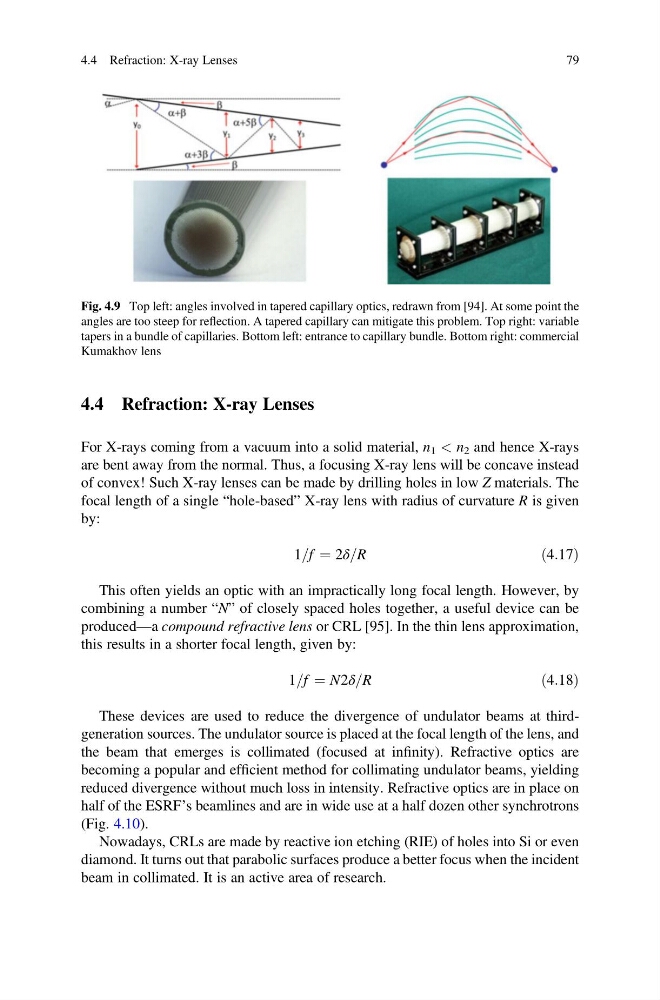
Fig. 4.9 Top left: angles involved in tapered capillary optics, redrawn from [94]. At some point the
angles are too steep for reflection. A tapered capillary can mitigate this problem. Top right: variable
tapers in a bundle of capillaries. Bottom left: entrance to capillary bundle. Bottom right: commercial
Kumakhov lens
4.4 Refraction: X-ray Lenses
79
For X-rays coming from a vacuum into a solid material, n 1 < n 2 and hence X-rays
are bent away from the normal. Thus, a focusing X-ray lens will be concave instead
of convex! Such X-ray lenses can be made by drilling holes in low Z materials. The
focal length of a single “hole-based” X-ray lens with radius of curvature R is given
by:
1=f ¼ 2δ=R
ð4:17Þ
This often yields an optic with an impractically long focal length. However, by
combining a number “N” of closely spaced holes together, a useful device can be
produced—a compound refractive lens or CRL [95]. In the thin lens approximation,
this results in a shorter focal length, given by:
1=f ¼ N2δ=R
ð4:18Þ
These devices are used to reduce the divergence of undulator beams at thirdgeneration sources. The undulator source is placed at the focal length of the lens, and
the beam that emerges is collimated (focused at infinity). Refractive optics are
becoming a popular and efficient method for collimating undulator beams, yielding
reduced divergence without much loss in intensity. Refractive optics are in place on
half of the ESRF’s beamlines and are in wide use at a half dozen other synchrotrons
(Fig. 4.10).
Nowadays, CRLs are made by reactive ion etching (RIE) of holes into Si or even
diamond. It turns out that parabolic surfaces produce a better focus when the incident
beam in collimated. It is an active area of research.
Fig. 4.9 Top left: angles involved in tapered capillary optics, redrawn from [94]. At some point the
angles are too steep for reflection. A tapered capillary can mitigate this problem. Top right: variable
tapers in a bundle of capillaries. Bottom left: entrance to capillary bundle. Bottom right: commercial
Kumakhov lens
4.4 Refraction: X-ray Lenses
79