

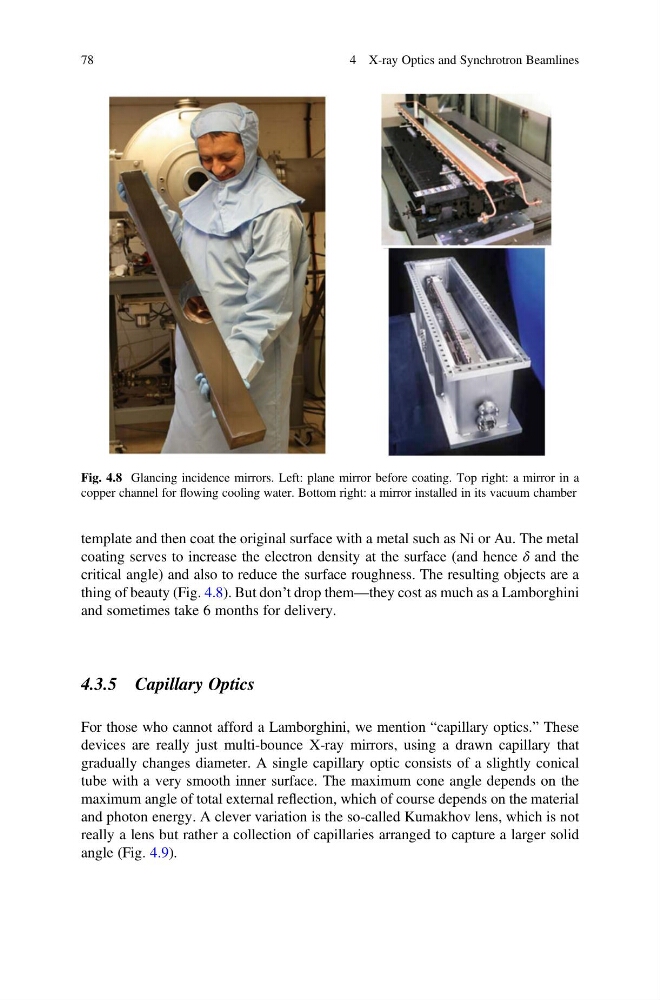
template and then coat the original surface with a metal such as Ni or Au. The metal
coating serves to increase the electron density at the surface (and hence δ and the
critical angle) and also to reduce the surface roughness. The resulting objects are a
thing of beauty (Fig. 4.8). But don’t drop them—they cost as much as a Lamborghini
and sometimes take 6 months for delivery.
4.3.5 Capillary Optics
For those who cannot afford a Lamborghini, we mention “capillary optics.” These
devices are really just multi-bounce X-ray mirrors, using a drawn capillary that
gradually changes diameter. A single capillary optic consists of a slightly conical
tube with a very smooth inner surface. The maximum cone angle depends on the
maximum angle of total external reflection, which of course depends on the material
and photon energy. A clever variation is the so-called Kumakhov lens, which is not
really a lens but rather a collection of capillaries arranged to capture a larger solid
angle (Fig. 4.9).
Fig. 4.8 Glancing incidence mirrors. Left: plane mirror before coating. Top right: a mirror in a
copper channel for flowing cooling water. Bottom right: a mirror installed in its vacuum chamber
78
4 X-ray Optics and Synchrotron Beamlines
coating serves to increase the electron density at the surface (and hence δ and the
critical angle) and also to reduce the surface roughness. The resulting objects are a
thing of beauty (Fig. 4.8). But don’t drop them—they cost as much as a Lamborghini
and sometimes take 6 months for delivery.
4.3.5 Capillary Optics
For those who cannot afford a Lamborghini, we mention “capillary optics.” These
devices are really just multi-bounce X-ray mirrors, using a drawn capillary that
gradually changes diameter. A single capillary optic consists of a slightly conical
tube with a very smooth inner surface. The maximum cone angle depends on the
maximum angle of total external reflection, which of course depends on the material
and photon energy. A clever variation is the so-called Kumakhov lens, which is not
really a lens but rather a collection of capillaries arranged to capture a larger solid
angle (Fig. 4.9).
Fig. 4.8 Glancing incidence mirrors. Left: plane mirror before coating. Top right: a mirror in a
copper channel for flowing cooling water. Bottom right: a mirror installed in its vacuum chamber
78
4 X-ray Optics and Synchrotron Beamlines