

achieved by clever bending schemes [91], referred to as “dynamic figuring.” Nowadays the best elliptical mirrors use “static figuring” and are machined with liquid jet
or other technologies directly to an ellipsoidal shape with sub-nanometer figure
accuracy and ~1 Å rms roughness [92, 93].
4.3.4 Practical Mirror Fabrication
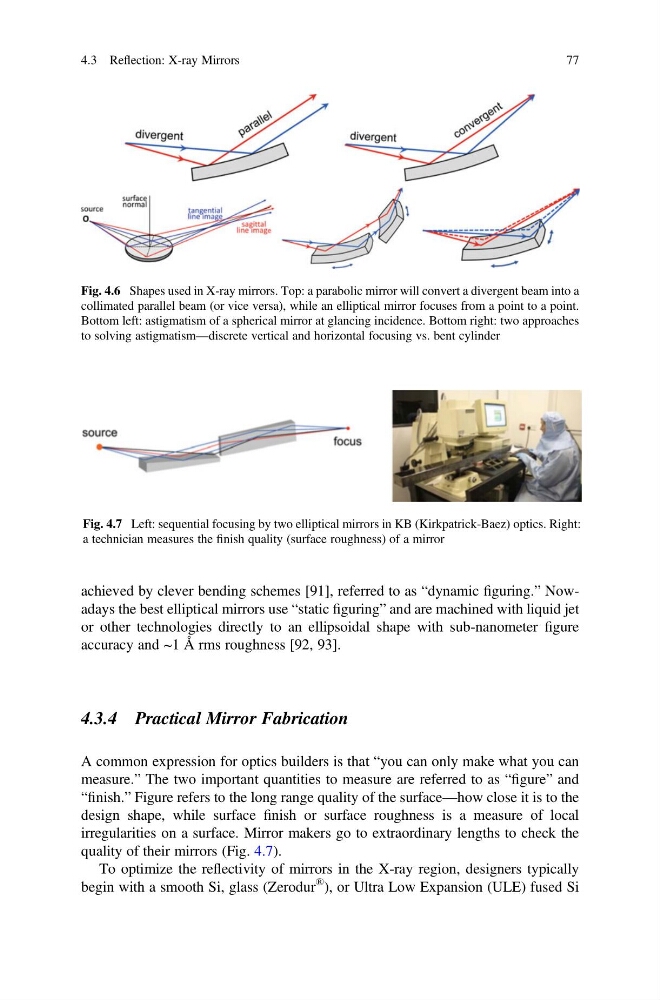
A common expression for optics builders is that “you can only make what you can
measure.” The two important quantities to measure are referred to as “figure” and
“finish.” Figure refers to the long range quality of the surface—how close it is to the
design shape, while surface finish or surface roughness is a measure of local
irregularities on a surface. Mirror makers go to extraordinary lengths to check the
quality of their mirrors (Fig. 4.7).
To optimize the reflectivity of mirrors in the X-ray region, designers typically
begin with a smooth Si, glass (Zerodur
® ), or Ultra Low Expansion (ULE) fused Si
Fig. 4.6 Shapes used in X-ray mirrors. Top: a parabolic mirror will convert a divergent beam into a
collimated parallel beam (or vice versa), while an elliptical mirror focuses from a point to a point.
Bottom left: astigmatism of a spherical mirror at glancing incidence. Bottom right: two approaches
to solving astigmatism—discrete vertical and horizontal focusing vs. bent cylinder
Fig. 4.7 Left: sequential focusing by two elliptical mirrors in KB (Kirkpatrick-Baez) optics. Right:
a technician measures the finish quality (surface roughness) of a mirror
4.3 Reflection: X-ray Mirrors
77
or other technologies directly to an ellipsoidal shape with sub-nanometer figure
accuracy and ~1 Å rms roughness [92, 93].
4.3.4 Practical Mirror Fabrication
A common expression for optics builders is that “you can only make what you can
measure.” The two important quantities to measure are referred to as “figure” and
“finish.” Figure refers to the long range quality of the surface—how close it is to the
design shape, while surface finish or surface roughness is a measure of local
irregularities on a surface. Mirror makers go to extraordinary lengths to check the
quality of their mirrors (Fig. 4.7).
To optimize the reflectivity of mirrors in the X-ray region, designers typically
begin with a smooth Si, glass (Zerodur
® ), or Ultra Low Expansion (ULE) fused Si
Fig. 4.6 Shapes used in X-ray mirrors. Top: a parabolic mirror will convert a divergent beam into a
collimated parallel beam (or vice versa), while an elliptical mirror focuses from a point to a point.
Bottom left: astigmatism of a spherical mirror at glancing incidence. Bottom right: two approaches
to solving astigmatism—discrete vertical and horizontal focusing vs. bent cylinder
Fig. 4.7 Left: sequential focusing by two elliptical mirrors in KB (Kirkpatrick-Baez) optics. Right:
a technician measures the finish quality (surface roughness) of a mirror
4.3 Reflection: X-ray Mirrors
77