

3.7.9 Polarization of a Planar Undulator
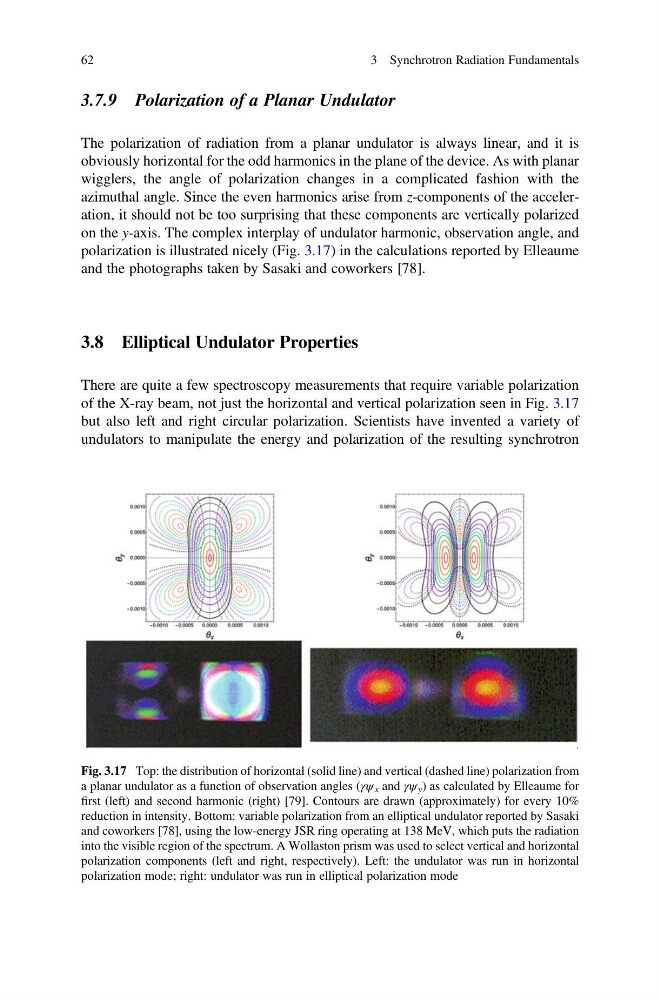
The polarization of radiation from a planar undulator is always linear, and it is
obviously horizontal for the odd harmonics in the plane of the device. As with planar
wigglers, the angle of polarization changes in a complicated fashion with the
azimuthal angle. Since the even harmonics arise from z-components of the acceleration, it should not be too surprising that these components are vertically polarized
on the y-axis. The complex interplay of undulator harmonic, observation angle, and
polarization is illustrated nicely (Fig. 3.17) in the calculations reported by Elleaume
and the photographs taken by Sasaki and coworkers [78].
3.8 Elliptical Undulator Properties
There are quite a few spectroscopy measurements that require variable polarization
of the X-ray beam, not just the horizontal and vertical polarization seen in Fig. 3.17
but also left and right circular polarization. Scientists have invented a variety of
undulators to manipulate the energy and polarization of the resulting synchrotron
Fig. 3.17 Top: the distribution of horizontal (solid line) and vertical (dashed line) polarization from
a planar undulator as a function of observation angles (γψ x and γψ y ) as calculated by Elleaume for
first (left) and second harmonic (right) [79]. Contours are drawn (approximately) for every 10%
reduction in intensity. Bottom: variable polarization from an elliptical undulator reported by Sasaki
and coworkers [78], using the low-energy JSR ring operating at 138 MeV, which puts the radiation
into the visible region of the spectrum. A Wollaston prism was used to select vertical and horizontal
polarization components (left and right, respectively). Left: the undulator was run in horizontal
polarization mode; right: undulator was run in elliptical polarization mode
62
3 Synchrotron Radiation Fundamentals
The polarization of radiation from a planar undulator is always linear, and it is
obviously horizontal for the odd harmonics in the plane of the device. As with planar
wigglers, the angle of polarization changes in a complicated fashion with the
azimuthal angle. Since the even harmonics arise from z-components of the acceleration, it should not be too surprising that these components are vertically polarized
on the y-axis. The complex interplay of undulator harmonic, observation angle, and
polarization is illustrated nicely (Fig. 3.17) in the calculations reported by Elleaume
and the photographs taken by Sasaki and coworkers [78].
3.8 Elliptical Undulator Properties
There are quite a few spectroscopy measurements that require variable polarization
of the X-ray beam, not just the horizontal and vertical polarization seen in Fig. 3.17
but also left and right circular polarization. Scientists have invented a variety of
undulators to manipulate the energy and polarization of the resulting synchrotron
Fig. 3.17 Top: the distribution of horizontal (solid line) and vertical (dashed line) polarization from
a planar undulator as a function of observation angles (γψ x and γψ y ) as calculated by Elleaume for
first (left) and second harmonic (right) [79]. Contours are drawn (approximately) for every 10%
reduction in intensity. Bottom: variable polarization from an elliptical undulator reported by Sasaki
and coworkers [78], using the low-energy JSR ring operating at 138 MeV, which puts the radiation
into the visible region of the spectrum. A Wollaston prism was used to select vertical and horizontal
polarization components (left and right, respectively). Left: the undulator was run in horizontal
polarization mode; right: undulator was run in elliptical polarization mode
62
3 Synchrotron Radiation Fundamentals