

3.7.8 Integrated Flux and Spectral Brightness Envelopes
Of course, in a real-world experiment, one has to integrate the undulator radiation
over a finite solid angle to obtain the maximum practical flux F of photons. To obtain
this more realistic estimate of the flux, we use an approximate formula for the odd
harmonic flux in the central cone. In practical units of photons s
À1 (0.1%
bandwidth)
À1 , the integrated flux is at the n
th harmonic:
ℱ
n
und
ϕ,ψ¼0 ¼ ½1:431 Â 10
14 N I A
½ Q n K
ð Þ
ð3:55Þ
where Q n (K ) was defined in Eq. 3.47.
Now that we have the undulator flux, we can obtain the practical brightness by
dividing by the source area and divergence. We also need to consider contributions
from the electron beam properties and possibly from diffraction effects. In deriving
the bend magnet brightness, we ignored the angular divergence of the electron beam,
because of the significant contribution from the natural opening angle 1/γ. Since the
natural divergence of undulator radiation is potentially very small, we now have to
consider both the effective source sizes in the x and y dimensions, Σ x and Σ y , and the
effective angular divergences, Σ
0
x and Σ
0
y . The various contributions yield the
following expression for the on-axis brightness:
ℬ und ¼
ℱ und
2π
ð Þ
2 P
x
P
y
P 0
x
P 0
y
ð3:56Þ
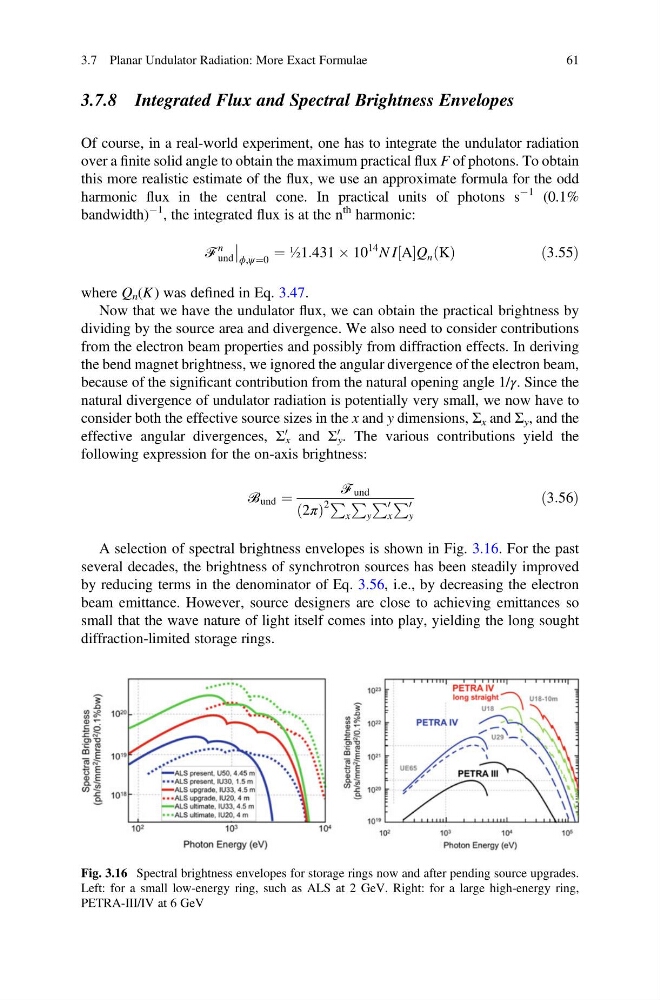
A selection of spectral brightness envelopes is shown in Fig. 3.16. For the past
several decades, the brightness of synchrotron sources has been steadily improved
by reducing terms in the denominator of Eq. 3.56, i.e., by decreasing the electron
beam emittance. However, source designers are close to achieving emittances so
small that the wave nature of light itself comes into play, yielding the long sought
diffraction-limited storage rings.
Fig. 3.16 Spectral brightness envelopes for storage rings now and after pending source upgrades.
Left: for a small low-energy ring, such as ALS at 2 GeV. Right: for a large high-energy ring,
PETRA-III/IV at 6 GeV
3.7 Planar Undulator Radiation: More Exact Formulae
61
Of course, in a real-world experiment, one has to integrate the undulator radiation
over a finite solid angle to obtain the maximum practical flux F of photons. To obtain
this more realistic estimate of the flux, we use an approximate formula for the odd
harmonic flux in the central cone. In practical units of photons s
À1 (0.1%
bandwidth)
À1 , the integrated flux is at the n
th harmonic:
ℱ
n
und
ϕ,ψ¼0 ¼ ½1:431 Â 10
14 N I A
½ Q n K
ð Þ
ð3:55Þ
where Q n (K ) was defined in Eq. 3.47.
Now that we have the undulator flux, we can obtain the practical brightness by
dividing by the source area and divergence. We also need to consider contributions
from the electron beam properties and possibly from diffraction effects. In deriving
the bend magnet brightness, we ignored the angular divergence of the electron beam,
because of the significant contribution from the natural opening angle 1/γ. Since the
natural divergence of undulator radiation is potentially very small, we now have to
consider both the effective source sizes in the x and y dimensions, Σ x and Σ y , and the
effective angular divergences, Σ
0
x and Σ
0
y . The various contributions yield the
following expression for the on-axis brightness:
ℬ und ¼
ℱ und
2π
ð Þ
2 P
x
P
y
P 0
x
P 0
y
ð3:56Þ
A selection of spectral brightness envelopes is shown in Fig. 3.16. For the past
several decades, the brightness of synchrotron sources has been steadily improved
by reducing terms in the denominator of Eq. 3.56, i.e., by decreasing the electron
beam emittance. However, source designers are close to achieving emittances so
small that the wave nature of light itself comes into play, yielding the long sought
diffraction-limited storage rings.
Fig. 3.16 Spectral brightness envelopes for storage rings now and after pending source upgrades.
Left: for a small low-energy ring, such as ALS at 2 GeV. Right: for a large high-energy ring,
PETRA-III/IV at 6 GeV
3.7 Planar Undulator Radiation: More Exact Formulae
61