

of the spectrum is not a δ function, but instead the square of a sin function. This is
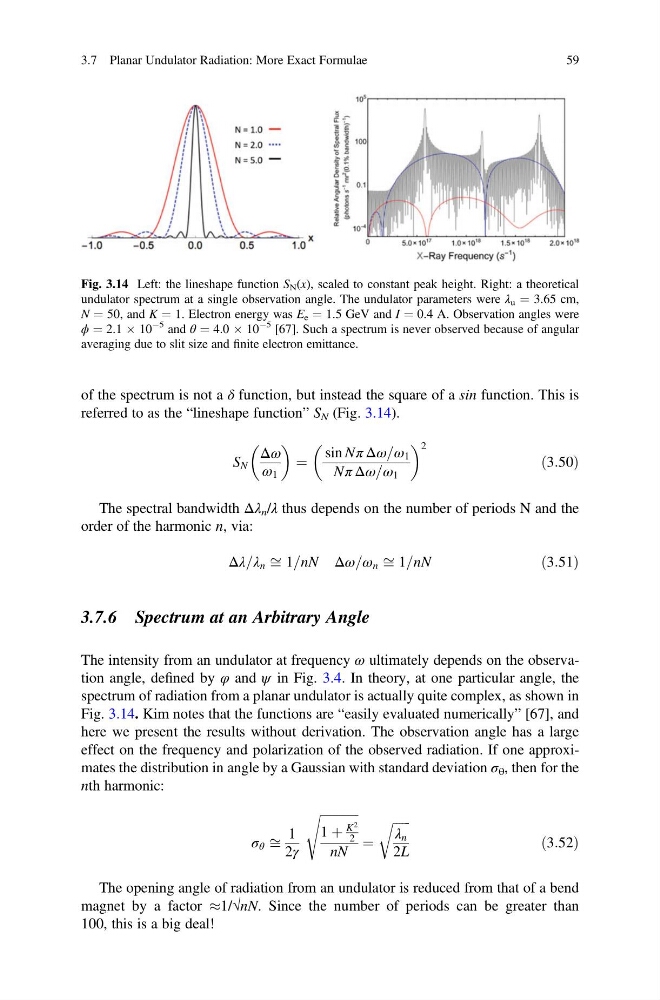
referred to as the “lineshape function” S N (Fig. 3.14).
S N
Δω
ω 1
¼
sin Nπ Δω=ω 1
Nπ Δω=ω 1
2
ð3:50Þ
The spectral bandwidth Δλ n /λ thus depends on the number of periods N and the
order of the harmonic n, via:
Δλ=λ n ffi 1=nN Δω=ω n ffi 1=nN
ð3:51Þ
3.7.6 Spectrum at an Arbitrary Angle
The intensity from an undulator at frequency ω ultimately depends on the observation angle, defined by φ and ψ in Fig. 3.4. In theory, at one particular angle, the
spectrum of radiation from a planar undulator is actually quite complex, as shown in
Fig. 3.14. Kim notes that the functions are “easily evaluated numerically” [67], and
here we present the results without derivation. The observation angle has a large
effect on the frequency and polarization of the observed radiation. If one approximates the distribution in angle by a Gaussian with standard deviation σ θ , then for the
nth harmonic:
σ θ ffi
1
2γ
ffiffiffiffiffiffiffiffiffiffiffiffi ffi
1 þ
K
2
2
nN
s
¼
ffiffiffiffiffi ffi
λ n
2L
r
ð3:52Þ
The opening angle of radiation from an undulator is reduced from that of a bend
magnet by a factor %1/√nN. Since the number of periods can be greater than
100, this is a big deal!
Fig. 3.14 Left: the lineshape function S N (x), scaled to constant peak height. Right: a theoretical
undulator spectrum at a single observation angle. The undulator parameters were λ u ¼ 3.65 cm,
N ¼ 50, and K ¼ 1. Electron energy was E e ¼ 1.5 GeV and I ¼ 0.4 A. Observation angles were
ϕ ¼ 2.1 Â 10
À5 and θ ¼ 4.0 Â 10
À5 [67]. Such a spectrum is never observed because of angular
averaging due to slit size and finite electron emittance.
3.7 Planar Undulator Radiation: More Exact Formulae
59
referred to as the “lineshape function” S N (Fig. 3.14).
S N
Δω
ω 1
¼
sin Nπ Δω=ω 1
Nπ Δω=ω 1
2
ð3:50Þ
The spectral bandwidth Δλ n /λ thus depends on the number of periods N and the
order of the harmonic n, via:
Δλ=λ n ffi 1=nN Δω=ω n ffi 1=nN
ð3:51Þ
3.7.6 Spectrum at an Arbitrary Angle
The intensity from an undulator at frequency ω ultimately depends on the observation angle, defined by φ and ψ in Fig. 3.4. In theory, at one particular angle, the
spectrum of radiation from a planar undulator is actually quite complex, as shown in
Fig. 3.14. Kim notes that the functions are “easily evaluated numerically” [67], and
here we present the results without derivation. The observation angle has a large
effect on the frequency and polarization of the observed radiation. If one approximates the distribution in angle by a Gaussian with standard deviation σ θ , then for the
nth harmonic:
σ θ ffi
1
2γ
ffiffiffiffiffiffiffiffiffiffiffiffi ffi
1 þ
K
2
2
nN
s
¼
ffiffiffiffiffi ffi
λ n
2L
r
ð3:52Þ
The opening angle of radiation from an undulator is reduced from that of a bend
magnet by a factor %1/√nN. Since the number of periods can be greater than
100, this is a big deal!
Fig. 3.14 Left: the lineshape function S N (x), scaled to constant peak height. Right: a theoretical
undulator spectrum at a single observation angle. The undulator parameters were λ u ¼ 3.65 cm,
N ¼ 50, and K ¼ 1. Electron energy was E e ¼ 1.5 GeV and I ¼ 0.4 A. Observation angles were
ϕ ¼ 2.1 Â 10
À5 and θ ¼ 4.0 Â 10
À5 [67]. Such a spectrum is never observed because of angular
averaging due to slit size and finite electron emittance.
3.7 Planar Undulator Radiation: More Exact Formulae
59