

Walker has provided a nice expression for the relative amplitude motions in the x´
and z´ directions of the frame traveling with the average electron speed βc:
z
0 amplitude
x 0 amplitude
¼
K
8 1 þ K
2
=2
À
Á 1=2
ð3:49Þ
3.7.4 Angular Properties of Undulator Radiation
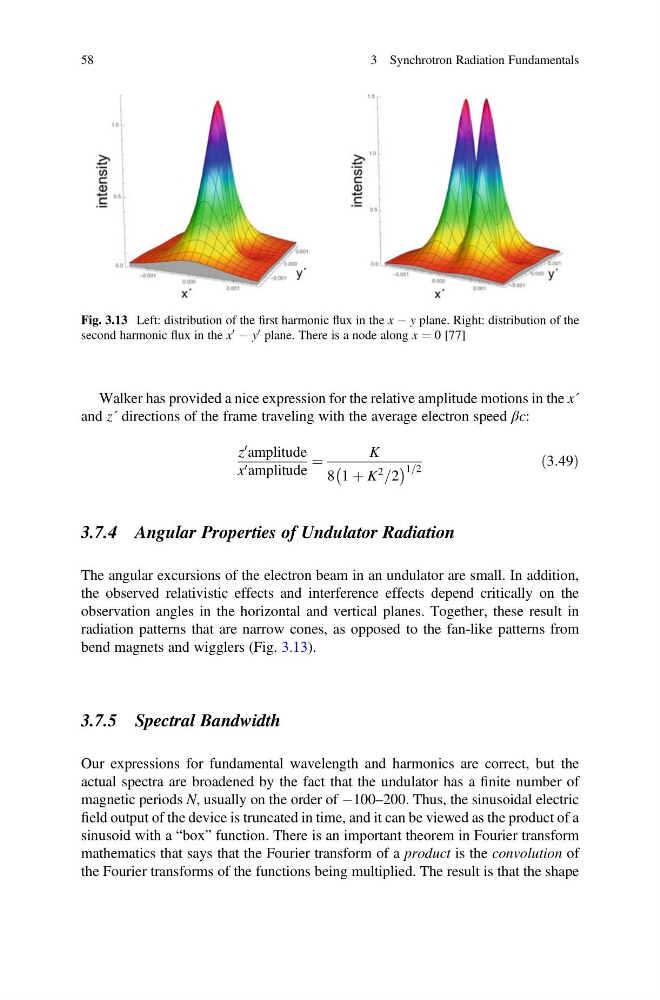
The angular excursions of the electron beam in an undulator are small. In addition,
the observed relativistic effects and interference effects depend critically on the
observation angles in the horizontal and vertical planes. Together, these result in
radiation patterns that are narrow cones, as opposed to the fan-like patterns from
bend magnets and wigglers (Fig. 3.13).
3.7.5 Spectral Bandwidth
Our expressions for fundamental wavelength and harmonics are correct, but the
actual spectra are broadened by the fact that the undulator has a finite number of
magnetic periods N, usually on the order of À100–200. Thus, the sinusoidal electric
field output of the device is truncated in time, and it can be viewed as the product of a
sinusoid with a “box” function. There is an important theorem in Fourier transform
mathematics that says that the Fourier transform of a product is the convolution of
the Fourier transforms of the functions being multiplied. The result is that the shape
Fig. 3.13 Left: distribution of the first harmonic flux in the x À y plane. Right: distribution of the
second harmonic flux in the x
0 À y
0 plane. There is a node along x ¼ 0 [77]
58
3 Synchrotron Radiation Fundamentals
and z´ directions of the frame traveling with the average electron speed βc:
z
0 amplitude
x 0 amplitude
¼
K
8 1 þ K
2
=2
À
Á 1=2
ð3:49Þ
3.7.4 Angular Properties of Undulator Radiation
The angular excursions of the electron beam in an undulator are small. In addition,
the observed relativistic effects and interference effects depend critically on the
observation angles in the horizontal and vertical planes. Together, these result in
radiation patterns that are narrow cones, as opposed to the fan-like patterns from
bend magnets and wigglers (Fig. 3.13).
3.7.5 Spectral Bandwidth
Our expressions for fundamental wavelength and harmonics are correct, but the
actual spectra are broadened by the fact that the undulator has a finite number of
magnetic periods N, usually on the order of À100–200. Thus, the sinusoidal electric
field output of the device is truncated in time, and it can be viewed as the product of a
sinusoid with a “box” function. There is an important theorem in Fourier transform
mathematics that says that the Fourier transform of a product is the convolution of
the Fourier transforms of the functions being multiplied. The result is that the shape
Fig. 3.13 Left: distribution of the first harmonic flux in the x À y plane. Right: distribution of the
second harmonic flux in the x
0 À y
0 plane. There is a node along x ¼ 0 [77]
58
3 Synchrotron Radiation Fundamentals