

ℱ
n
$ Q n K
ð Þ
Q n K
ð Þ ¼ 1 þ K
2
=2
À
Á
F n K
ð Þ=n
ð3:47Þ
The same logic that led to a reduced average β in the forward direction implies
that there will be some z-motion at 2x the frequency of horizontal motion. The factor
of 2 comes from the fact that a complete front-to-back oscillation occurs for each
center-to-side horizontal excursion. Of course, the variable z-motion will generate an
additional variable Lorentz force in the x-direction, which in turn leads to modified xmotion, a new z-motion ad infinitum. The situation is properly described by a pair of
coupled differential equations that can only be solved numerically:
d
2 x
dt
2
¼
dz
dt
e
mγ
B y z
ð Þ
d
2 z
dt
2
¼
dx
dt
e
mγ
B y z
ð Þ
ð3:48Þ
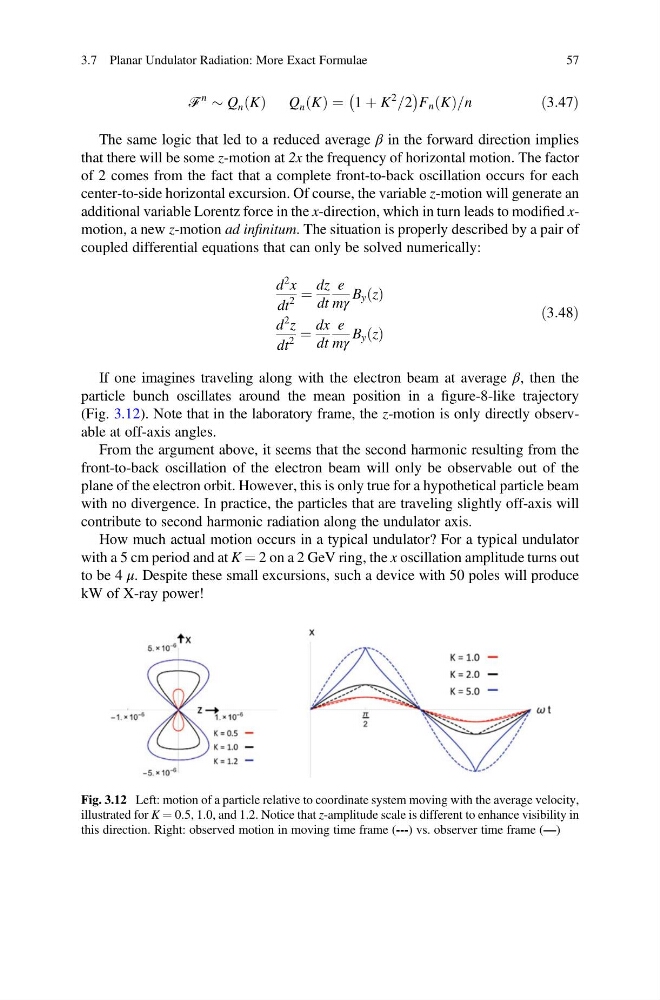
If one imagines traveling along with the electron beam at average β, then the
particle bunch oscillates around the mean position in a figure-8-like trajectory
(Fig. 3.12). Note that in the laboratory frame, the z-motion is only directly observable at off-axis angles.
From the argument above, it seems that the second harmonic resulting from the
front-to-back oscillation of the electron beam will only be observable out of the
plane of the electron orbit. However, this is only true for a hypothetical particle beam
with no divergence. In practice, the particles that are traveling slightly off-axis will
contribute to second harmonic radiation along the undulator axis.
How much actual motion occurs in a typical undulator? For a typical undulator
with a 5 cm period and at K ¼ 2 on a 2 GeV ring, the x oscillation amplitude turns out
to be 4 μ. Despite these small excursions, such a device with 50 poles will produce
kW of X-ray power!
Fig. 3.12 Left: motion of a particle relative to coordinate system moving with the average velocity,
illustrated for K ¼ 0.5, 1.0, and 1.2. Notice that z-amplitude scale is different to enhance visibility in
this direction. Right: observed motion in moving time frame (---) vs. observer time frame (—)
3.7 Planar Undulator Radiation: More Exact Formulae
57
n
$ Q n K
ð Þ
Q n K
ð Þ ¼ 1 þ K
2
=2
À
Á
F n K
ð Þ=n
ð3:47Þ
The same logic that led to a reduced average β in the forward direction implies
that there will be some z-motion at 2x the frequency of horizontal motion. The factor
of 2 comes from the fact that a complete front-to-back oscillation occurs for each
center-to-side horizontal excursion. Of course, the variable z-motion will generate an
additional variable Lorentz force in the x-direction, which in turn leads to modified xmotion, a new z-motion ad infinitum. The situation is properly described by a pair of
coupled differential equations that can only be solved numerically:
d
2 x
dt
2
¼
dz
dt
e
mγ
B y z
ð Þ
d
2 z
dt
2
¼
dx
dt
e
mγ
B y z
ð Þ
ð3:48Þ
If one imagines traveling along with the electron beam at average β, then the
particle bunch oscillates around the mean position in a figure-8-like trajectory
(Fig. 3.12). Note that in the laboratory frame, the z-motion is only directly observable at off-axis angles.
From the argument above, it seems that the second harmonic resulting from the
front-to-back oscillation of the electron beam will only be observable out of the
plane of the electron orbit. However, this is only true for a hypothetical particle beam
with no divergence. In practice, the particles that are traveling slightly off-axis will
contribute to second harmonic radiation along the undulator axis.
How much actual motion occurs in a typical undulator? For a typical undulator
with a 5 cm period and at K ¼ 2 on a 2 GeV ring, the x oscillation amplitude turns out
to be 4 μ. Despite these small excursions, such a device with 50 poles will produce
kW of X-ray power!
Fig. 3.12 Left: motion of a particle relative to coordinate system moving with the average velocity,
illustrated for K ¼ 0.5, 1.0, and 1.2. Notice that z-amplitude scale is different to enhance visibility in
this direction. Right: observed motion in moving time frame (---) vs. observer time frame (—)
3.7 Planar Undulator Radiation: More Exact Formulae
57