

In terms of energy or wavelength in practical units, the first harmonic from an
undulator is given by:
E keV
½
¼ 0:950
E
2
e GeV
½
1 þ K
2
=2 þ γ 2 θ
2
À
Á
λ u cm
½
ð3:40Þ
λ Å
 à ¼ 13:06
λ u cm
½ 1 þ K
2
=2 þ γ
2
θ
2
À
Á
E
2
e GeV
½
ð3:41Þ
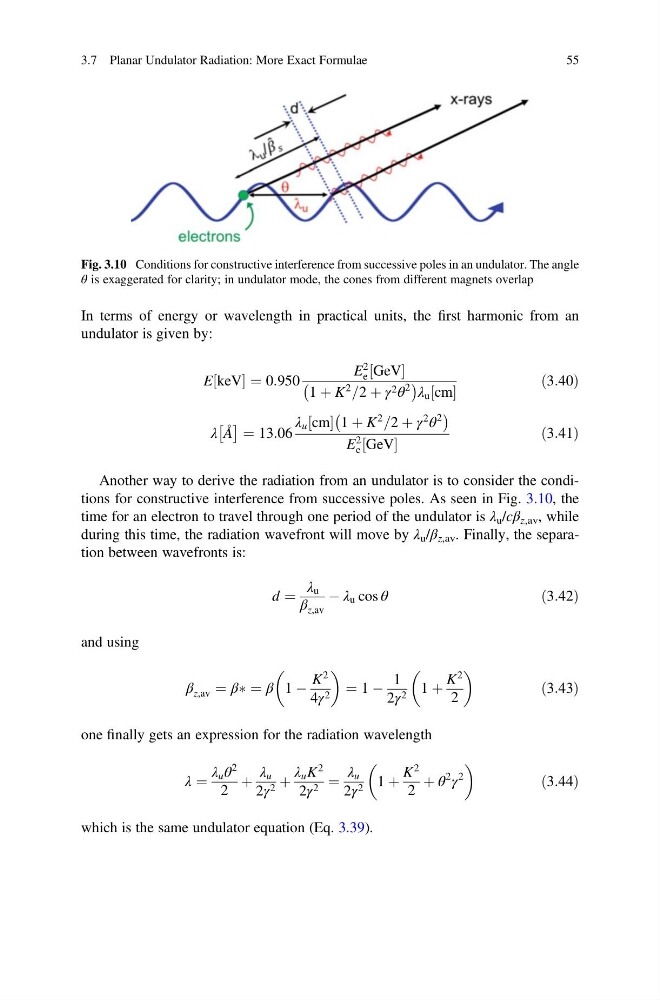
Another way to derive the radiation from an undulator is to consider the conditions for constructive interference from successive poles. As seen in Fig. 3.10, the
time for an electron to travel through one period of the undulator is λ u /cβ z,av , while
during this time, the radiation wavefront will move by λ u /β z,av . Finally, the separation between wavefronts is:
d ¼
λ u
β z,av
À λ u cos θ
ð3:42Þ
and using
β z,av ¼ βà ¼ β 1 À
K
2
4γ 2
¼ 1 À
1
2γ 2 1 þ
K
2
2
ð3:43Þ
one finally gets an expression for the radiation wavelength
λ ¼
λ u θ
2
2
þ
λ u
2γ 2 þ
λ u K
2
2γ 2 ¼
λ u
2γ 2 1 þ
K
2
2
þ θ
2
γ
2
ð3:44Þ
which is the same undulator equation (Eq. 3.39).
Fig. 3.10 Conditions for constructive interference from successive poles in an undulator. The angle
θ is exaggerated for clarity; in undulator mode, the cones from different magnets overlap
3.7 Planar Undulator Radiation: More Exact Formulae
55
undulator is given by:
E keV
½
¼ 0:950
E
2
e GeV
½
1 þ K
2
=2 þ γ 2 θ
2
À
Á
λ u cm
½
ð3:40Þ
λ Å
 à ¼ 13:06
λ u cm
½ 1 þ K
2
=2 þ γ
2
θ
2
À
Á
E
2
e GeV
½
ð3:41Þ
Another way to derive the radiation from an undulator is to consider the conditions for constructive interference from successive poles. As seen in Fig. 3.10, the
time for an electron to travel through one period of the undulator is λ u /cβ z,av , while
during this time, the radiation wavefront will move by λ u /β z,av . Finally, the separation between wavefronts is:
d ¼
λ u
β z,av
À λ u cos θ
ð3:42Þ
and using
β z,av ¼ βà ¼ β 1 À
K
2
4γ 2
¼ 1 À
1
2γ 2 1 þ
K
2
2
ð3:43Þ
one finally gets an expression for the radiation wavelength
λ ¼
λ u θ
2
2
þ
λ u
2γ 2 þ
λ u K
2
2γ 2 ¼
λ u
2γ 2 1 þ
K
2
2
þ θ
2
γ
2
ð3:44Þ
which is the same undulator equation (Eq. 3.39).
Fig. 3.10 Conditions for constructive interference from successive poles in an undulator. The angle
θ is exaggerated for clarity; in undulator mode, the cones from different magnets overlap
3.7 Planar Undulator Radiation: More Exact Formulae
55