

beamline 4 undulator period is 5 cm, and with the ring operating at 1.9 GeV,
γ ¼ 3718. Hence the output wavelength is as short as 18 Å or an energy of 689 eV!
3.7 Planar Undulator Radiation: More Exact Formulae
3.7.1 The Undulator Fundamental Wavelength
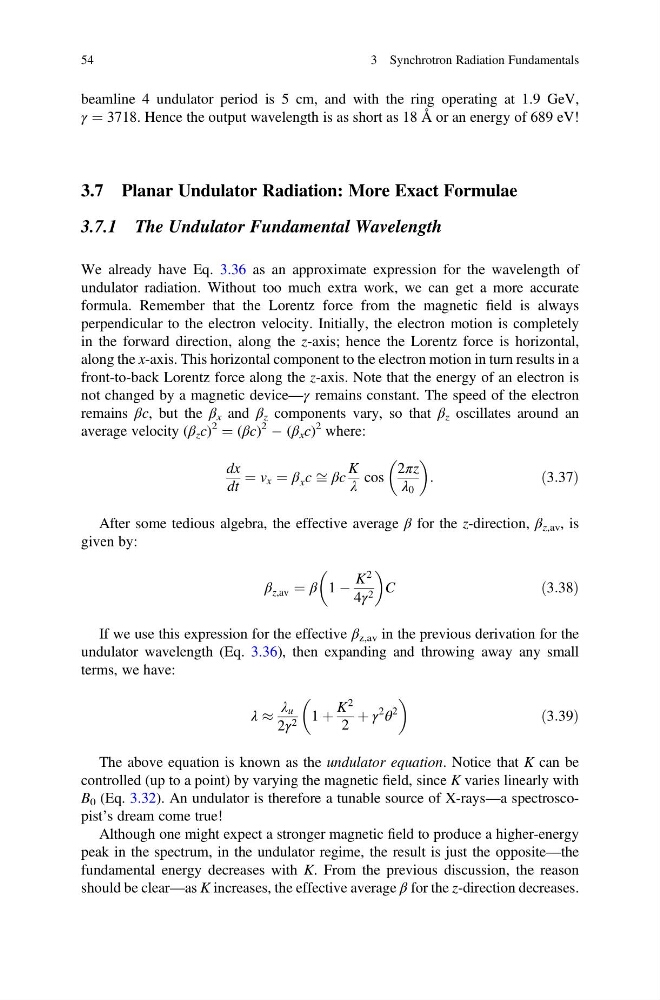
We already have Eq. 3.36 as an approximate expression for the wavelength of
undulator radiation. Without too much extra work, we can get a more accurate
formula. Remember that the Lorentz force from the magnetic field is always
perpendicular to the electron velocity. Initially, the electron motion is completely
in the forward direction, along the z-axis; hence the Lorentz force is horizontal,
along the x-axis. This horizontal component to the electron motion in turn results in a
front-to-back Lorentz force along the z-axis. Note that the energy of an electron is
not changed by a magnetic device—γ remains constant. The speed of the electron
remains βc, but the β x and β z components vary, so that β z oscillates around an
average velocity (β z c)
2
¼ (βc)
2
À (β x c)
2 where:
dx
dt
¼ v x ¼ β x c ffi βc
K
λ
cos
2πz
λ 0
:
ð3:37Þ
After some tedious algebra, the effective average β for the z-direction, β z,av , is
given by:
β z,av ¼ β 1 À
K
2
4γ 2
C
ð3:38Þ
If we use this expression for the effective β z,av in the previous derivation for the
undulator wavelength (Eq. 3.36), then expanding and throwing away any small
terms, we have:
λ %
λ u
2γ 2 1 þ
K
2
2
þ γ
2
θ
2
ð3:39Þ
The above equation is known as the undulator equation. Notice that K can be
controlled (up to a point) by varying the magnetic field, since K varies linearly with
B 0 (Eq. 3.32). An undulator is therefore a tunable source of X-rays—a spectroscopist’s dream come true!
Although one might expect a stronger magnetic field to produce a higher-energy
peak in the spectrum, in the undulator regime, the result is just the opposite—the
fundamental energy decreases with K. From the previous discussion, the reason
should be clear—as K increases, the effective average β for the z-direction decreases.
54
3 Synchrotron Radiation Fundamentals
γ ¼ 3718. Hence the output wavelength is as short as 18 Å or an energy of 689 eV!
3.7 Planar Undulator Radiation: More Exact Formulae
3.7.1 The Undulator Fundamental Wavelength
We already have Eq. 3.36 as an approximate expression for the wavelength of
undulator radiation. Without too much extra work, we can get a more accurate
formula. Remember that the Lorentz force from the magnetic field is always
perpendicular to the electron velocity. Initially, the electron motion is completely
in the forward direction, along the z-axis; hence the Lorentz force is horizontal,
along the x-axis. This horizontal component to the electron motion in turn results in a
front-to-back Lorentz force along the z-axis. Note that the energy of an electron is
not changed by a magnetic device—γ remains constant. The speed of the electron
remains βc, but the β x and β z components vary, so that β z oscillates around an
average velocity (β z c)
2
¼ (βc)
2
À (β x c)
2 where:
dx
dt
¼ v x ¼ β x c ffi βc
K
λ
cos
2πz
λ 0
:
ð3:37Þ
After some tedious algebra, the effective average β for the z-direction, β z,av , is
given by:
β z,av ¼ β 1 À
K
2
4γ 2
C
ð3:38Þ
If we use this expression for the effective β z,av in the previous derivation for the
undulator wavelength (Eq. 3.36), then expanding and throwing away any small
terms, we have:
λ %
λ u
2γ 2 1 þ
K
2
2
þ γ
2
θ
2
ð3:39Þ
The above equation is known as the undulator equation. Notice that K can be
controlled (up to a point) by varying the magnetic field, since K varies linearly with
B 0 (Eq. 3.32). An undulator is therefore a tunable source of X-rays—a spectroscopist’s dream come true!
Although one might expect a stronger magnetic field to produce a higher-energy
peak in the spectrum, in the undulator regime, the result is just the opposite—the
fundamental energy decreases with K. From the previous discussion, the reason
should be clear—as K increases, the effective average β for the z-direction decreases.
54
3 Synchrotron Radiation Fundamentals