

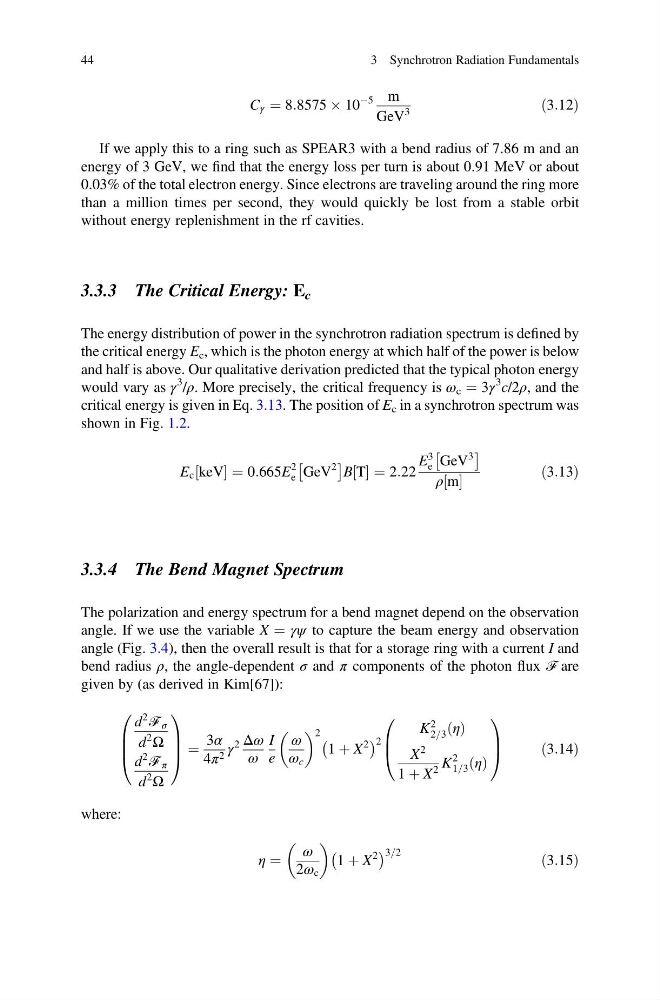
C γ ¼ 8:8575 Â 10
À5 m
GeV
3
ð3:12Þ
If we apply this to a ring such as SPEAR3 with a bend radius of 7.86 m and an
energy of 3 GeV, we find that the energy loss per turn is about 0.91 MeV or about
0.03% of the total electron energy. Since electrons are traveling around the ring more
than a million times per second, they would quickly be lost from a stable orbit
without energy replenishment in the rf cavities.
3.3.3 The Critical Energy: E c
The energy distribution of power in the synchrotron radiation spectrum is defined by
the critical energy E c , which is the photon energy at which half of the power is below
and half is above. Our qualitative derivation predicted that the typical photon energy
would vary as γ
3 /ρ. More precisely, the critical frequency is ω c ¼ 3γ
3 c/2ρ, and the
critical energy is given in Eq. 3.13. The position of E c in a synchrotron spectrum was
shown in Fig. 1.2.
E c keV
½
¼ 0:665E
2
e GeV
2
Â
Ã
B T
½ ¼ 2:22
E
3
e GeV
3
Â
Ã
ρ m
½
ð3:13Þ
3.3.4 The Bend Magnet Spectrum
The polarization and energy spectrum for a bend magnet depend on the observation
angle. If we use the variable X ¼ γψ to capture the beam energy and observation
angle (Fig. 3.4), then the overall result is that for a storage ring with a current I and
bend radius ρ, the angle-dependent σ and π components of the photon flux ℱ are
given by (as derived in Kim[67]):
d
2
ℱ σ
d
2
Ω
d
2
ℱ π
d
2
Ω
0
B
B
@
1
C
C
A ¼
3α
4π 2 γ
2 Δω
ω
I
e
ω
ω c
2
1 þ X
2
À
Á 2
K
2
2=3 η
ð Þ
X
2
1 þ X
2
K
2
1=3 η
ð Þ
0
B
@
1
C
A
ð3:14Þ
where:
η ¼
ω
2ω c
1 þ X
2
À
Á 3=2
ð3:15Þ
44
3 Synchrotron Radiation Fundamentals
À5 m
GeV
3
ð3:12Þ
If we apply this to a ring such as SPEAR3 with a bend radius of 7.86 m and an
energy of 3 GeV, we find that the energy loss per turn is about 0.91 MeV or about
0.03% of the total electron energy. Since electrons are traveling around the ring more
than a million times per second, they would quickly be lost from a stable orbit
without energy replenishment in the rf cavities.
3.3.3 The Critical Energy: E c
The energy distribution of power in the synchrotron radiation spectrum is defined by
the critical energy E c , which is the photon energy at which half of the power is below
and half is above. Our qualitative derivation predicted that the typical photon energy
would vary as γ
3 /ρ. More precisely, the critical frequency is ω c ¼ 3γ
3 c/2ρ, and the
critical energy is given in Eq. 3.13. The position of E c in a synchrotron spectrum was
shown in Fig. 1.2.
E c keV
½
¼ 0:665E
2
e GeV
2
Â
Ã
B T
½ ¼ 2:22
E
3
e GeV
3
Â
Ã
ρ m
½
ð3:13Þ
3.3.4 The Bend Magnet Spectrum
The polarization and energy spectrum for a bend magnet depend on the observation
angle. If we use the variable X ¼ γψ to capture the beam energy and observation
angle (Fig. 3.4), then the overall result is that for a storage ring with a current I and
bend radius ρ, the angle-dependent σ and π components of the photon flux ℱ are
given by (as derived in Kim[67]):
d
2
ℱ σ
d
2
Ω
d
2
ℱ π
d
2
Ω
0
B
B
@
1
C
C
A ¼
3α
4π 2 γ
2 Δω
ω
I
e
ω
ω c
2
1 þ X
2
À
Á 2
K
2
2=3 η
ð Þ
X
2
1 þ X
2
K
2
1=3 η
ð Þ
0
B
@
1
C
A
ð3:14Þ
where:
η ¼
ω
2ω c
1 þ X
2
À
Á 3=2
ð3:15Þ
44
3 Synchrotron Radiation Fundamentals