

3.3.1 Power Density and Power
In our qualitative derivation, we argued that the power radiated should scale with γ
4 ,
which in terms of beam energy means E
4
e . This turns out to be correct. In practical
units, the angular power density is given by:
d
2 P
dϕ
2
W mrad
À2
Â
à ¼ 5:42E
4
e GeV
½
B T
½ I A
½
ð3:8Þ
As a reminder, the beam energy E e and the strength of the magnetic field B are
related to the bend radius ρ, via:
ρ m
½ ¼ 3:336
E e GeV
½
B T
½
ð3:9Þ
If we integrate over horizontal and vertical angles, we finally obtain, in practical
units, a formula for the power emitted over an arc of length l:
P bm kW
½ ¼ 1:27E
2
e GeV
½
B
2 T
½ I A
½ l m
½
ð3:10Þ
3.3.2 Energy Loss Per Revolution
From the above equations, one can derive an interesting formula provided by
Wiedemann for the energy loss per revolution for one electron [13]:
ΔE GeV
½
¼C γ
E
4
e GeV
½
ρ m
½
ð3:11Þ
where:
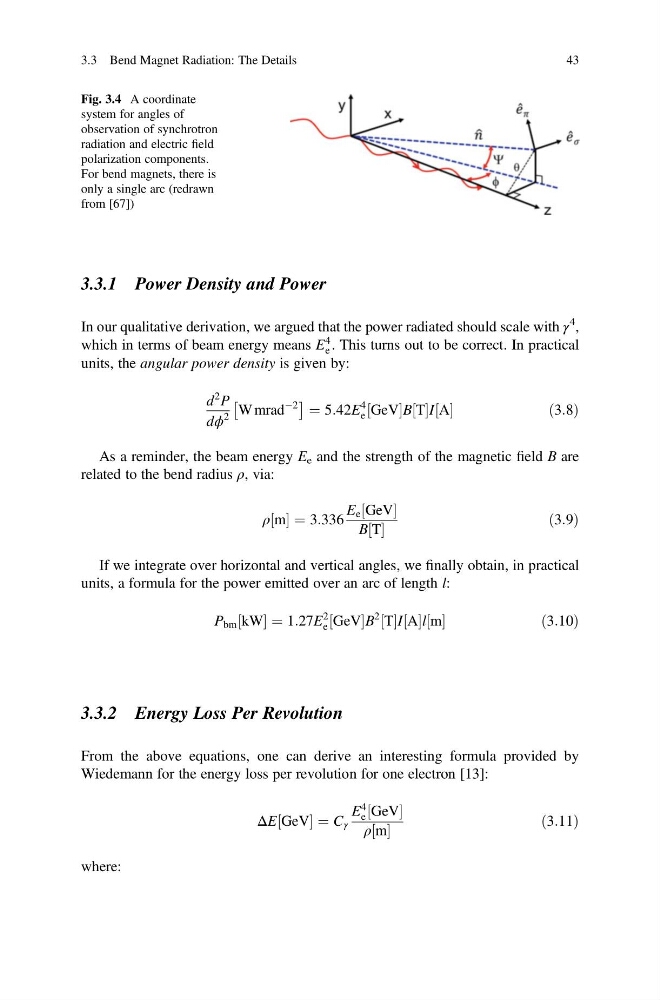
Fig. 3.4 A coordinate
system for angles of
observation of synchrotron
radiation and electric field
polarization components.
For bend magnets, there is
only a single arc (redrawn
from [67])
3.3 Bend Magnet Radiation: The Details
43
In our qualitative derivation, we argued that the power radiated should scale with γ
4 ,
which in terms of beam energy means E
4
e . This turns out to be correct. In practical
units, the angular power density is given by:
d
2 P
dϕ
2
W mrad
À2
Â
à ¼ 5:42E
4
e GeV
½
B T
½ I A
½
ð3:8Þ
As a reminder, the beam energy E e and the strength of the magnetic field B are
related to the bend radius ρ, via:
ρ m
½ ¼ 3:336
E e GeV
½
B T
½
ð3:9Þ
If we integrate over horizontal and vertical angles, we finally obtain, in practical
units, a formula for the power emitted over an arc of length l:
P bm kW
½ ¼ 1:27E
2
e GeV
½
B
2 T
½ I A
½ l m
½
ð3:10Þ
3.3.2 Energy Loss Per Revolution
From the above equations, one can derive an interesting formula provided by
Wiedemann for the energy loss per revolution for one electron [13]:
ΔE GeV
½
¼C γ
E
4
e GeV
½
ρ m
½
ð3:11Þ
where:
Fig. 3.4 A coordinate
system for angles of
observation of synchrotron
radiation and electric field
polarization components.
For bend magnets, there is
only a single arc (redrawn
from [67])
3.3 Bend Magnet Radiation: The Details
43