

In the above, K 2/3 and K 1/3 are special functions known as modified Bessel
functions of the second kind. These functions are illustrated in Appendix D, and
their origin and properties are nicely explained by Duke [70].
If we add the two polarizations together, then the angular density of total photon
flux at angular frequency ω and at observation angles θ and ψ, d
2
ℱ bm /dθdψ, is given
by:
d
2
ℱ bm
dθdψ
¼
3α
4π 2 γ
2 Δω
ω
I
e
y
2 1 þ X
2
À
Á 2 Â K
2
2=3 ξ
ð Þ þ
X
2
1 þ X
2
K
2
1=3 ξ
ð Þ
ð3:16Þ
where the additional symbols involved are α ¼ fine structure constant, e ¼ electron
charge ¼ 1.602 Â 10
À19 Coulomb, ω c (critical frequency) ¼ 3γ
3 /2ρ, y ¼ ω/ω c , and
ξ ¼ y(1 + X
2 )
3/2 /2. In the forward direction, ψ ¼ 0, hence there is only a σ component
to the flux, and a formula in practical units [photons s
À1 mr
À2 (0.1%ΔE/E)
À1 ] is:
d
2
ℱ bm
d
2
Ω
ψ¼0
¼ 1:33 Â 10
13 E
2
e GeV
½
I A
½ H 2 ω=ω c
ð
Þ
ð3:17Þ
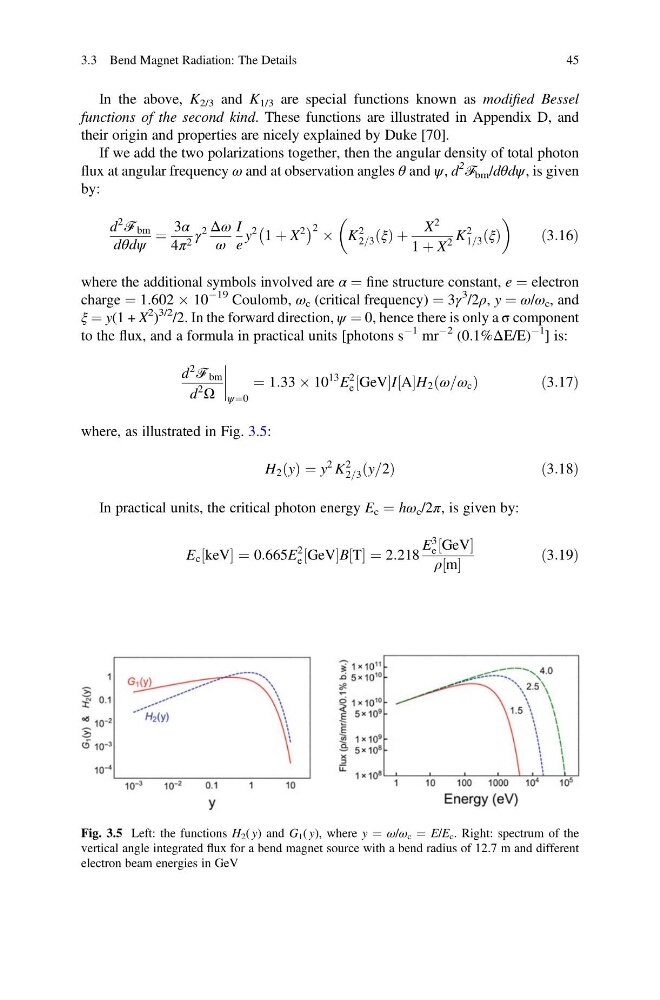
where, as illustrated in Fig. 3.5:
H 2 y
ð Þ ¼ y
2 K
2
2=3 y=2
ð Þ
ð3:18Þ
In practical units, the critical photon energy E c ¼ hω c /2π, is given by:
E c keV
½
¼ 0:665E
2
e GeV
½
B T
½ ¼ 2:218
E
3
e GeV
½
ρ m
½
ð3:19Þ
Fig. 3.5 Left: the functions H 2 ( y) and G 1 ( y), where y ¼ ω/ω c ¼ E/E c . Right: spectrum of the
vertical angle integrated flux for a bend magnet source with a bend radius of 12.7 m and different
electron beam energies in GeV
3.3 Bend Magnet Radiation: The Details
45
functions of the second kind. These functions are illustrated in Appendix D, and
their origin and properties are nicely explained by Duke [70].
If we add the two polarizations together, then the angular density of total photon
flux at angular frequency ω and at observation angles θ and ψ, d
2
ℱ bm /dθdψ, is given
by:
d
2
ℱ bm
dθdψ
¼
3α
4π 2 γ
2 Δω
ω
I
e
y
2 1 þ X
2
À
Á 2 Â K
2
2=3 ξ
ð Þ þ
X
2
1 þ X
2
K
2
1=3 ξ
ð Þ
ð3:16Þ
where the additional symbols involved are α ¼ fine structure constant, e ¼ electron
charge ¼ 1.602 Â 10
À19 Coulomb, ω c (critical frequency) ¼ 3γ
3 /2ρ, y ¼ ω/ω c , and
ξ ¼ y(1 + X
2 )
3/2 /2. In the forward direction, ψ ¼ 0, hence there is only a σ component
to the flux, and a formula in practical units [photons s
À1 mr
À2 (0.1%ΔE/E)
À1 ] is:
d
2
ℱ bm
d
2
Ω
ψ¼0
¼ 1:33 Â 10
13 E
2
e GeV
½
I A
½ H 2 ω=ω c
ð
Þ
ð3:17Þ
where, as illustrated in Fig. 3.5:
H 2 y
ð Þ ¼ y
2 K
2
2=3 y=2
ð Þ
ð3:18Þ
In practical units, the critical photon energy E c ¼ hω c /2π, is given by:
E c keV
½
¼ 0:665E
2
e GeV
½
B T
½ ¼ 2:218
E
3
e GeV
½
ρ m
½
ð3:19Þ
Fig. 3.5 Left: the functions H 2 ( y) and G 1 ( y), where y ¼ ω/ω c ¼ E/E c . Right: spectrum of the
vertical angle integrated flux for a bend magnet source with a bend radius of 12.7 m and different
electron beam energies in GeV
3.3 Bend Magnet Radiation: The Details
45