

2.5.6 Superconducting Undulators
The use of superconducting magnets is the latest step in the quest for shorter periods
and higher fields. In principle, superconducting coils can provide higher field
strength for the same gap and period length, which translates to more flux from
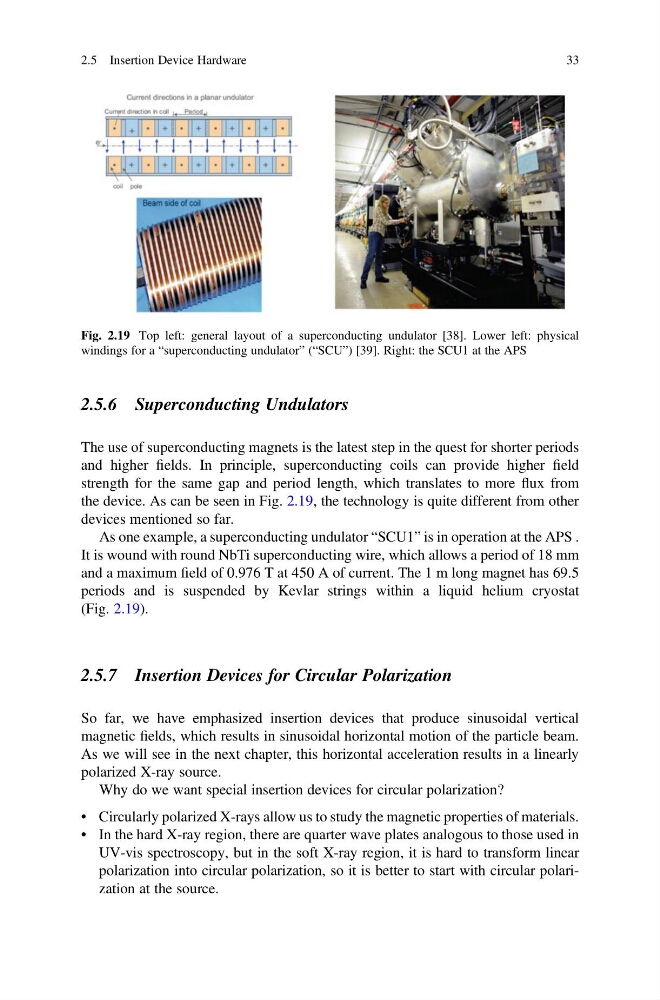
the device. As can be seen in Fig. 2.19, the technology is quite different from other
devices mentioned so far.
As one example, a superconducting undulator “SCU1” is in operation at the APS .
It is wound with round NbTi superconducting wire, which allows a period of 18 mm
and a maximum field of 0.976 T at 450 A of current. The 1 m long magnet has 69.5
periods and is suspended by Kevlar strings within a liquid helium cryostat
(Fig. 2.19).
2.5.7 Insertion Devices for Circular Polarization
So far, we have emphasized insertion devices that produce sinusoidal vertical
magnetic fields, which results in sinusoidal horizontal motion of the particle beam.
As we will see in the next chapter, this horizontal acceleration results in a linearly
polarized X-ray source.
Why do we want special insertion devices for circular polarization?
• Circularly polarized X-rays allow us to study the magnetic properties of materials.
• In the hard X-ray region, there are quarter wave plates analogous to those used in
UV-vis spectroscopy, but in the soft X-ray region, it is hard to transform linear
polarization into circular polarization, so it is better to start with circular polarization at the source.
Fig. 2.19 Top left: general layout of a superconducting undulator [38]. Lower left: physical
windings for a “superconducting undulator” (“SCU”) [39]. Right: the SCU1 at the APS
2.5 Insertion Device Hardware
33
The use of superconducting magnets is the latest step in the quest for shorter periods
and higher fields. In principle, superconducting coils can provide higher field
strength for the same gap and period length, which translates to more flux from
the device. As can be seen in Fig. 2.19, the technology is quite different from other
devices mentioned so far.
As one example, a superconducting undulator “SCU1” is in operation at the APS .
It is wound with round NbTi superconducting wire, which allows a period of 18 mm
and a maximum field of 0.976 T at 450 A of current. The 1 m long magnet has 69.5
periods and is suspended by Kevlar strings within a liquid helium cryostat
(Fig. 2.19).
2.5.7 Insertion Devices for Circular Polarization
So far, we have emphasized insertion devices that produce sinusoidal vertical
magnetic fields, which results in sinusoidal horizontal motion of the particle beam.
As we will see in the next chapter, this horizontal acceleration results in a linearly
polarized X-ray source.
Why do we want special insertion devices for circular polarization?
• Circularly polarized X-rays allow us to study the magnetic properties of materials.
• In the hard X-ray region, there are quarter wave plates analogous to those used in
UV-vis spectroscopy, but in the soft X-ray region, it is hard to transform linear
polarization into circular polarization, so it is better to start with circular polarization at the source.
Fig. 2.19 Top left: general layout of a superconducting undulator [38]. Lower left: physical
windings for a “superconducting undulator” (“SCU”) [39]. Right: the SCU1 at the APS
2.5 Insertion Device Hardware
33