

SmCo 5 with a remanent field of 0.9 T and vanadium-permendur alloy pole pieces,
yielding a maximum field of 1.63 T. A more modern example of a hybrid insertion
device is the 2 m long U-29 standard undulator for PETRA-III (Fig. 2.17). With an
undulator period of 28 mm, at the minimum gap of 9.5 mm, it provides a peak field
B 0 of 0.81 Tesla and radiates about 3 kW of power [35].
2.5.5 In-Vacuum and Cryogenic Undulators
Machine physicists are constantly striving to build insertion devices with higher
fields and shorter periods. Part of the driving force is economics, because higher
fields and shorter periods mean that the storage ring can operate at a lower energy
and produce the same X-rays. From the expressions for the undulator peak fields, we
find that one needs to either (a) decrease the gap or (b) increase the remanent field or
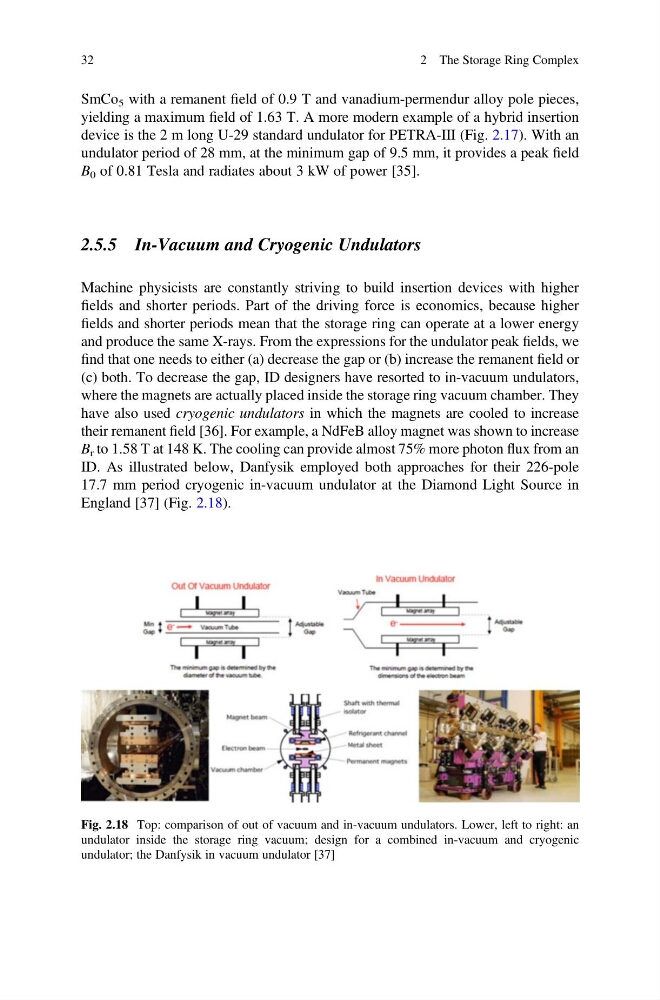
(c) both. To decrease the gap, ID designers have resorted to in-vacuum undulators,
where the magnets are actually placed inside the storage ring vacuum chamber. They
have also used cryogenic undulators in which the magnets are cooled to increase
their remanent field [36]. For example, a NdFeB alloy magnet was shown to increase
B r to 1.58 T at 148 K. The cooling can provide almost 75% more photon flux from an
ID. As illustrated below, Danfysik employed both approaches for their 226-pole
17.7 mm period cryogenic in-vacuum undulator at the Diamond Light Source in
England [37] (Fig. 2.18).
Fig. 2.18 Top: comparison of out of vacuum and in-vacuum undulators. Lower, left to right: an
undulator inside the storage ring vacuum; design for a combined in-vacuum and cryogenic
undulator; the Danfysik in vacuum undulator [37]
32
2 The Storage Ring Complex
yielding a maximum field of 1.63 T. A more modern example of a hybrid insertion
device is the 2 m long U-29 standard undulator for PETRA-III (Fig. 2.17). With an
undulator period of 28 mm, at the minimum gap of 9.5 mm, it provides a peak field
B 0 of 0.81 Tesla and radiates about 3 kW of power [35].
2.5.5 In-Vacuum and Cryogenic Undulators
Machine physicists are constantly striving to build insertion devices with higher
fields and shorter periods. Part of the driving force is economics, because higher
fields and shorter periods mean that the storage ring can operate at a lower energy
and produce the same X-rays. From the expressions for the undulator peak fields, we
find that one needs to either (a) decrease the gap or (b) increase the remanent field or
(c) both. To decrease the gap, ID designers have resorted to in-vacuum undulators,
where the magnets are actually placed inside the storage ring vacuum chamber. They
have also used cryogenic undulators in which the magnets are cooled to increase
their remanent field [36]. For example, a NdFeB alloy magnet was shown to increase
B r to 1.58 T at 148 K. The cooling can provide almost 75% more photon flux from an
ID. As illustrated below, Danfysik employed both approaches for their 226-pole
17.7 mm period cryogenic in-vacuum undulator at the Diamond Light Source in
England [37] (Fig. 2.18).
Fig. 2.18 Top: comparison of out of vacuum and in-vacuum undulators. Lower, left to right: an
undulator inside the storage ring vacuum; design for a combined in-vacuum and cryogenic
undulator; the Danfysik in vacuum undulator [37]
32
2 The Storage Ring Complex