

which gave more flexibility for the beam parameters in the insertion device
region, was also used by the Swiss light source (SLS). However, subsequent
designs such as NSLS-II, Diamond, and SOLEIL stayed with a DBA lattice.
DBA and TBA designs remained the rule for more than three decades.
Since the emittance of a storage ring synchrotron light scales with the third
power of the bend magnet deflection angles, it was often thought that for very
low emittance, a ring had to be very large, with many small deflection
magnets. However, the ring designers in Sweden realized that the same
principle could be applied to a modest size ring, and they developed a
“multi-bend achromat” (MBA) design with 7 bend magnets in each of 20 achromat cells [20]. This new lattice design was implemented in 2016 with the
commissioning of the Swedish light source MAX-IV [14], while the ALS-U
upgrade envisions a 9-bend MBA lattice [21]. Plans for MBA upgrades now
exist for many of the third-generation sources [22], all in a quest for the
ultimate “diffraction-limited storage ring” or DLSR [23].
Apart from small orbit deviations caused by synchrotron radiation, particles can
be scattered so far from the ideal orbit that they are lost from the beam entirely. This
scattering can be caused by (a) collisions with residual gas molecules in the
chamber—bunch-gas scattering, (b) scattering between electrons within the same
bunch—Touschek scattering, and (c) quantum excitations due to synchrotron radiation. Whether or not these events result in loss from the beam depends on the
“transverse acceptance” of the ring—how large a deviation from the ideal orbit can
occur with the electron still in a stable orbit.
Each of these loss mechanisms is associated with a lifetime. The vacuum lifetime
associated with bunch-gas scattering can be divided between τ cs for Coulomb or
elastic scattering and τ bs for bremsstrahlung or inelastic scattering, and both of these
are inversely related to the residual gas pressure in the ring. The Touschek lifetime,
τ T , is one of the factors that determines how dense a charge can be placed in a given
bucket. Finally, the quantum lifetime, τ q , is proportional to the aperature of the ring.
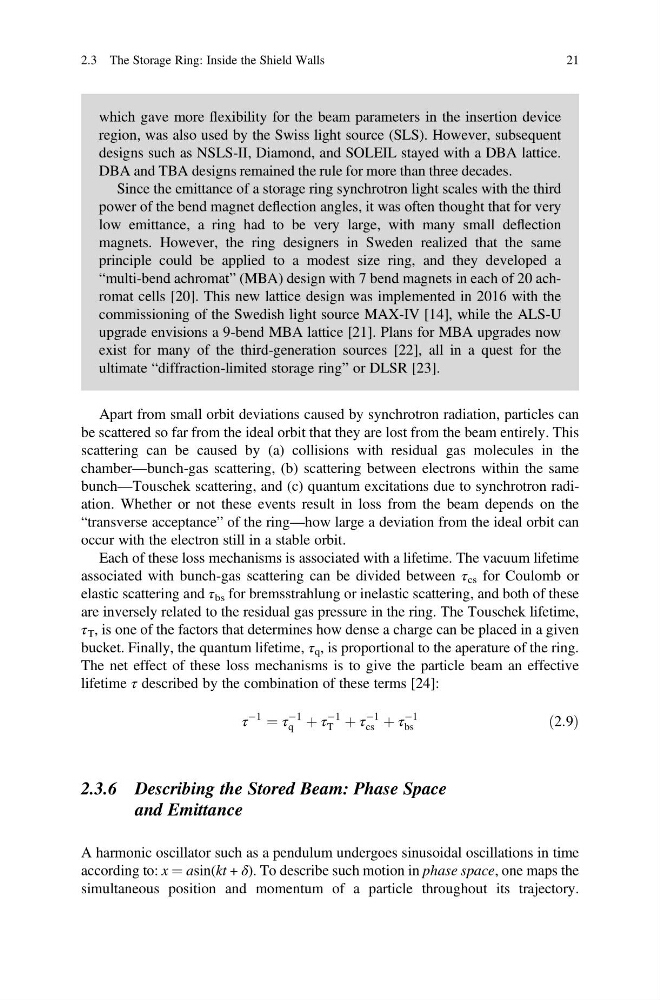
The net effect of these loss mechanisms is to give the particle beam an effective
lifetime τ described by the combination of these terms [24]:
τ
À1
¼ τ
À1
q þ τ
À1
T þ τ
À1
cs þ τ
À1
bs
ð2:9Þ
2.3.6 Describing the Stored Beam: Phase Space
and Emittance
A harmonic oscillator such as a pendulum undergoes sinusoidal oscillations in time
according to: x ¼ asin(kt + δ). To describe such motion in phase space, one maps the
simultaneous position and momentum of a particle throughout its trajectory.
2.3 The Storage Ring: Inside the Shield Walls
21
region, was also used by the Swiss light source (SLS). However, subsequent
designs such as NSLS-II, Diamond, and SOLEIL stayed with a DBA lattice.
DBA and TBA designs remained the rule for more than three decades.
Since the emittance of a storage ring synchrotron light scales with the third
power of the bend magnet deflection angles, it was often thought that for very
low emittance, a ring had to be very large, with many small deflection
magnets. However, the ring designers in Sweden realized that the same
principle could be applied to a modest size ring, and they developed a
“multi-bend achromat” (MBA) design with 7 bend magnets in each of 20 achromat cells [20]. This new lattice design was implemented in 2016 with the
commissioning of the Swedish light source MAX-IV [14], while the ALS-U
upgrade envisions a 9-bend MBA lattice [21]. Plans for MBA upgrades now
exist for many of the third-generation sources [22], all in a quest for the
ultimate “diffraction-limited storage ring” or DLSR [23].
Apart from small orbit deviations caused by synchrotron radiation, particles can
be scattered so far from the ideal orbit that they are lost from the beam entirely. This
scattering can be caused by (a) collisions with residual gas molecules in the
chamber—bunch-gas scattering, (b) scattering between electrons within the same
bunch—Touschek scattering, and (c) quantum excitations due to synchrotron radiation. Whether or not these events result in loss from the beam depends on the
“transverse acceptance” of the ring—how large a deviation from the ideal orbit can
occur with the electron still in a stable orbit.
Each of these loss mechanisms is associated with a lifetime. The vacuum lifetime
associated with bunch-gas scattering can be divided between τ cs for Coulomb or
elastic scattering and τ bs for bremsstrahlung or inelastic scattering, and both of these
are inversely related to the residual gas pressure in the ring. The Touschek lifetime,
τ T , is one of the factors that determines how dense a charge can be placed in a given
bucket. Finally, the quantum lifetime, τ q , is proportional to the aperature of the ring.
The net effect of these loss mechanisms is to give the particle beam an effective
lifetime τ described by the combination of these terms [24]:
τ
À1
¼ τ
À1
q þ τ
À1
T þ τ
À1
cs þ τ
À1
bs
ð2:9Þ
2.3.6 Describing the Stored Beam: Phase Space
and Emittance
A harmonic oscillator such as a pendulum undergoes sinusoidal oscillations in time
according to: x ¼ asin(kt + δ). To describe such motion in phase space, one maps the
simultaneous position and momentum of a particle throughout its trajectory.
2.3 The Storage Ring: Inside the Shield Walls
21