

A Selective History of Storage Ring Design
The earliest storage ring lattices were developed for high-energy physics
experiments, and they were simple repeats of focusing (F) and defocusing
(D) magnets, with drift sections (O) containing bend magnets in between,
hence the name “FODO” lattice. Over time, machine physicists developed
increasingly sophisticated designs to improve the brightness of synchrotron
radiation sources. From 1975 to 1977, Renate Chasman and G. Kenneth Green
were the first to design a ring to minimize the emittance of the stored particle
beam [18]. With contributions by Sam Krinsky, they invented the so-called
Chasman-Green lattice that was implemented in the first facility built for
brightness—NSLS. Part of the secret was to introduce sextupole magnets to
reduce the chromatic aberrations of conventional designs that had only dipoles
and quadrupoles, and such a design is often called a double-bend achromat or
DBA. Sadly, they both died in 1977 before construction of NSLS began [19].
Renate Chasman and Kenneth Green
Another option, the “triple-bend achromat” or TBA, added an extra bend
magnet to the superperiod and was used for the first time at the ALS. This design,
(continued)
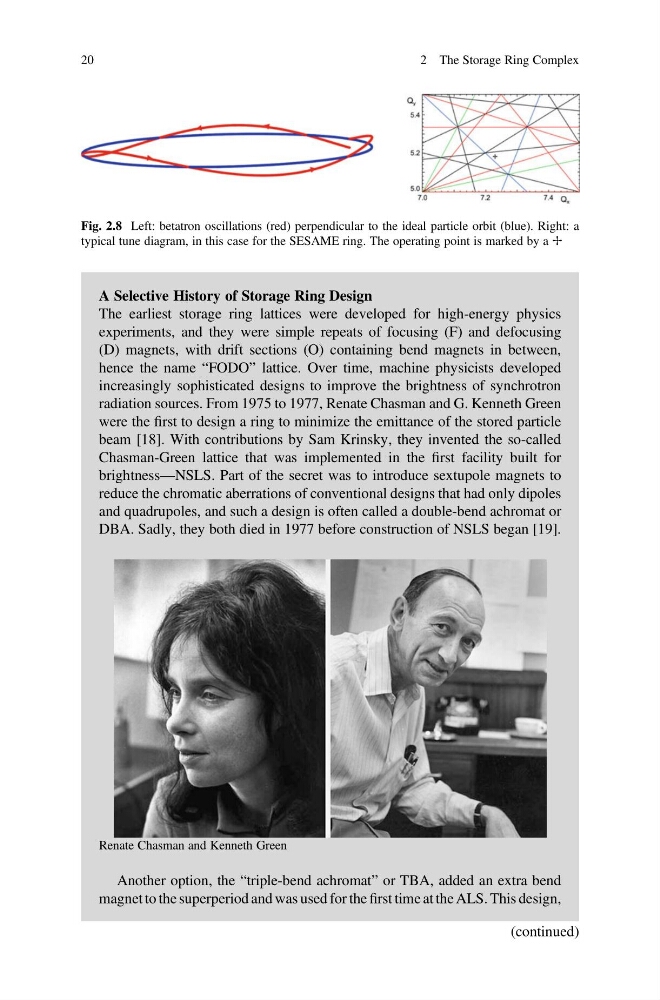
Fig. 2.8 Left: betatron oscillations (red) perpendicular to the ideal particle orbit (blue). Right: a
typical tune diagram, in this case for the SESAME ring. The operating point is marked by a ✢
20
2 The Storage Ring Complex
The earliest storage ring lattices were developed for high-energy physics
experiments, and they were simple repeats of focusing (F) and defocusing
(D) magnets, with drift sections (O) containing bend magnets in between,
hence the name “FODO” lattice. Over time, machine physicists developed
increasingly sophisticated designs to improve the brightness of synchrotron
radiation sources. From 1975 to 1977, Renate Chasman and G. Kenneth Green
were the first to design a ring to minimize the emittance of the stored particle
beam [18]. With contributions by Sam Krinsky, they invented the so-called
Chasman-Green lattice that was implemented in the first facility built for
brightness—NSLS. Part of the secret was to introduce sextupole magnets to
reduce the chromatic aberrations of conventional designs that had only dipoles
and quadrupoles, and such a design is often called a double-bend achromat or
DBA. Sadly, they both died in 1977 before construction of NSLS began [19].
Renate Chasman and Kenneth Green
Another option, the “triple-bend achromat” or TBA, added an extra bend
magnet to the superperiod and was used for the first time at the ALS. This design,
(continued)
Fig. 2.8 Left: betatron oscillations (red) perpendicular to the ideal particle orbit (blue). Right: a
typical tune diagram, in this case for the SESAME ring. The operating point is marked by a ✢
20
2 The Storage Ring Complex