

Assuming constant mass, one can also map position and velocity, in this case:
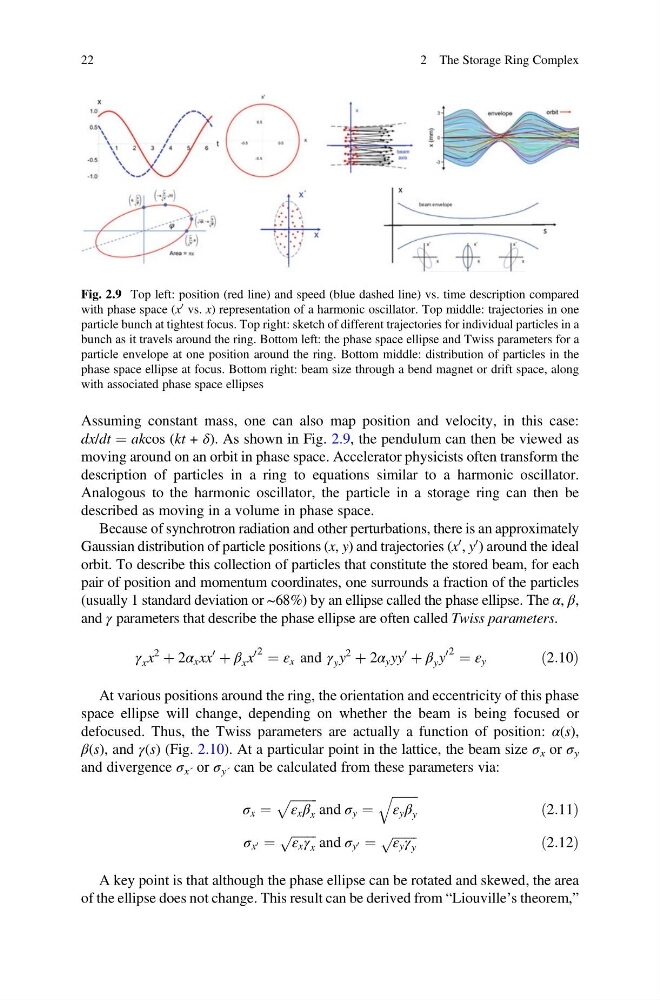
dx/dt ¼ akcos (kt + δ). As shown in Fig. 2.9, the pendulum can then be viewed as
moving around on an orbit in phase space. Accelerator physicists often transform the
description of particles in a ring to equations similar to a harmonic oscillator.
Analogous to the harmonic oscillator, the particle in a storage ring can then be
described as moving in a volume in phase space.
Because of synchrotron radiation and other perturbations, there is an approximately
Gaussian distribution of particle positions (x, y) and trajectories (x
0 , y
0 ) around the ideal
orbit. To describe this collection of particles that constitute the stored beam, for each
pair of position and momentum coordinates, one surrounds a fraction of the particles
(usually 1 standard deviation or ~68%) by an ellipse called the phase ellipse. The α, β,
and γ parameters that describe the phase ellipse are often called Twiss parameters.
γ x x
2
þ 2α x xx
0
þ β x x
0 2 ¼ ε x and γ y y
2
þ 2α y yy
0
þ β y y
0 2 ¼ ε y
ð2:10Þ
At various positions around the ring, the orientation and eccentricity of this phase
space ellipse will change, depending on whether the beam is being focused or
defocused. Thus, the Twiss parameters are actually a function of position: α(s),
β(s), and γ(s) (Fig. 2.10). At a particular point in the lattice, the beam size σ x or σ y
and divergence σ x´ or σ y´ can be calculated from these parameters via:
σ x ¼
ffiffiffiffiffiffiffiffi ffi
ε x β x
p
and σ y ¼
ffiffiffiffiffiffiffiffi ffi
ε y β y
q
ð2:11Þ
σ x 0 ¼
ffiffiffiffiffiffiffiffi
ε x γ x
p
and σ y 0 ¼
ffiffiffiffiffiffiffiffi
ε y γ y
p
ð2:12Þ
A key point is that although the phase ellipse can be rotated and skewed, the area
of the ellipse does not change. This result can be derived from “Liouville’s theorem,”
Fig. 2.9 Top left: position (red line) and speed (blue dashed line) vs. time description compared
with phase space (x
0 vs. x) representation of a harmonic oscillator. Top middle: trajectories in one
particle bunch at tightest focus. Top right: sketch of different trajectories for individual particles in a
bunch as it travels around the ring. Bottom left: the phase space ellipse and Twiss parameters for a
particle envelope at one position around the ring. Bottom middle: distribution of particles in the
phase space ellipse at focus. Bottom right: beam size through a bend magnet or drift space, along
with associated phase space ellipses
22
2 The Storage Ring Complex
dx/dt ¼ akcos (kt + δ). As shown in Fig. 2.9, the pendulum can then be viewed as
moving around on an orbit in phase space. Accelerator physicists often transform the
description of particles in a ring to equations similar to a harmonic oscillator.
Analogous to the harmonic oscillator, the particle in a storage ring can then be
described as moving in a volume in phase space.
Because of synchrotron radiation and other perturbations, there is an approximately
Gaussian distribution of particle positions (x, y) and trajectories (x
0 , y
0 ) around the ideal
orbit. To describe this collection of particles that constitute the stored beam, for each
pair of position and momentum coordinates, one surrounds a fraction of the particles
(usually 1 standard deviation or ~68%) by an ellipse called the phase ellipse. The α, β,
and γ parameters that describe the phase ellipse are often called Twiss parameters.
γ x x
2
þ 2α x xx
0
þ β x x
0 2 ¼ ε x and γ y y
2
þ 2α y yy
0
þ β y y
0 2 ¼ ε y
ð2:10Þ
At various positions around the ring, the orientation and eccentricity of this phase
space ellipse will change, depending on whether the beam is being focused or
defocused. Thus, the Twiss parameters are actually a function of position: α(s),
β(s), and γ(s) (Fig. 2.10). At a particular point in the lattice, the beam size σ x or σ y
and divergence σ x´ or σ y´ can be calculated from these parameters via:
σ x ¼
ffiffiffiffiffiffiffiffi ffi
ε x β x
p
and σ y ¼
ffiffiffiffiffiffiffiffi ffi
ε y β y
q
ð2:11Þ
σ x 0 ¼
ffiffiffiffiffiffiffiffi
ε x γ x
p
and σ y 0 ¼
ffiffiffiffiffiffiffiffi
ε y γ y
p
ð2:12Þ
A key point is that although the phase ellipse can be rotated and skewed, the area
of the ellipse does not change. This result can be derived from “Liouville’s theorem,”
Fig. 2.9 Top left: position (red line) and speed (blue dashed line) vs. time description compared
with phase space (x
0 vs. x) representation of a harmonic oscillator. Top middle: trajectories in one
particle bunch at tightest focus. Top right: sketch of different trajectories for individual particles in a
bunch as it travels around the ring. Bottom left: the phase space ellipse and Twiss parameters for a
particle envelope at one position around the ring. Bottom middle: distribution of particles in the
phase space ellipse at focus. Bottom right: beam size through a bend magnet or drift space, along
with associated phase space ellipses
22
2 The Storage Ring Complex