

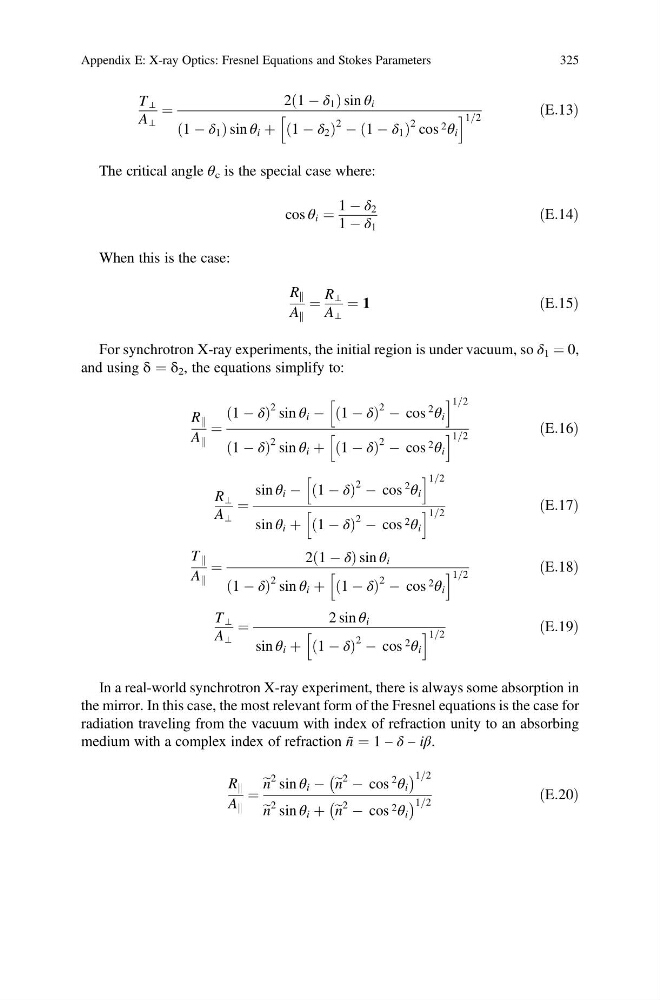
T ⊥
A ⊥
¼
2 1 À δ 1
ð
Þsin θ i
1 À δ 1
ð
Þsin θ i þ 1 À δ 2
ð
Þ
2 À 1 À δ 1
ð
Þ
2 cos 2 θ i
h
i 1=2
ðE:13Þ
The critical angle θ c is the special case where:
cos θ i ¼
1 À δ 2
1 À δ 1
ðE:14Þ
When this is the case:
R k
A k
¼
R ⊥
A ⊥
¼ 1
ðE:15Þ
For synchrotron X-ray experiments, the initial region is under vacuum, so δ 1 ¼ 0,
and using δ ¼ δ 2 , the equations simplify to:
R k
A k
¼
1 À δ
ð
Þ
2 sin θ i À 1 À δ
ð
Þ
2 À cos
2
θ i
h
i 1=2
1 À δ
ð
Þ
2 sin θ i þ 1 À δ
ð
Þ
2 À cos 2 θ i
h
i 1=2
ðE:16Þ
R ⊥
A ⊥
¼
sin θ i À 1 À δ
ð
Þ
2 À cos
2
θ i
h
i 1=2
sin θ i þ 1 À δ
ð
Þ
2 À cos 2 θ i
h
i 1=2
ðE:17Þ
T k
A k
¼
2 1 À δ
ð
Þsin θ i
1 À δ
ð
Þ
2 sin θ i þ 1 À δ
ð
Þ
2 À cos 2 θ i
h
i 1=2
ðE:18Þ
T ⊥
A ⊥
¼
2 sin θ i
sin θ i þ 1 À δ
ð
Þ
2 À cos 2 θ i
h
i 1=2
ðE:19Þ
In a real-world synchrotron X-ray experiment, there is always some absorption in
the mirror. In this case, the most relevant form of the Fresnel equations is the case for
radiation traveling from the vacuum with index of refraction unity to an absorbing
medium with a complex index of refraction ñ ¼ 1 – δ – iβ.
R k
A k
¼
e n
2 sin θ i À e n
2 À cos
2
θ i
À
Á 1=2
e n
2 sin θ i þ e n
2 À cos 2 θ i
À
Á 1=2
ðE:20Þ
Appendix E: X-ray Optics: Fresnel Equations and Stokes Parameters
325
A ⊥
¼
2 1 À δ 1
ð
Þsin θ i
1 À δ 1
ð
Þsin θ i þ 1 À δ 2
ð
Þ
2 À 1 À δ 1
ð
Þ
2 cos 2 θ i
h
i 1=2
ðE:13Þ
The critical angle θ c is the special case where:
cos θ i ¼
1 À δ 2
1 À δ 1
ðE:14Þ
When this is the case:
R k
A k
¼
R ⊥
A ⊥
¼ 1
ðE:15Þ
For synchrotron X-ray experiments, the initial region is under vacuum, so δ 1 ¼ 0,
and using δ ¼ δ 2 , the equations simplify to:
R k
A k
¼
1 À δ
ð
Þ
2 sin θ i À 1 À δ
ð
Þ
2 À cos
2
θ i
h
i 1=2
1 À δ
ð
Þ
2 sin θ i þ 1 À δ
ð
Þ
2 À cos 2 θ i
h
i 1=2
ðE:16Þ
R ⊥
A ⊥
¼
sin θ i À 1 À δ
ð
Þ
2 À cos
2
θ i
h
i 1=2
sin θ i þ 1 À δ
ð
Þ
2 À cos 2 θ i
h
i 1=2
ðE:17Þ
T k
A k
¼
2 1 À δ
ð
Þsin θ i
1 À δ
ð
Þ
2 sin θ i þ 1 À δ
ð
Þ
2 À cos 2 θ i
h
i 1=2
ðE:18Þ
T ⊥
A ⊥
¼
2 sin θ i
sin θ i þ 1 À δ
ð
Þ
2 À cos 2 θ i
h
i 1=2
ðE:19Þ
In a real-world synchrotron X-ray experiment, there is always some absorption in
the mirror. In this case, the most relevant form of the Fresnel equations is the case for
radiation traveling from the vacuum with index of refraction unity to an absorbing
medium with a complex index of refraction ñ ¼ 1 – δ – iβ.
R k
A k
¼
e n
2 sin θ i À e n
2 À cos
2
θ i
À
Á 1=2
e n
2 sin θ i þ e n
2 À cos 2 θ i
À
Á 1=2
ðE:20Þ
Appendix E: X-ray Optics: Fresnel Equations and Stokes Parameters
325