

12.7.5 Miscellaneous
The rapidly growing field of FEL applications clearly merits a book of its own, and
additional references are listed below. You can also consult a few review articles
about recent applications, at LCLS [586], at SACLA [604], and at the European
XFEL [605].
12.8 Are FELs Lasers?
For a late-night debate at the beamline, consider the question of whether FELs
deserve to be called lasers. In Madey’s original paper, an FEL was considered a
source of stimulated emission (the SE in laser), “Stimulated emission of Bremsstrahlung in a Period Magnetic Field” [557], and a subsequent paper appeared with
the title “A Free Electron Laser” [558]. However, according to Saldin, “the principle
of its operation is similar to that of conventional vacuum tube devices” [606]. Ribic
and Margaritondo agree, noting “the term ‘laser’ refers to optical amplification based
on quantum stimulated emission . . . the X-FEL mechanism is different and based on
classical effects” [607]. However, they admit “the seemingly unstoppable use of the
name ‘free-electron laser’ can be, if not fully accepted, at least magnanimously
tolerated”. Have a drink and take sides . . .
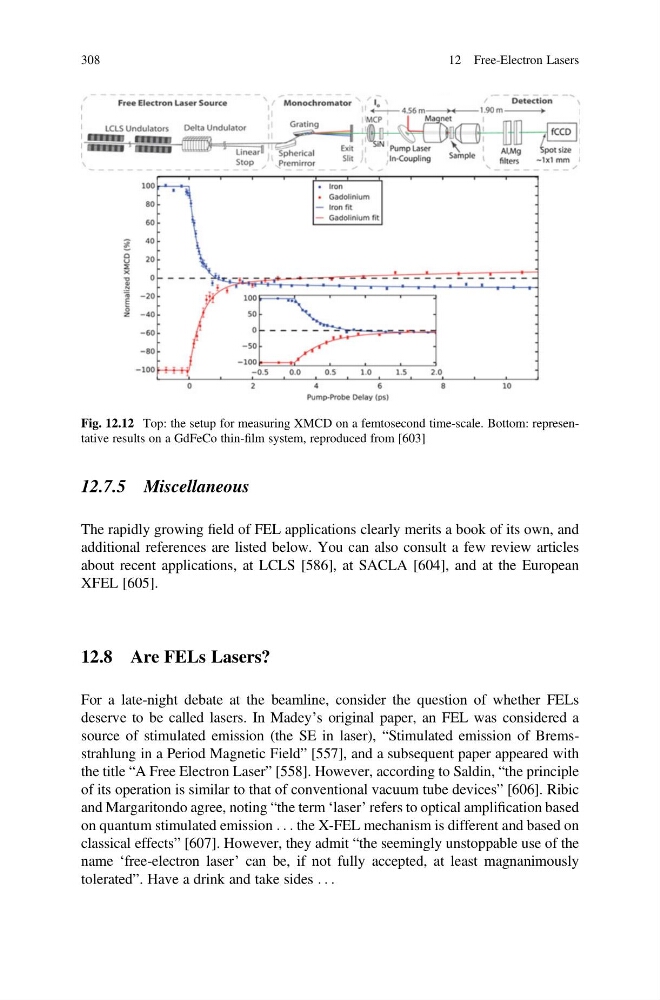
Fig. 12.12 Top: the setup for measuring XMCD on a femtosecond time-scale. Bottom: representative results on a GdFeCo thin-film system, reproduced from [603]
308
12 Free-Electron Lasers
The rapidly growing field of FEL applications clearly merits a book of its own, and
additional references are listed below. You can also consult a few review articles
about recent applications, at LCLS [586], at SACLA [604], and at the European
XFEL [605].
12.8 Are FELs Lasers?
For a late-night debate at the beamline, consider the question of whether FELs
deserve to be called lasers. In Madey’s original paper, an FEL was considered a
source of stimulated emission (the SE in laser), “Stimulated emission of Bremsstrahlung in a Period Magnetic Field” [557], and a subsequent paper appeared with
the title “A Free Electron Laser” [558]. However, according to Saldin, “the principle
of its operation is similar to that of conventional vacuum tube devices” [606]. Ribic
and Margaritondo agree, noting “the term ‘laser’ refers to optical amplification based
on quantum stimulated emission . . . the X-FEL mechanism is different and based on
classical effects” [607]. However, they admit “the seemingly unstoppable use of the
name ‘free-electron laser’ can be, if not fully accepted, at least magnanimously
tolerated”. Have a drink and take sides . . .
Fig. 12.12 Top: the setup for measuring XMCD on a femtosecond time-scale. Bottom: representative results on a GdFeCo thin-film system, reproduced from [603]
308
12 Free-Electron Lasers