

12.7.3 Stimulated Emission: X-ray Lasers
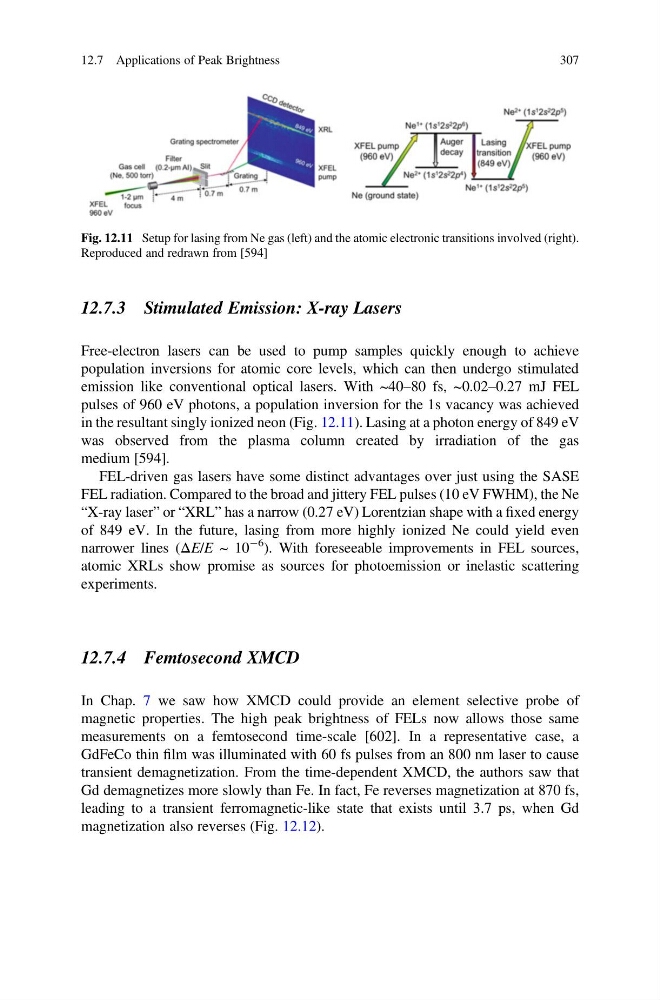
Free-electron lasers can be used to pump samples quickly enough to achieve
population inversions for atomic core levels, which can then undergo stimulated
emission like conventional optical lasers. With ~40–80 fs, ~0.02–0.27 mJ FEL
pulses of 960 eV photons, a population inversion for the 1s vacancy was achieved
in the resultant singly ionized neon (Fig. 12.11). Lasing at a photon energy of 849 eV
was observed from the plasma column created by irradiation of the gas
medium [594].
FEL-driven gas lasers have some distinct advantages over just using the SASE
FEL radiation. Compared to the broad and jittery FEL pulses (10 eV FWHM), the Ne
“X-ray laser” or “XRL” has a narrow (0.27 eV) Lorentzian shape with a fixed energy
of 849 eV. In the future, lasing from more highly ionized Ne could yield even
narrower lines (ΔE/E ~ 10
À6 ). With foreseeable improvements in FEL sources,
atomic XRLs show promise as sources for photoemission or inelastic scattering
experiments.
12.7.4 Femtosecond XMCD
In Chap. 7 we saw how XMCD could provide an element selective probe of
magnetic properties. The high peak brightness of FELs now allows those same
measurements on a femtosecond time-scale [602]. In a representative case, a
GdFeCo thin film was illuminated with 60 fs pulses from an 800 nm laser to cause
transient demagnetization. From the time-dependent XMCD, the authors saw that
Gd demagnetizes more slowly than Fe. In fact, Fe reverses magnetization at 870 fs,
leading to a transient ferromagnetic-like state that exists until 3.7 ps, when Gd
magnetization also reverses (Fig. 12.12).
Fig. 12.11 Setup for lasing from Ne gas (left) and the atomic electronic transitions involved (right).
Reproduced and redrawn from [594]
12.7 Applications of Peak Brightness
307
Free-electron lasers can be used to pump samples quickly enough to achieve
population inversions for atomic core levels, which can then undergo stimulated
emission like conventional optical lasers. With ~40–80 fs, ~0.02–0.27 mJ FEL
pulses of 960 eV photons, a population inversion for the 1s vacancy was achieved
in the resultant singly ionized neon (Fig. 12.11). Lasing at a photon energy of 849 eV
was observed from the plasma column created by irradiation of the gas
medium [594].
FEL-driven gas lasers have some distinct advantages over just using the SASE
FEL radiation. Compared to the broad and jittery FEL pulses (10 eV FWHM), the Ne
“X-ray laser” or “XRL” has a narrow (0.27 eV) Lorentzian shape with a fixed energy
of 849 eV. In the future, lasing from more highly ionized Ne could yield even
narrower lines (ΔE/E ~ 10
À6 ). With foreseeable improvements in FEL sources,
atomic XRLs show promise as sources for photoemission or inelastic scattering
experiments.
12.7.4 Femtosecond XMCD
In Chap. 7 we saw how XMCD could provide an element selective probe of
magnetic properties. The high peak brightness of FELs now allows those same
measurements on a femtosecond time-scale [602]. In a representative case, a
GdFeCo thin film was illuminated with 60 fs pulses from an 800 nm laser to cause
transient demagnetization. From the time-dependent XMCD, the authors saw that
Gd demagnetizes more slowly than Fe. In fact, Fe reverses magnetization at 870 fs,
leading to a transient ferromagnetic-like state that exists until 3.7 ps, when Gd
magnetization also reverses (Fig. 12.12).
Fig. 12.11 Setup for lasing from Ne gas (left) and the atomic electronic transitions involved (right).
Reproduced and redrawn from [594]
12.7 Applications of Peak Brightness
307