

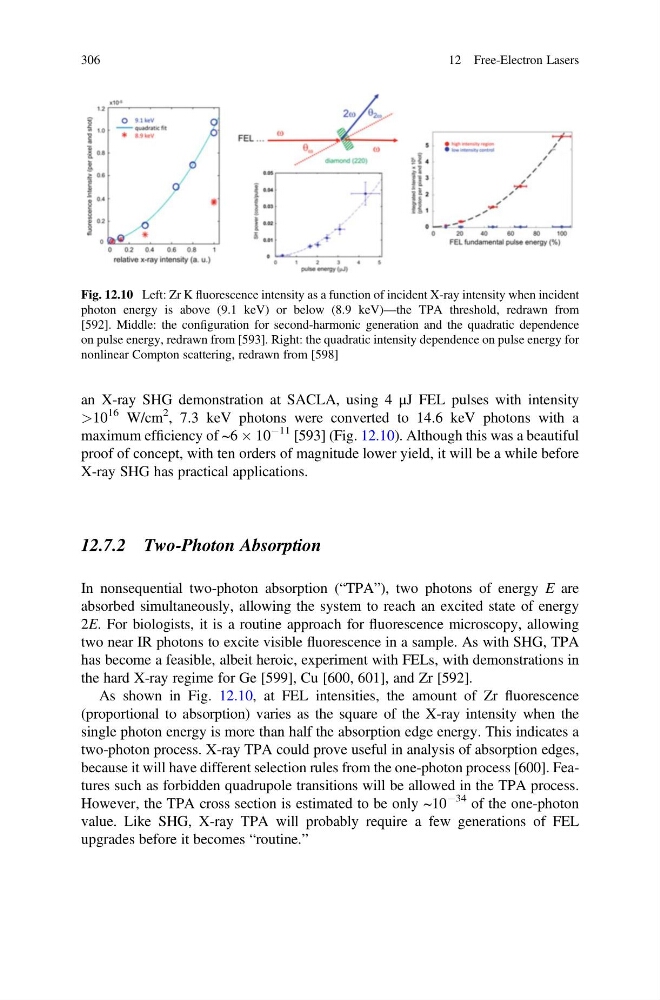
an X-ray SHG demonstration at SACLA, using 4 μJ FEL pulses with intensity
>10
16 W/cm
2 , 7.3 keV photons were converted to 14.6 keV photons with a
maximum efficiency of ~6 Â 10
À11 [593] (Fig. 12.10). Although this was a beautiful
proof of concept, with ten orders of magnitude lower yield, it will be a while before
X-ray SHG has practical applications.
12.7.2 Two-Photon Absorption
In nonsequential two-photon absorption (“TPA”), two photons of energy E are
absorbed simultaneously, allowing the system to reach an excited state of energy
2E. For biologists, it is a routine approach for fluorescence microscopy, allowing
two near IR photons to excite visible fluorescence in a sample. As with SHG, TPA
has become a feasible, albeit heroic, experiment with FELs, with demonstrations in
the hard X-ray regime for Ge [599], Cu [600, 601], and Zr [592].
As shown in Fig. 12.10, at FEL intensities, the amount of Zr fluorescence
(proportional to absorption) varies as the square of the X-ray intensity when the
single photon energy is more than half the absorption edge energy. This indicates a
two-photon process. X-ray TPA could prove useful in analysis of absorption edges,
because it will have different selection rules from the one-photon process [600]. Features such as forbidden quadrupole transitions will be allowed in the TPA process.
However, the TPA cross section is estimated to be only ~10
À34 of the one-photon
value. Like SHG, X-ray TPA will probably require a few generations of FEL
upgrades before it becomes “routine.”
Fig. 12.10 Left: Zr K fluorescence intensity as a function of incident X-ray intensity when incident
photon energy is above (9.1 keV) or below (8.9 keV)—the TPA threshold, redrawn from
[592]. Middle: the configuration for second-harmonic generation and the quadratic dependence
on pulse energy, redrawn from [593]. Right: the quadratic intensity dependence on pulse energy for
nonlinear Compton scattering, redrawn from [598]
306
12 Free-Electron Lasers
>10
16 W/cm
2 , 7.3 keV photons were converted to 14.6 keV photons with a
maximum efficiency of ~6 Â 10
À11 [593] (Fig. 12.10). Although this was a beautiful
proof of concept, with ten orders of magnitude lower yield, it will be a while before
X-ray SHG has practical applications.
12.7.2 Two-Photon Absorption
In nonsequential two-photon absorption (“TPA”), two photons of energy E are
absorbed simultaneously, allowing the system to reach an excited state of energy
2E. For biologists, it is a routine approach for fluorescence microscopy, allowing
two near IR photons to excite visible fluorescence in a sample. As with SHG, TPA
has become a feasible, albeit heroic, experiment with FELs, with demonstrations in
the hard X-ray regime for Ge [599], Cu [600, 601], and Zr [592].
As shown in Fig. 12.10, at FEL intensities, the amount of Zr fluorescence
(proportional to absorption) varies as the square of the X-ray intensity when the
single photon energy is more than half the absorption edge energy. This indicates a
two-photon process. X-ray TPA could prove useful in analysis of absorption edges,
because it will have different selection rules from the one-photon process [600]. Features such as forbidden quadrupole transitions will be allowed in the TPA process.
However, the TPA cross section is estimated to be only ~10
À34 of the one-photon
value. Like SHG, X-ray TPA will probably require a few generations of FEL
upgrades before it becomes “routine.”
Fig. 12.10 Left: Zr K fluorescence intensity as a function of incident X-ray intensity when incident
photon energy is above (9.1 keV) or below (8.9 keV)—the TPA threshold, redrawn from
[592]. Middle: the configuration for second-harmonic generation and the quadratic dependence
on pulse energy, redrawn from [593]. Right: the quadratic intensity dependence on pulse energy for
nonlinear Compton scattering, redrawn from [598]
306
12 Free-Electron Lasers