

12.7 Applications of Peak Brightness
The diffraction-before-destruction applications of FELs are well-documented elsewhere [590]. There, the idea is to gather diffraction or imaging data before the
sample is destroyed by the FEL pulse. Since our emphasis is on synchrotron
spectroscopy, here we highlight a few of the methods that are simply not possible
without the high instantaneous brightness of X-ray FELs. One clear example is
nonlinear X-ray optics.
Nonlinear optical processes are those that depend on higher powers of the electric
field—to be technical, the dielectric polarization P is no longer just a linear function
of the electric field, but needs to be expressed in terms of higher-order polarizabilities. Research in this area has flourished since the advent of lasers made extremely
strong electric fields routine, and much of the theory was already developed by 1965
[591]. These experiments are much harder for X-rays, since multi-photon interactions with n photons scale with the frequency ω as ω
À2n+1 [592]. Nonlinear interactions in the X-ray region are therefore many many orders of magnitude weaker
than their optical counterparts. Nevertheless, FELs now have the intensity required
to observe nonlinear processes in the X-ray regime, including second-harmonic
generation [593], two-photon absorption [592], stimulated X-ray emission [594],
stimulated X-ray Raman [595, 596], sum-frequency generation [597], and nonlinear
Compton scattering [598].
12.7.1 Second-Harmonic Generation
In a fundamental nonlinear process known as “second-harmonic generation”
(“SHG”), two photons at one energy are converted into one photon at twice the
energy. This is routine stuff with optical lasers; it is done in labs that convert
1064 nm Nd:YAG light into 532 nm radiation with greater than 50% efficiency. In
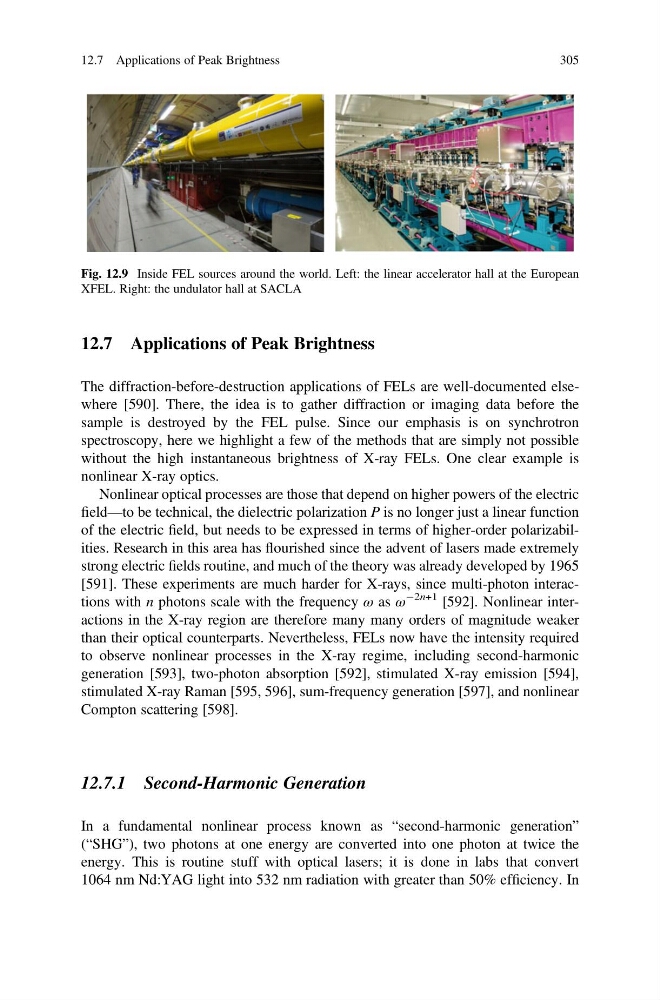
Fig. 12.9 Inside FEL sources around the world. Left: the linear accelerator hall at the European
XFEL. Right: the undulator hall at SACLA
12.7 Applications of Peak Brightness
305
The diffraction-before-destruction applications of FELs are well-documented elsewhere [590]. There, the idea is to gather diffraction or imaging data before the
sample is destroyed by the FEL pulse. Since our emphasis is on synchrotron
spectroscopy, here we highlight a few of the methods that are simply not possible
without the high instantaneous brightness of X-ray FELs. One clear example is
nonlinear X-ray optics.
Nonlinear optical processes are those that depend on higher powers of the electric
field—to be technical, the dielectric polarization P is no longer just a linear function
of the electric field, but needs to be expressed in terms of higher-order polarizabilities. Research in this area has flourished since the advent of lasers made extremely
strong electric fields routine, and much of the theory was already developed by 1965
[591]. These experiments are much harder for X-rays, since multi-photon interactions with n photons scale with the frequency ω as ω
À2n+1 [592]. Nonlinear interactions in the X-ray region are therefore many many orders of magnitude weaker
than their optical counterparts. Nevertheless, FELs now have the intensity required
to observe nonlinear processes in the X-ray regime, including second-harmonic
generation [593], two-photon absorption [592], stimulated X-ray emission [594],
stimulated X-ray Raman [595, 596], sum-frequency generation [597], and nonlinear
Compton scattering [598].
12.7.1 Second-Harmonic Generation
In a fundamental nonlinear process known as “second-harmonic generation”
(“SHG”), two photons at one energy are converted into one photon at twice the
energy. This is routine stuff with optical lasers; it is done in labs that convert
1064 nm Nd:YAG light into 532 nm radiation with greater than 50% efficiency. In
Fig. 12.9 Inside FEL sources around the world. Left: the linear accelerator hall at the European
XFEL. Right: the undulator hall at SACLA
12.7 Applications of Peak Brightness
305