

Colella and Luccio first proposed to use crystals as reflectors for an XFELO in
1983, at the same workshop where SASE was proposed for X-ray FELs [587]. Following decades of progress in electron beam optics, the XFELO concept was revived
by Kim and coworkers around 2007 [588]. The basic idea is to use a set of diamond
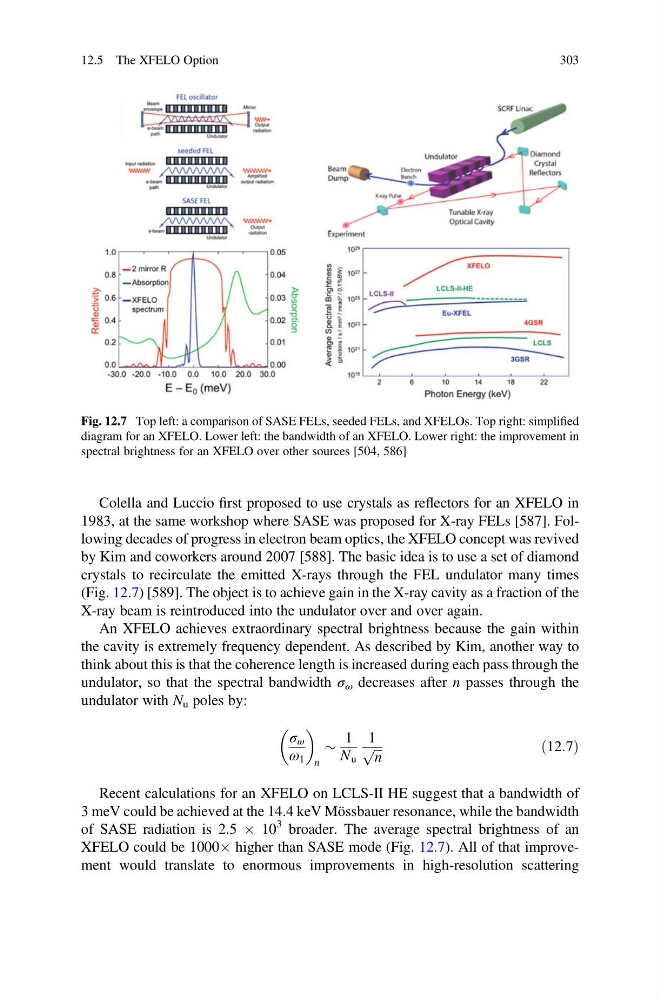
crystals to recirculate the emitted X-rays through the FEL undulator many times
(Fig. 12.7) [589]. The object is to achieve gain in the X-ray cavity as a fraction of the
X-ray beam is reintroduced into the undulator over and over again.
An XFELO achieves extraordinary spectral brightness because the gain within
the cavity is extremely frequency dependent. As described by Kim, another way to
think about this is that the coherence length is increased during each pass through the
undulator, so that the spectral bandwidth σ ω decreases after n passes through the
undulator with N u poles by:
σ ω
ω 1
n
$
1
N u
1
ffiffi ffi
n
p
ð12:7Þ
Recent calculations for an XFELO on LCLS-II HE suggest that a bandwidth of
3 meV could be achieved at the 14.4 keV Mössbauer resonance, while the bandwidth
of SASE radiation is 2.5 Â 10
3 broader. The average spectral brightness of an
XFELO could be 1000Â higher than SASE mode (Fig. 12.7). All of that improvement would translate to enormous improvements in high-resolution scattering
Fig. 12.7 Top left: a comparison of SASE FELs, seeded FELs, and XFELOs. Top right: simplified
diagram for an XFELO. Lower left: the bandwidth of an XFELO. Lower right: the improvement in
spectral brightness for an XFELO over other sources [504, 586]
12.5 The XFELO Option
303
1983, at the same workshop where SASE was proposed for X-ray FELs [587]. Following decades of progress in electron beam optics, the XFELO concept was revived
by Kim and coworkers around 2007 [588]. The basic idea is to use a set of diamond
crystals to recirculate the emitted X-rays through the FEL undulator many times
(Fig. 12.7) [589]. The object is to achieve gain in the X-ray cavity as a fraction of the
X-ray beam is reintroduced into the undulator over and over again.
An XFELO achieves extraordinary spectral brightness because the gain within
the cavity is extremely frequency dependent. As described by Kim, another way to
think about this is that the coherence length is increased during each pass through the
undulator, so that the spectral bandwidth σ ω decreases after n passes through the
undulator with N u poles by:
σ ω
ω 1
n
$
1
N u
1
ffiffi ffi
n
p
ð12:7Þ
Recent calculations for an XFELO on LCLS-II HE suggest that a bandwidth of
3 meV could be achieved at the 14.4 keV Mössbauer resonance, while the bandwidth
of SASE radiation is 2.5 Â 10
3 broader. The average spectral brightness of an
XFELO could be 1000Â higher than SASE mode (Fig. 12.7). All of that improvement would translate to enormous improvements in high-resolution scattering
Fig. 12.7 Top left: a comparison of SASE FELs, seeded FELs, and XFELOs. Top right: simplified
diagram for an XFELO. Lower left: the bandwidth of an XFELO. Lower right: the improvement in
spectral brightness for an XFELO over other sources [504, 586]
12.5 The XFELO Option
303