

select a single wavelength, and then recombine it with the delayed electron beam to
stimulate the FEL gain process. This approach is called “self-seeding.” In the soft
X-ray regime, the monochromators are based on gratings, while seeding at higher
energies employs diamond crystals to select the desired wavelength (Fig. 12.5).
Note the presence of a “chicane” in the self-seeding FELs. This is a set of magnets
that will divert the electron beam around the monochromator and also delay it in
time. The presence of a monochromator delays the radiation by ~5–10 ps in the soft
X-ray range or ~10 fs in the hard X-ray region. The chicane delay matches the timing
of the electron and photon beams so that they overlap following the seeding
monochromator. Dispersion in the chicane also resets the electron beam to its initial
shot noise distribution and washes out any of the original microbunching from the
SASE process. The monochromatic X-rays and the electron beam then interact in a
second undulator, restarting the FEL interaction at a controlled wavelength. The
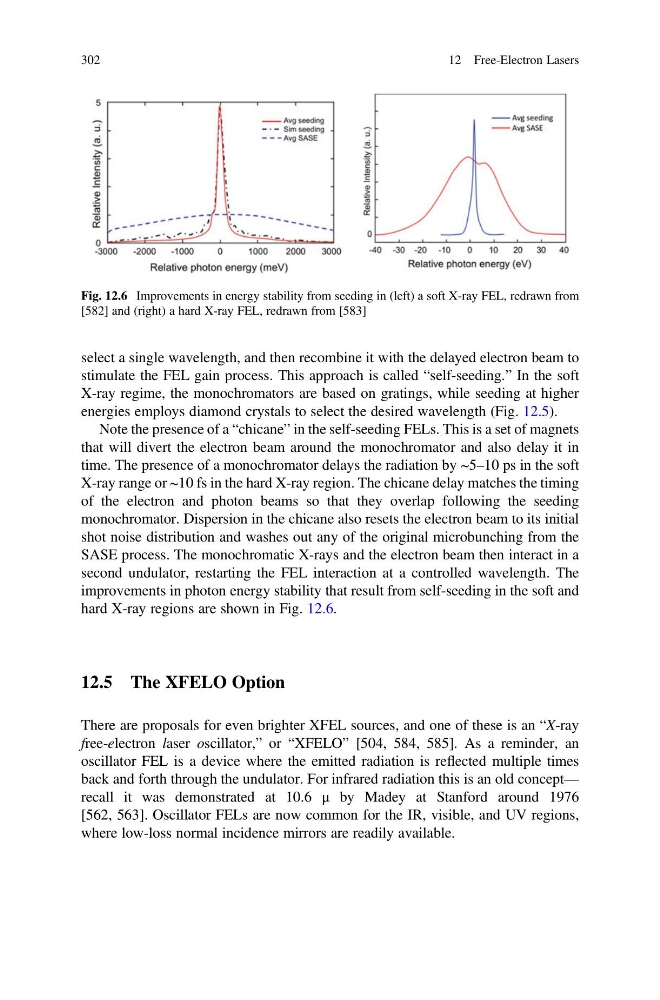
improvements in photon energy stability that result from self-seeding in the soft and
hard X-ray regions are shown in Fig. 12.6.
12.5 The XFELO Option
There are proposals for even brighter XFEL sources, and one of these is an “X-ray
free-electron laser oscillator,” or “XFELO” [504, 584, 585]. As a reminder, an
oscillator FEL is a device where the emitted radiation is reflected multiple times
back and forth through the undulator. For infrared radiation this is an old concept—
recall it was demonstrated at 10.6 μ by Madey at Stanford around 1976
[562, 563]. Oscillator FELs are now common for the IR, visible, and UV regions,
where low-loss normal incidence mirrors are readily available.
Fig. 12.6 Improvements in energy stability from seeding in (left) a soft X-ray FEL, redrawn from
[582] and (right) a hard X-ray FEL, redrawn from [583]
302
12 Free-Electron Lasers
stimulate the FEL gain process. This approach is called “self-seeding.” In the soft
X-ray regime, the monochromators are based on gratings, while seeding at higher
energies employs diamond crystals to select the desired wavelength (Fig. 12.5).
Note the presence of a “chicane” in the self-seeding FELs. This is a set of magnets
that will divert the electron beam around the monochromator and also delay it in
time. The presence of a monochromator delays the radiation by ~5–10 ps in the soft
X-ray range or ~10 fs in the hard X-ray region. The chicane delay matches the timing
of the electron and photon beams so that they overlap following the seeding
monochromator. Dispersion in the chicane also resets the electron beam to its initial
shot noise distribution and washes out any of the original microbunching from the
SASE process. The monochromatic X-rays and the electron beam then interact in a
second undulator, restarting the FEL interaction at a controlled wavelength. The
improvements in photon energy stability that result from self-seeding in the soft and
hard X-ray regions are shown in Fig. 12.6.
12.5 The XFELO Option
There are proposals for even brighter XFEL sources, and one of these is an “X-ray
free-electron laser oscillator,” or “XFELO” [504, 584, 585]. As a reminder, an
oscillator FEL is a device where the emitted radiation is reflected multiple times
back and forth through the undulator. For infrared radiation this is an old concept—
recall it was demonstrated at 10.6 μ by Madey at Stanford around 1976
[562, 563]. Oscillator FELs are now common for the IR, visible, and UV regions,
where low-loss normal incidence mirrors are readily available.
Fig. 12.6 Improvements in energy stability from seeding in (left) a soft X-ray FEL, redrawn from
[582] and (right) a hard X-ray FEL, redrawn from [583]
302
12 Free-Electron Lasers