

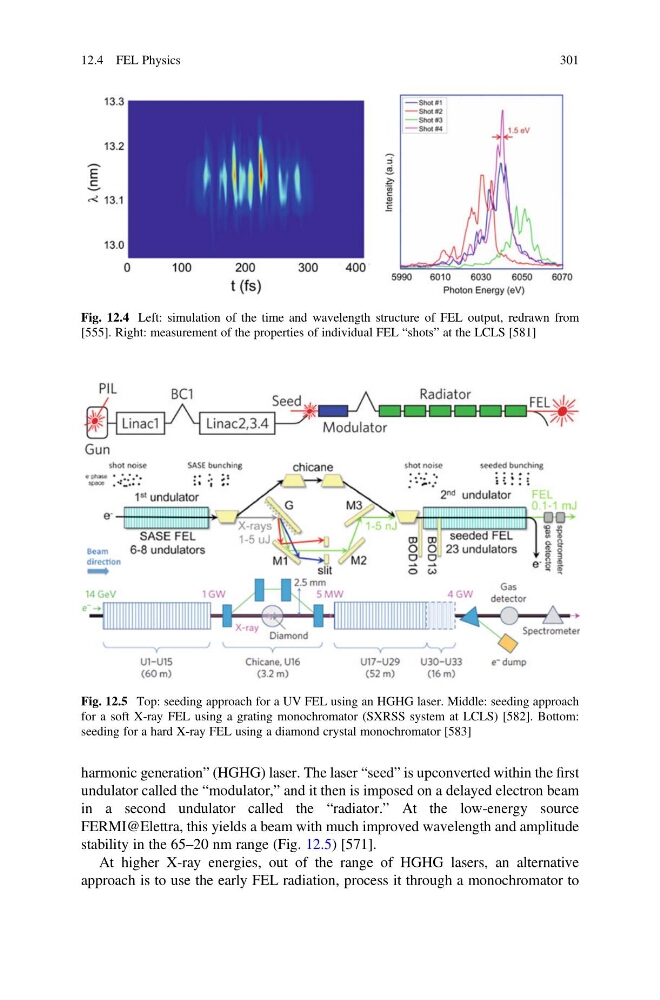
harmonic generation” (HGHG) laser. The laser “seed” is upconverted within the first
undulator called the “modulator,” and it then is imposed on a delayed electron beam
in a second undulator called the “radiator.” At the low-energy source
FERMI@Elettra, this yields a beam with much improved wavelength and amplitude
stability in the 65–20 nm range (Fig. 12.5) [571].
At higher X-ray energies, out of the range of HGHG lasers, an alternative
approach is to use the early FEL radiation, process it through a monochromator to
Fig. 12.4 Left: simulation of the time and wavelength structure of FEL output, redrawn from
[555]. Right: measurement of the properties of individual FEL “shots” at the LCLS [581]
Fig. 12.5 Top: seeding approach for a UV FEL using an HGHG laser. Middle: seeding approach
for a soft X-ray FEL using a grating monochromator (SXRSS system at LCLS) [582]. Bottom:
seeding for a hard X-ray FEL using a diamond crystal monochromator [583]
12.4 FEL Physics
301
undulator called the “modulator,” and it then is imposed on a delayed electron beam
in a second undulator called the “radiator.” At the low-energy source
FERMI@Elettra, this yields a beam with much improved wavelength and amplitude
stability in the 65–20 nm range (Fig. 12.5) [571].
At higher X-ray energies, out of the range of HGHG lasers, an alternative
approach is to use the early FEL radiation, process it through a monochromator to
Fig. 12.4 Left: simulation of the time and wavelength structure of FEL output, redrawn from
[555]. Right: measurement of the properties of individual FEL “shots” at the LCLS [581]
Fig. 12.5 Top: seeding approach for a UV FEL using an HGHG laser. Middle: seeding approach
for a soft X-ray FEL using a grating monochromator (SXRSS system at LCLS) [582]. Bottom:
seeding for a hard X-ray FEL using a diamond crystal monochromator [583]
12.4 FEL Physics
301