

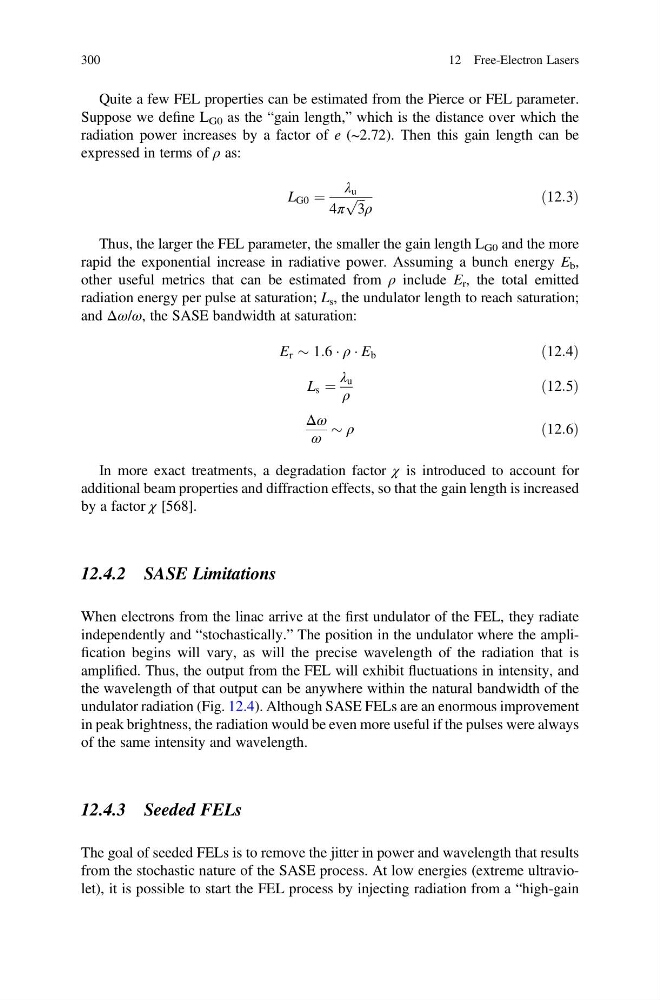
Quite a few FEL properties can be estimated from the Pierce or FEL parameter.
Suppose we define L G0 as the “gain length,” which is the distance over which the
radiation power increases by a factor of e (~2.72). Then this gain length can be
expressed in terms of ρ as:
L G0 ¼
λ u
4π
ffiffi ffi
3
p ρ
ð12:3Þ
Thus, the larger the FEL parameter, the smaller the gain length L G0 and the more
rapid the exponential increase in radiative power. Assuming a bunch energy E b ,
other useful metrics that can be estimated from ρ include E r , the total emitted
radiation energy per pulse at saturation; L s , the undulator length to reach saturation;
and Δω/ω, the SASE bandwidth at saturation:
E r $ 1:6 Á ρ Á E b
ð12:4Þ
L s ¼
λ u
ρ
ð12:5Þ
Δω
ω
$ ρ
ð12:6Þ
In more exact treatments, a degradation factor χ is introduced to account for
additional beam properties and diffraction effects, so that the gain length is increased
by a factor χ [568].
12.4.2 SASE Limitations
When electrons from the linac arrive at the first undulator of the FEL, they radiate
independently and “stochastically.” The position in the undulator where the amplification begins will vary, as will the precise wavelength of the radiation that is
amplified. Thus, the output from the FEL will exhibit fluctuations in intensity, and
the wavelength of that output can be anywhere within the natural bandwidth of the
undulator radiation (Fig. 12.4). Although SASE FELs are an enormous improvement
in peak brightness, the radiation would be even more useful if the pulses were always
of the same intensity and wavelength.
12.4.3 Seeded FELs
The goal of seeded FELs is to remove the jitter in power and wavelength that results
from the stochastic nature of the SASE process. At low energies (extreme ultraviolet), it is possible to start the FEL process by injecting radiation from a “high-gain
300
12 Free-Electron Lasers
Suppose we define L G0 as the “gain length,” which is the distance over which the
radiation power increases by a factor of e (~2.72). Then this gain length can be
expressed in terms of ρ as:
L G0 ¼
λ u
4π
ffiffi ffi
3
p ρ
ð12:3Þ
Thus, the larger the FEL parameter, the smaller the gain length L G0 and the more
rapid the exponential increase in radiative power. Assuming a bunch energy E b ,
other useful metrics that can be estimated from ρ include E r , the total emitted
radiation energy per pulse at saturation; L s , the undulator length to reach saturation;
and Δω/ω, the SASE bandwidth at saturation:
E r $ 1:6 Á ρ Á E b
ð12:4Þ
L s ¼
λ u
ρ
ð12:5Þ
Δω
ω
$ ρ
ð12:6Þ
In more exact treatments, a degradation factor χ is introduced to account for
additional beam properties and diffraction effects, so that the gain length is increased
by a factor χ [568].
12.4.2 SASE Limitations
When electrons from the linac arrive at the first undulator of the FEL, they radiate
independently and “stochastically.” The position in the undulator where the amplification begins will vary, as will the precise wavelength of the radiation that is
amplified. Thus, the output from the FEL will exhibit fluctuations in intensity, and
the wavelength of that output can be anywhere within the natural bandwidth of the
undulator radiation (Fig. 12.4). Although SASE FELs are an enormous improvement
in peak brightness, the radiation would be even more useful if the pulses were always
of the same intensity and wavelength.
12.4.3 Seeded FELs
The goal of seeded FELs is to remove the jitter in power and wavelength that results
from the stochastic nature of the SASE process. At low energies (extreme ultraviolet), it is possible to start the FEL process by injecting radiation from a “high-gain
300
12 Free-Electron Lasers