

growth) regime, there are no complete analytic solutions, and it is necessary to
employ numerical simulation codes. Still, there is one useful parameter that distills
the essential physics of 1D FEL theory: the “Pierce parameter” or “FEL parameter”
ρ.
The parameter ρ is a fundamental indicator of FEL performance—it represents
the efficiency of the conversion of electron beam power to radiation power, and it has
been called “the jack of all trades of 1D FEL theory” [580]. It is calculated from a
collection of fundamental constants and system parameters:
ρ ¼
I e
γ 3 I A
λ
2
u
2πσ x σ y
K Â JJ
½
ð
Þ
2
32π
! 1=3
ð12:2Þ
where I e is the peak electron current, I A ¼ ec/r e % 17 kA (the “Alfvén current”), γ is
the ratio of the electron energy to its rest mass energy, σ x and σ y are the rms
transverse sizes of the electron beam, λ u is the undulator period, and K is the
undulator parameter. JJ is a combination of Bessel function defined as
JJ ¼ [J 0 (ξ) À J 1 (ξ)], where ξ ¼ K
2 /(4 + 2K
2 ).
Although ρ may be complicated to derive, it is easy to see how it depends on
system parameters. Clearly, a larger ρ will result from (a) a smaller transverse beam
size σ, (b) a longer undulator period λ u , and (c) a lower beam energy ~ γ. On the other
hand, ρ modestly improves with beam current I e . Typical values for ρ are on the
order of 10
À3 .
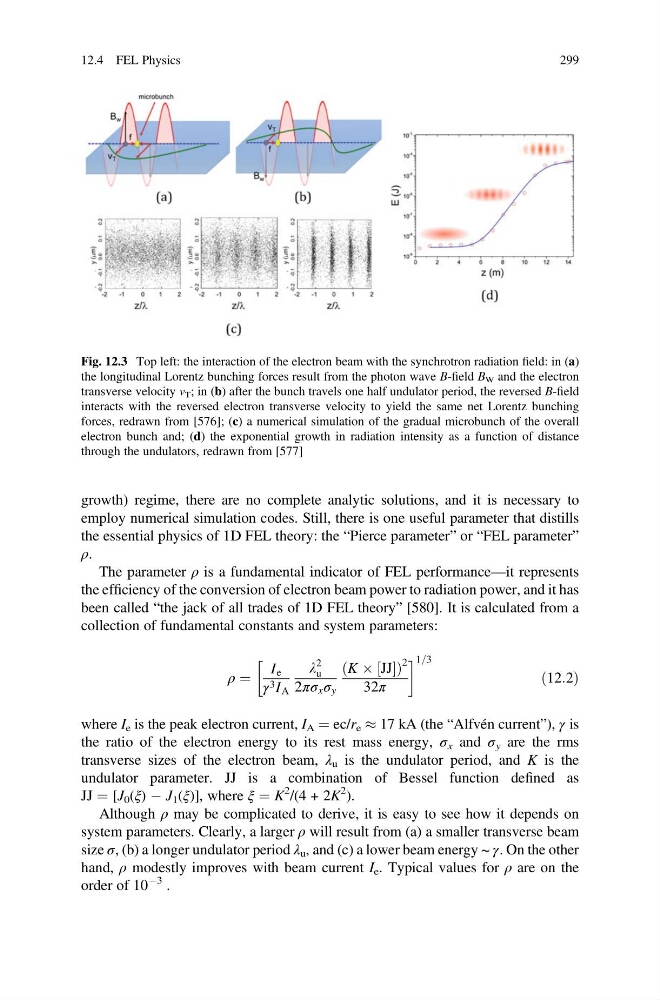
Fig. 12.3 Top left: the interaction of the electron beam with the synchrotron radiation field: in (a)
the longitudinal Lorentz bunching forces result from the photon wave B-field B W and the electron
transverse velocity v T ; in (b) after the bunch travels one half undulator period, the reversed B-field
interacts with the reversed electron transverse velocity to yield the same net Lorentz bunching
forces, redrawn from [576]; (c) a numerical simulation of the gradual microbunch of the overall
electron bunch and; (d) the exponential growth in radiation intensity as a function of distance
through the undulators, redrawn from [577]
12.4 FEL Physics
299
employ numerical simulation codes. Still, there is one useful parameter that distills
the essential physics of 1D FEL theory: the “Pierce parameter” or “FEL parameter”
ρ.
The parameter ρ is a fundamental indicator of FEL performance—it represents
the efficiency of the conversion of electron beam power to radiation power, and it has
been called “the jack of all trades of 1D FEL theory” [580]. It is calculated from a
collection of fundamental constants and system parameters:
ρ ¼
I e
γ 3 I A
λ
2
u
2πσ x σ y
K Â JJ
½
ð
Þ
2
32π
! 1=3
ð12:2Þ
where I e is the peak electron current, I A ¼ ec/r e % 17 kA (the “Alfvén current”), γ is
the ratio of the electron energy to its rest mass energy, σ x and σ y are the rms
transverse sizes of the electron beam, λ u is the undulator period, and K is the
undulator parameter. JJ is a combination of Bessel function defined as
JJ ¼ [J 0 (ξ) À J 1 (ξ)], where ξ ¼ K
2 /(4 + 2K
2 ).
Although ρ may be complicated to derive, it is easy to see how it depends on
system parameters. Clearly, a larger ρ will result from (a) a smaller transverse beam
size σ, (b) a longer undulator period λ u , and (c) a lower beam energy ~ γ. On the other
hand, ρ modestly improves with beam current I e . Typical values for ρ are on the
order of 10
À3 .
Fig. 12.3 Top left: the interaction of the electron beam with the synchrotron radiation field: in (a)
the longitudinal Lorentz bunching forces result from the photon wave B-field B W and the electron
transverse velocity v T ; in (b) after the bunch travels one half undulator period, the reversed B-field
interacts with the reversed electron transverse velocity to yield the same net Lorentz bunching
forces, redrawn from [576]; (c) a numerical simulation of the gradual microbunch of the overall
electron bunch and; (d) the exponential growth in radiation intensity as a function of distance
through the undulators, redrawn from [577]
12.4 FEL Physics
299