

For the strength of this field-bunch interaction to be strong, the electron bunch
needs to be as short as possible. This is accomplished by starting with a very short
electron bunch and compressing the bunch further (by orders of magnitude) with
electron optics. A typical configuration employs a series of “bunch compressors,” as
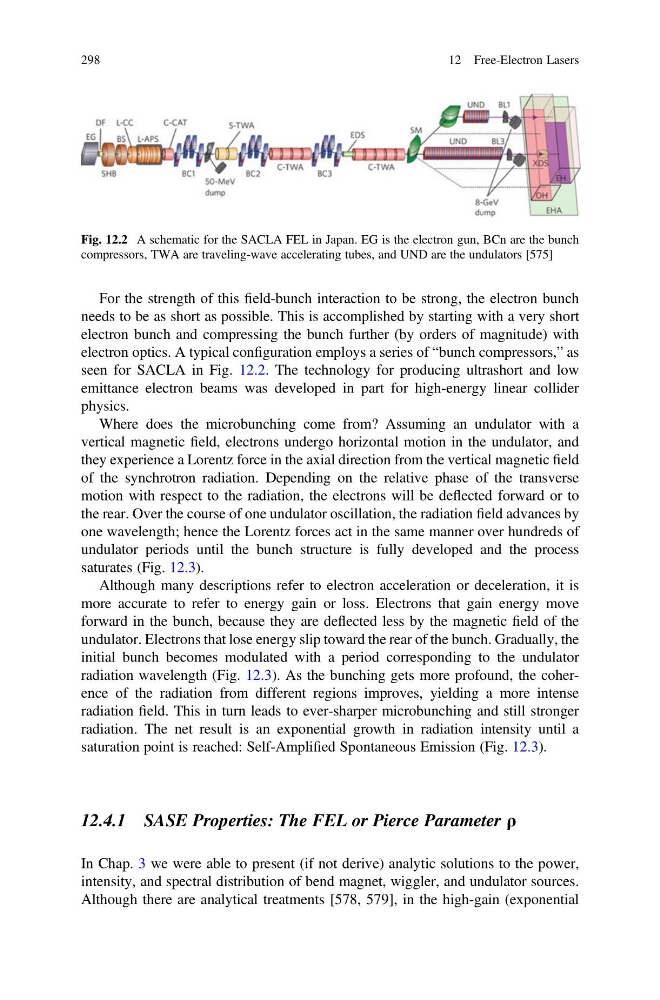
seen for SACLA in Fig. 12.2. The technology for producing ultrashort and low
emittance electron beams was developed in part for high-energy linear collider
physics.
Where does the microbunching come from? Assuming an undulator with a
vertical magnetic field, electrons undergo horizontal motion in the undulator, and
they experience a Lorentz force in the axial direction from the vertical magnetic field
of the synchrotron radiation. Depending on the relative phase of the transverse
motion with respect to the radiation, the electrons will be deflected forward or to
the rear. Over the course of one undulator oscillation, the radiation field advances by
one wavelength; hence the Lorentz forces act in the same manner over hundreds of
undulator periods until the bunch structure is fully developed and the process
saturates (Fig. 12.3).
Although many descriptions refer to electron acceleration or deceleration, it is
more accurate to refer to energy gain or loss. Electrons that gain energy move
forward in the bunch, because they are deflected less by the magnetic field of the
undulator. Electrons that lose energy slip toward the rear of the bunch. Gradually, the
initial bunch becomes modulated with a period corresponding to the undulator
radiation wavelength (Fig. 12.3). As the bunching gets more profound, the coherence of the radiation from different regions improves, yielding a more intense
radiation field. This in turn leads to ever-sharper microbunching and still stronger
radiation. The net result is an exponential growth in radiation intensity until a
saturation point is reached: Self-Amplified Spontaneous Emission (Fig. 12.3).
12.4.1 SASE Properties: The FEL or Pierce Parameter ρ
In Chap. 3 we were able to present (if not derive) analytic solutions to the power,
intensity, and spectral distribution of bend magnet, wiggler, and undulator sources.
Although there are analytical treatments [578, 579], in the high-gain (exponential
Fig. 12.2 A schematic for the SACLA FEL in Japan. EG is the electron gun, BCn are the bunch
compressors, TWA are traveling-wave accelerating tubes, and UND are the undulators [575]
298
12 Free-Electron Lasers
needs to be as short as possible. This is accomplished by starting with a very short
electron bunch and compressing the bunch further (by orders of magnitude) with
electron optics. A typical configuration employs a series of “bunch compressors,” as
seen for SACLA in Fig. 12.2. The technology for producing ultrashort and low
emittance electron beams was developed in part for high-energy linear collider
physics.
Where does the microbunching come from? Assuming an undulator with a
vertical magnetic field, electrons undergo horizontal motion in the undulator, and
they experience a Lorentz force in the axial direction from the vertical magnetic field
of the synchrotron radiation. Depending on the relative phase of the transverse
motion with respect to the radiation, the electrons will be deflected forward or to
the rear. Over the course of one undulator oscillation, the radiation field advances by
one wavelength; hence the Lorentz forces act in the same manner over hundreds of
undulator periods until the bunch structure is fully developed and the process
saturates (Fig. 12.3).
Although many descriptions refer to electron acceleration or deceleration, it is
more accurate to refer to energy gain or loss. Electrons that gain energy move
forward in the bunch, because they are deflected less by the magnetic field of the
undulator. Electrons that lose energy slip toward the rear of the bunch. Gradually, the
initial bunch becomes modulated with a period corresponding to the undulator
radiation wavelength (Fig. 12.3). As the bunching gets more profound, the coherence of the radiation from different regions improves, yielding a more intense
radiation field. This in turn leads to ever-sharper microbunching and still stronger
radiation. The net result is an exponential growth in radiation intensity until a
saturation point is reached: Self-Amplified Spontaneous Emission (Fig. 12.3).
12.4.1 SASE Properties: The FEL or Pierce Parameter ρ
In Chap. 3 we were able to present (if not derive) analytic solutions to the power,
intensity, and spectral distribution of bend magnet, wiggler, and undulator sources.
Although there are analytical treatments [578, 579], in the high-gain (exponential
Fig. 12.2 A schematic for the SACLA FEL in Japan. EG is the electron gun, BCn are the bunch
compressors, TWA are traveling-wave accelerating tubes, and UND are the undulators [575]
298
12 Free-Electron Lasers